Urban sociologist and geopolitical commentator
The Chariot and the Machine: Buddhist Philosophy on Minds That Build Minds
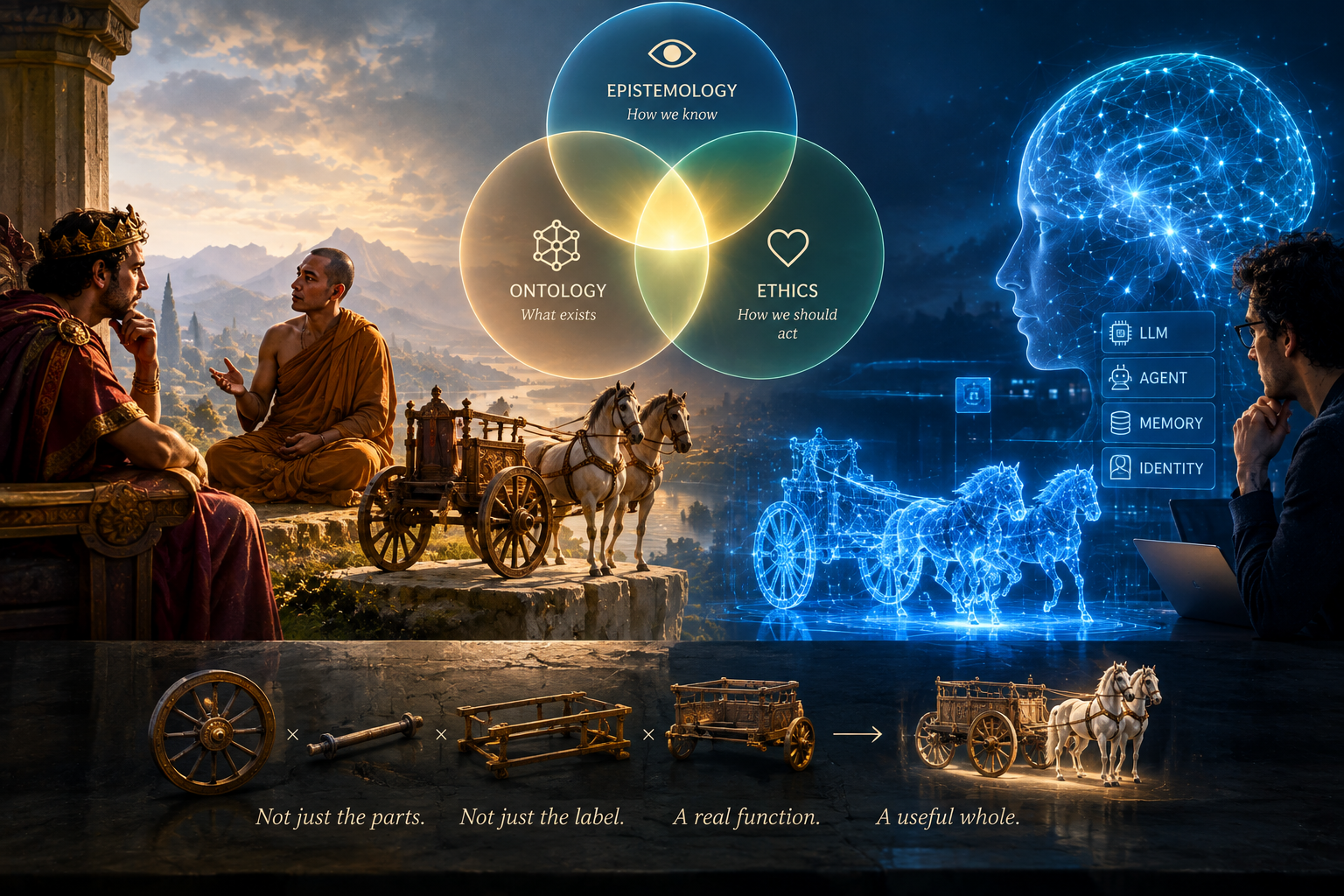
Buddhist Philosophy and the AI Ethics. An AI Illustration.
How most contemporary conversations about AI ethics begin too late, and why guardrails, as advocated by Anthropic CEO Dario Amodei, cannot repair a misunderstanding of mind.
There is a chariot parked at the edge of Western philosophy of mind, and almost nobody notices it anymore. It appears in a dialogue between the Greek king Menander and the monk Nāgasena, sometime around the 2nd century BCE. The king asks Nāgasena his name. Nāgasena replies that “Nāgasena” is merely a designation, that there is no fixed person answering to it. The king, amused, points at the royal chariot and asks: is the chariot the wheels? The axle? The frame? None of these, taken separately, is “the chariot.” Remove them one by one and the chariot vanishes before any single part does. And yet the chariot is not nothing: it carries the king to battle perfectly well. It is real at exactly the level a chariot needs to be real, and asking for more than that is asking the wrong question.
That dialogue is nearly 2,200 years old, and it is, without exaggeration, the sharpest thing available to say to a civilization currently trying to figure out whether a large language model (LLM) has a self, whether an “agent” persists across sessions, or whether a predictive model of your behavior has finally discovered who you really are. We are, as it happens, building an enormous number of chariots right now, and arguing about their wheels.
I want to take that seriously rather than decoratively, not as a cute analogy, but as evidence that a rigorous, technically serious tradition solved a version of our current metaphysical confusion a very long time ago, using tools worth examining on their own terms: an epistemology, an ontology, and an ethics, none of which work without the other two.
What kind of knowing is knowing?
Start with the epistemology, because it’s the least forgiving and the most immediately useful. Indian philosophers in the pramāṇa tradition, Dignāga, later Dharmakīrti, did not ask “what is true?” in the abstract. They asked a colder, more practical question: by what instrument, exactly, do you know this, and what is that instrument reliably good for? Perception is one instrument, valid for what is immediately present. Inference is another, valid for what can be correctly derived, and invalid the moment it’s stretched past its warrant. This is not skepticism. It’s calibration: knowledge treated the way an engineer treats a measuring device, with a stated range of accuracy and an explicit refusal to trust it outside that range.
Madhyamaka philosophy, primarily through Nāgārjuna, pushes this into something genuinely radical: the doctrine of two truths. Conventional truth – tables, chariots, persons, causes, your job, your name – is not a lesser or illusory truth to be corrected by some deeper final one. It is true at its own resolution, the way a weather forecast is true at the resolution of “70% chance of rain,” without needing to be a molecular description of the atmosphere to be worth trusting. Ultimate truth, meanwhile, is not a more zoomed-in fact about the same object. It is closer to the discovery that none of the objects at the conventional level turn out, on inspection, to have any independent, self-sufficient core holding them up.
Here is why this should matter to anyone thinking about artificial intelligence (AI), and it is not a metaphor: this is exactly the epistemic posture a large statistical model essentially has toward the world, whether or not its builders ever describe it this way. A model doesn’t touch causal reality. It constructs a representation, validated against an objective, useful at a specific level of resolution, for specific purposes, and it is neither “true” in some final sense nor a fraud for failing to be. Physicists arrived at almost the identical position independently: Stephen Hawking and Leonard Mlodinow’s “model-dependent realism” says there is no single privileged description of the world, only a stack of models, each valid in its domain, none of them The Answer. Nāgārjuna got there first, with none of the equipment, purely by refusing to let any description get away with claiming finality it hadn’t earned. The two-truths framework isn’t an ancient curiosity sitting next to modern epistemology of science. It’s the same insight, arrived at from opposite directions across two millennia, and it offers something our present moment badly needs: a way to be rigorously confident and provisional at the same time, instead of oscillating between dogmatism (my model is reality) and nihilism (nothing means anything, all models are equally fake).
What kind of thing is a thing?
Which brings us back to the chariot, and to pratītyasamutpāda (dependent origination), the ontological engine underneath the whole tradition. The claim is not “nothing exists.” The claim is that nothing exists independently: every phenomenon is what it is only in relation to the conditions that produce and sustain it, and has no svabhāva, no self-sufficient essence, sitting underneath those relations waiting to be found. Pull the relations apart, as Menander pulls the chariot apart, and there is no residue.
This is a genuinely different ontology from the one most of us, either as the modern Europeans or the colonised subjects encountering Western modernity, inherited without choosing it: the assumption, running from Aristotle through a great deal of common sense, that reality is fundamentally made of discrete objects with intrinsic properties, which then happen to enter into relations. Dependent origination inverts the priority: relation is basic, and “objects” are stable regularities within a field of relations, useful designations rather than metaphysical bedrock.
It is worth pausing on how strange it is that this inverted ontology is now, quietly, the operative one in the most advanced technology humans have built. An embedding, that is, the representational core of every modern language model, encodes what a word or an entity is entirely as a position relative to everything else in a learned space. There is no slot in the architecture for intrinsic essence. Identity is pure relation. Physicists working on relational quantum mechanics (Carlo Rovelli) and structural realists in philosophy of physics (Ladyman and Ross) have made comparable arguments about fundamental reality on entirely separate grounds. None of this proves Nāgārjuna correct as metaphysics: that would be too quick, and it isn’t really the point. The point is that a mind trained to expect essences will be perpetually startled by a world, and increasingly by machines, built on relation instead, and a philosophical tradition exists that spent centuries training minds out of that expectation, on the explicit grounds that clinging to essence where there is only relation is the single most reliable generator of unnecessary confusion, in cognition, in identity, and, this is the pivot to ethics, in how one being treats another.
Why seeing correctly is already half of acting well
Here is the move that Western philosophy usually resists and that Buddhist philosophy insists on (see, Karl-Heinz Brodbeck, page 122): it refuses to put ethics in a separate box from epistemology and ontology, to be connected later by some effortful bridge (the notorious “is-ought” problem that has occupied moral philosophers since Hume). The Eightfold Path does not open with a rule. It opens with right view, a correct grasp of dependent origination and non-self, and only after that arrives at right intention, right speech, right action. The ordering is not decorative. The claim embedded in it is that once you actually see, rather than merely assert, that your own condition is constituted by an inseparable web of relations with other beings, indifference to their suffering stops looking like a moral failure requiring a rule to forbid it, and starts looking like a factual error: a failure to have correctly understood what you are and what you depend on. Compassion, on this account, is not a nice feeling added on top of clear seeing. It is what clear seeing looks like from the inside.
Compare this to how most contemporary conversations about AI ethics actually proceed: build the system, get its predictive capacities working, and then bolt on a value layer (a reward model, a constitution, a set of guardrails) as a correction applied after the fact to an otherwise value-neutral engine. Ethics is “usually treated as an overlay, rather than a structural layer.” The Buddhist ordering suggests this sequencing is backwards, or at least dangerously incomplete. What a system (or a civilization) takes to be ontologically basic, which is, isolated agents with fixed interests who must be negotiated with, versus relationally constituted beings whose conditions are mutually entangled, will quietly determine which ethical conclusions arrive feeling natural and which feel like impositions. An architecture, human or artificial, built on an ontology of separate atoms tends to generate ethics as a negotiated truce between competing self-interests. One built on an ontology of dependent origination tends to generate ethics as the recognition of a condition already shared. That difference is not downstream of the design. On the Buddhist analysis, it is the design.
The chariot, again
None of this licenses the easy conclusion that a sufficiently large language model has, or lacks, a self in any deep sense: that question, on Nāgārjuna’s own terms, may be malformed in the way “is the chariot the wheels?” is malformed. What the tradition offers instead is a discipline for holding all three questions, i.e., how do you know, what is real, what do you owe, as facets of a single inquiry rather than separate departments to staff independently. A civilization that gets the epistemology right but treats ontology as someone else’s problem will build extremely capable systems on top of categories it never examined. One that gets the ontology right but treats ethics as a patch will discover, as we currently seem to be discovering, that the patch arrives too late and fits too loosely. The chariot carried the king to battle just fine without anyone resolving what it ultimately was. The question is whether we can say the same about the machines we’re currently building, or whether, this time, the parts we haven’t examined are the ones that matter most.
Related Topics