The City My Father Lost — Part I
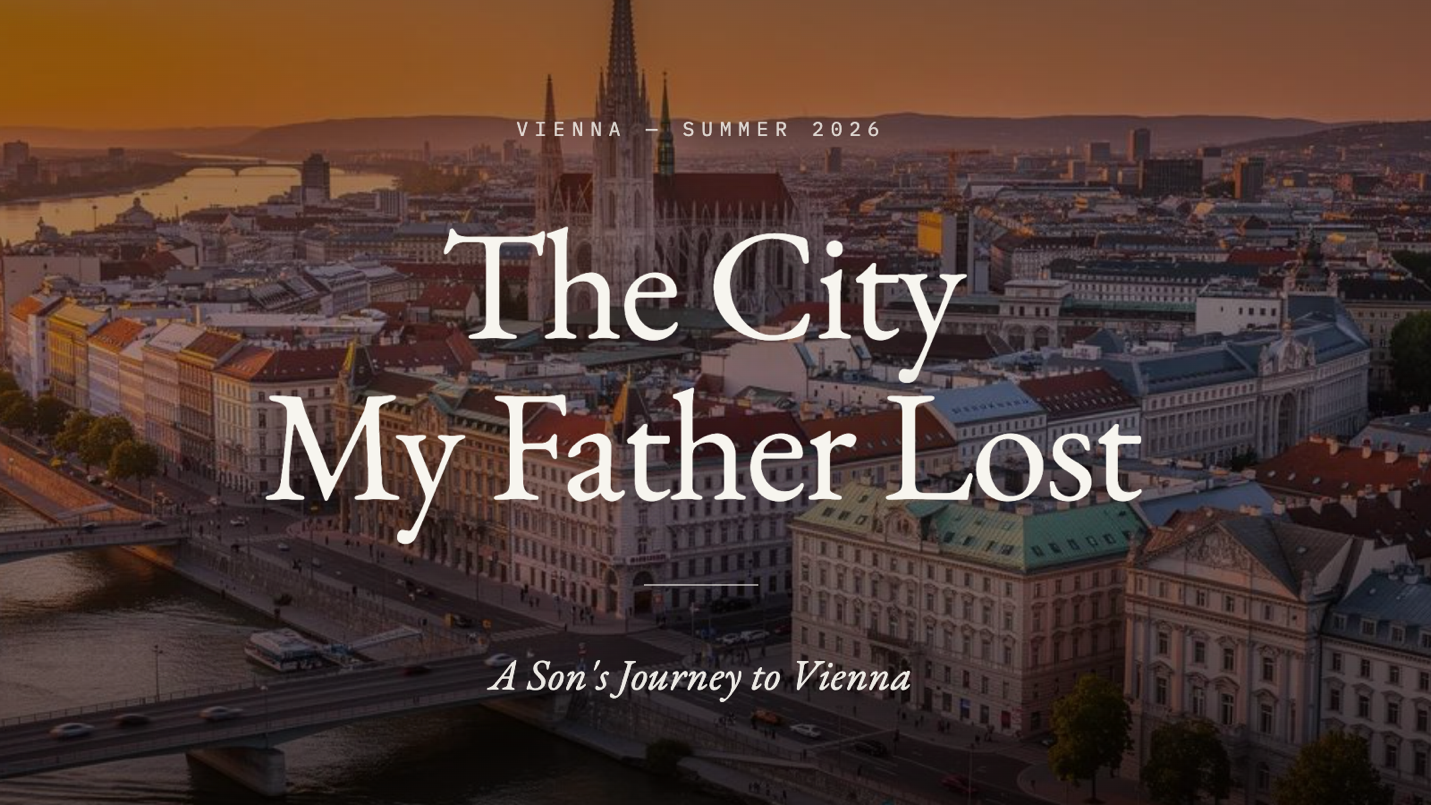
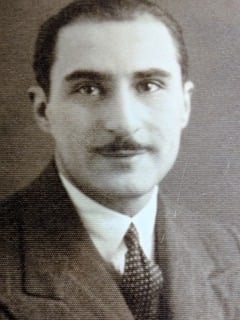
I. The River That Ignores Us
Some journeys are measured in miles. This one was measured in sentences — my father’s, which I had been carrying, unread, for sixty years.
The Austrian Airlines flight came down over the Marchfeld in the late afternoon and I understood, with the embarrassment of a man who has prepared too long for something, that I had no idea what I had come to do.
The other passengers had itineraries. Schönbrunn, the Kunsthistorisches, an evening of Mozart performed by musicians in period wigs for people who would applaud in the wrong places. There is nothing contemptible in this. Vienna sells itself honestly enough, and what it sells is real: the city did produce that music, those paintings, that arrangement of stone and proportion which announces to anyone arriving from the east that they have entered the presence of an idea about civilisation.
My own list was shorter and would have looked, to any of them, deranged. An apartment building. A street sign. A courtyard where a synagogue used to be. A section of a municipal cemetery. A wall in a small park behind the Ringstrasse. Six or seven addresses, most of which do not appear in any guidebook and one of which no longer exists in any sense a surveyor would recognise.
I had come, I told myself on the flight, to see where my father came from. This is the sentence one uses. It has the advantage of being unfalsifiable and the disadvantage of being false.
What I had come to do — I did not know this until the fourth day, standing in a courtyard in the sixth district, and I will come to it — was to find out whether the stories were true. Not factually true. I had the documents; the facts were not in question. I mean something else, something harder to admit: whether the world my father described had ever possessed the density he gave it. Whether Vienna had been the place he made it in the telling, or whether a boy driven out at seventeen had spent the following eighty-five years elaborating a city that never existed at that resolution.
He died three years ago, at a 102. It is a strange arithmetic. He outlived the Reich by 78 years, outlived nearly everyone who could have contradicted him, and in the end was the sole surviving witness to his own childhood. A man in that position is not lying when his descriptions grow more vivid with the decades. He is doing what memory does when it is the only remaining copy.
I came, then, as one comes to a text of uncertain transmission. Not to venerate it. To collate it.
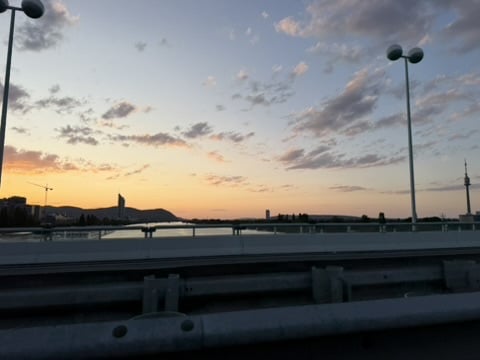
That first evening I walked down to the Danube, which took longer than I expected and required crossing several roads designed by people who did not anticipate pedestrians with this particular purpose. The July light held past nine. The river went brown and then gold and then a colour I will not attempt.
It is not a beautiful river. Everyone who writes about the Danube feels obliged to mention that it is not blue, and then to make something of the discrepancy, and I will resist. What struck me instead was its total indifference. This water had moved past the city while the Habsburgs assembled and dissolved an empire, while my grandfather arrived from Hungary in 1904 with whatever a young man carried, while the trains left the Aspangbahnhof, while the Soviets came and the Soviets went and the glass towers went up on the far bank. The river had registered none of it. It was on its way to the Black Sea and had been for a very long time.
There is a temptation here, and I want to name it and refuse it at the outset, because the whole book will otherwise slide down it. The temptation is to make the river mean something consoling. To say that memory flows beneath history, that the deep currents endure, that what is essential survives. This is the sort of thing one writes at a river’s edge in the evening after a long flight, and it is a lie, and it is the specific lie that this book exists to refuse.
Nothing flows beneath. The Danube does not remember my grandfather. It is water moving downhill under gravity, and its indifference is not a wisdom but simply an absence of the faculty. If there is a consolation available in Vienna, I had not yet found it, and I can tell you now, having looked for 11 days, that I did not find it later either.
What I found was something else, which took me the length of the visit to name, and which I have since been able to say in one word: betrayal. Not hatred. Betrayal.
On the first evening there was only the river, going about its business, and a man of 76 standing on a walkway above it, jet-lagged, holding a cell phone, taking a photograph of water because he did not yet know what else to point it at.
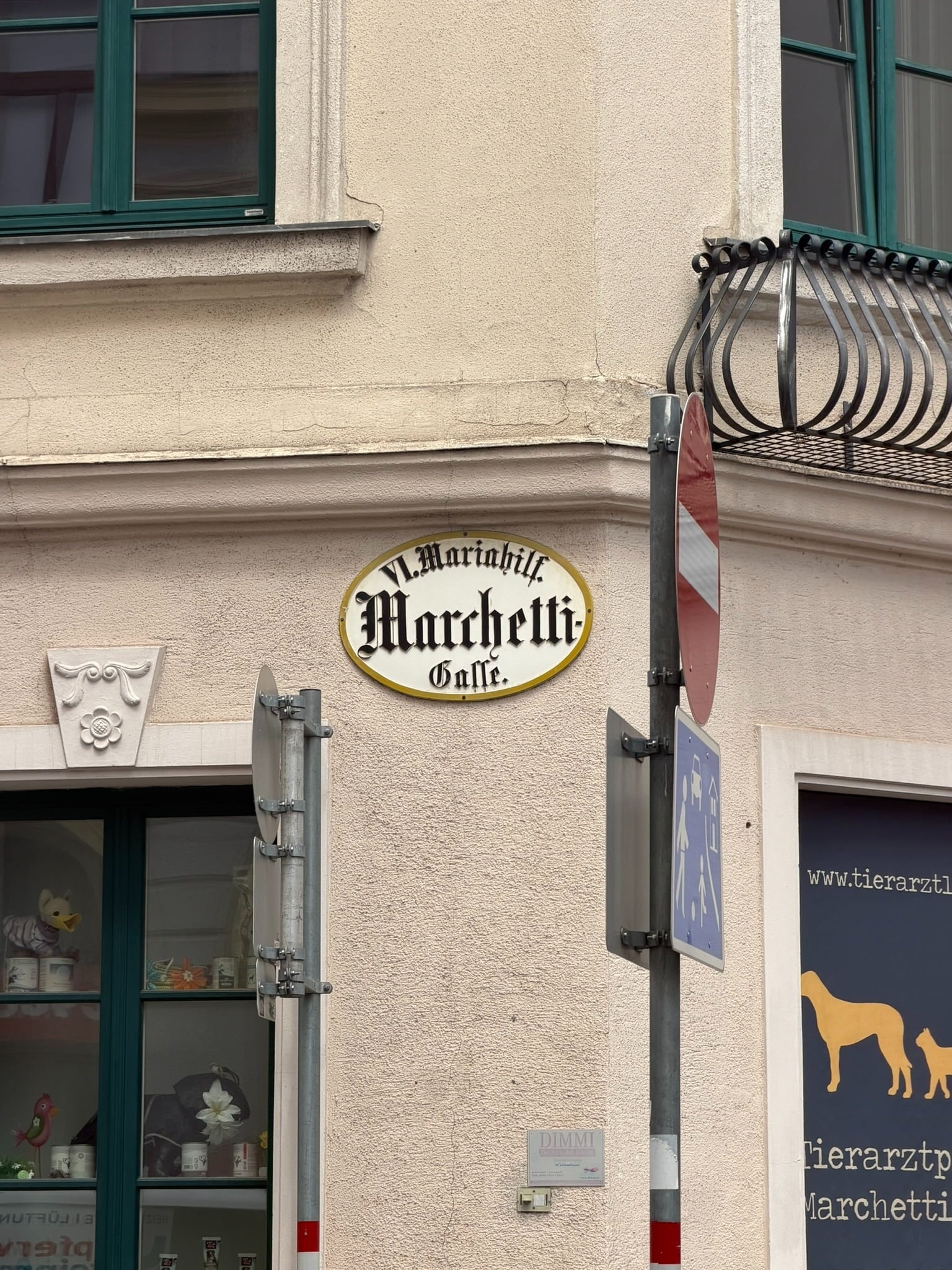
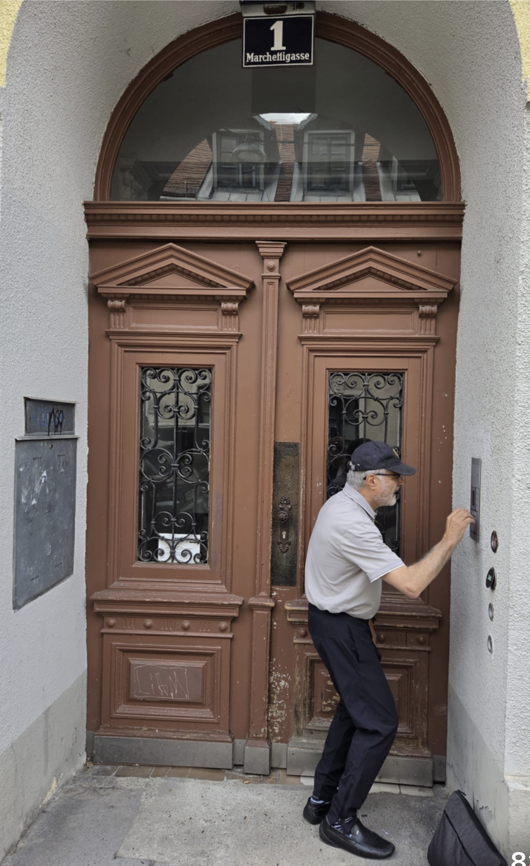
II. Marchettigasse 1, Apartment 10
“Every family has one address that becomes scripture. Not for the architecture. For what was read there.”
The address had been in the house all my life the way a liturgical phrase is in the house: repeated, unexamined, worn smooth. Marchettigasse eins, Wohnung zehn. My father said it the way other men recite a telephone number from childhood, in a single unpunctuated breath, and in his mouth it was not information. It was a formula.
I went on the second morning. The taxi driver took the address without interest and delivered us to the corner of a street in the sixth district — Mariahilf, not, as I had somehow half-believed from the way my father’s stories braided together, Leopoldstadt across the canal. Both districts live in his sentences. The Schiffschul was over there, in the second, where the Jewish Vienna (Matzah Island) of the popular imagination still resides. But the family lived here, in the sixth, in a quiet grid of nineteenth-century apartment houses between the Gumpendorfer Strasse and the Gürtel, and it was here that a boy walked to school and to shul and, one week in March 1938, stopped doing both. (The sixth had only a 5% Jewish population — why live there? Maybe his parents compromised: the Slovakian mother from Bratislava, educated, modern, and assertive; the father from a small shtetl, Nádszeg — simple, frum, honest, so honest he was the treasurer of the Stumpergasse shul. So Father went to gymnasium, not cheder, and learned Greek myths, not midrash.)
I want to record what I felt, and it was not what the genre requires.
I felt nothing. I remembered being here in 1961 with Father.
A street. Cars parked with Viennese precision. A veterinary practice on the ground floor with a cartoon dog in the window. Children on scooters. A woman carrying groceries in a canvas bag, negotiating the curb. The whole apparatus of an ordinary Tuesday, functioning smoothly, indifferent to my arrival in the way the river had been indifferent, but worse, because a street is made by people and therefore its indifference is a decision that someone, at some point, made.
I stood at the corner for a long time waiting to be moved and was not moved. This is the part of pilgrimage nobody writes about: the failure of the site to perform.
Then I looked up and saw the shape of the family plaque — the old enamel plate, the district number, the name in Fraktur — the lettering my father would have looked up at as a child and never once considered, because to him it was simply what a family plaque looked like. And that undid me, entirely and without warning, in a way that the building itself never managed.
I have spent 30 years arguing, in print, that the body reads before the mind does; that a patient’s account of his illness is a text whose surface meaning is the least interesting thing about it; that we understand by being addressed, not by gathering information. I have written this so often that I had ceased to believe it in the way one believes a thing that costs something. Standing under that absent sign, I believed it again. Nothing in the archive had touched me. The oblong space my grandfather’s plaque etched in the grime took my legs out.
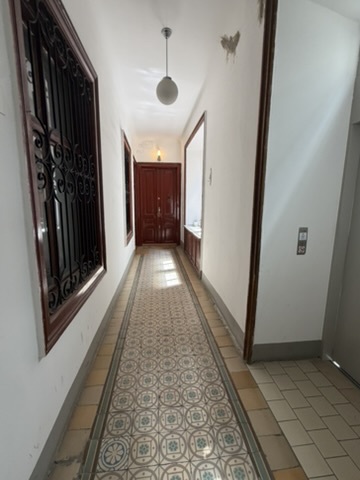
The entrance hall is cool and dim and tiled in a pattern that was cheap when it was laid and is now, by the accident of survival, beautiful. A long corridor. A hanging globe of a lamp. Doors on the right, one of them presumably 10, or presumably the door that stands where 10 stood before a renovation somewhere in the intervening century.
I knocked. I want to be clear that this was not delicacy. I knocked because I felt the urge to see the shape of family history come alive from the few photos; yet I was afraid of what would open — not a person, but the ordinariness of a person, some pleasant Viennese in socks holding a mélange coffee, mildly willing to let a foreign old man look at his hallway. The apartment has had 88 years of other lives in it. My family’s tenancy is a thin stratum in a deep deposit, and I did not want it measured against the present occupant’s furniture.
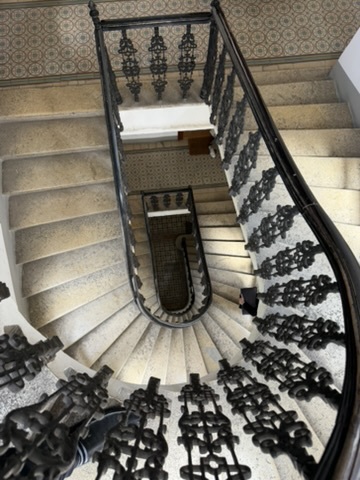
The staircase turns on itself in an iron spiral, the balusters cast in a pattern that must have been ordered by the metre in the 1880s and which nobody has thought about since. I put my hand on the rail. Of course I did. There is no version of this in which I do not put my hand on the rail.
And here I must be careful, because this is the moment the reader is waiting for, and the whole tradition of return-narratives has trained us to expect that at the touch of the banister the boy appears, the current runs backward, the generations touch. I felt the wood. It was wood. Slightly cool, worn concave at the outer edge by a 140 years of hands, of which perhaps 400, or 4,000, belonged to people I am descended from, and the rest to strangers, and the wood makes no distinction and neither does the building.
What the staircase gave me was not contact. It was scale. My father, in his telling, had been the protagonist of Vienna; the city had been the theatre of his childhood and, later, of his expulsion. Standing on that staircase I understood that the building had never known his name. He was one tenant’s son among the tenants’ sons. The Holocaust did not happen to him because he was remarkable. It happened to him because a bureaucracy determined a category and he was inside it, and the staircase, which was the same staircase, was and remains completely uninterested.
This is a colder thought than the one I came for and I have decided to keep it, because the alternative — the warm one, the one about hands across time — would be a small lie told in the service of comfort, and I have argued at length elsewhere that comfort purchased that way is exactly what a post-Holocaust theology is forbidden.
What did move me, when I got outside and could think, was the reverse of the grand claim. Not that this was the site of catastrophe. That before it was the site of catastrophe it was the site of nothing at all: breakfasts, a mother calling up the stairwell, a boy taking the steps two at a time and being told not to, arguments about homework, the smell of other people’s cooking on the landing, someone’s bicycle in the way. Ordinary goodness, which is the least documented and most consequential substance in human history, and which was here, in this stairwell, in quantities nobody recorded because nobody records it.
That is what was destroyed. Not a symbol. A Tuesday.
Historical note. Marchettigasse lies in the sixth district, Mariahilf, laid out in 1801 in the former suburb of Gumpendorf and named for Johann Baptist Marchetti, who built the first house in it. Before 1938 the district supported two synagogues — in the Schmalzhofgasse and the Stumpergasse — and a prayer house in the Millergasse. Leopoldstadt, across the Danube Canal, held the largest Jewish population of any Viennese district and remains, in the general imagination, the Jewish quarter; but Jewish Vienna was never confined there, and the family’s Vienna was here, in the sixth, 10 minutes’ walk from everything that mattered to it.
Part I of a three-part series.