
London based entrepreneur, cybersecurity analyst doing a PhD in AI
The Cola your mind consumes daily.
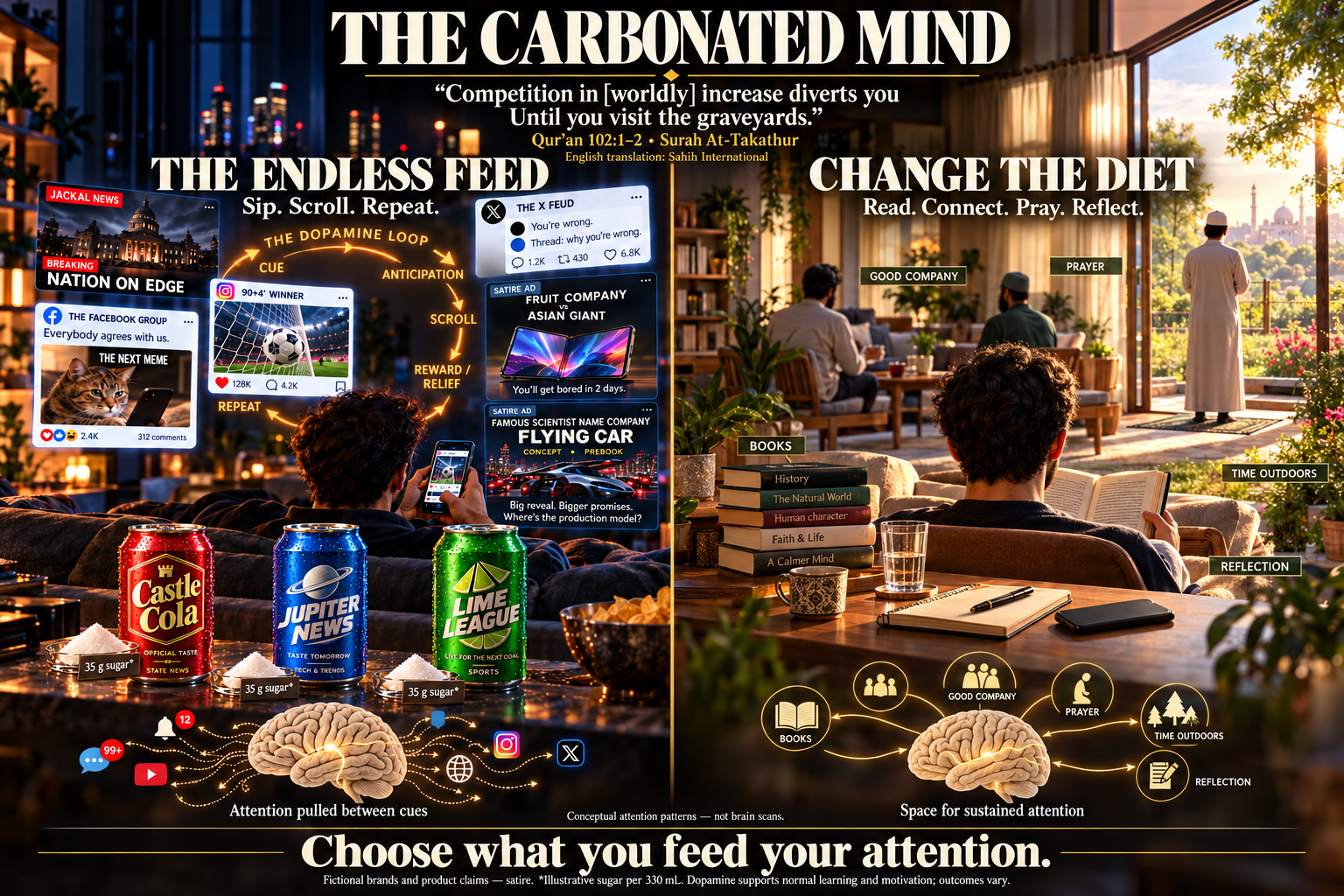
 The Carbonated Mind: Sports, State News, Tech Hype and the Dopamine Loop
You open your phone for the football score. A government headline interrupts. Below it, a technology founder announces that everything is about to change. Within seconds, you have moved from sporting suspense to national anxiety to technological anticipation. The subjects differ. The invitation remains: take another sip.
Imagine the feed as a drinks cabinet. Sports is your favourite green can lemonade drink: bright, sparkling, offering escape through competition. State news is your classic Cola: familiar, established, presenting the reassuring taste of an official account. Tech hype is your always chasing the Classic Red Can Blue Can: restless, future-facing, promising membership of the next generation. These are metaphors chosen for this argument, not claims about the companies or their consumers.
Social media mixes and serves them. Headlines provide the packaging; emotional intensity supplies the fizz. Propaganda can enter any bottle, turning selected information into a preferred interpretation. What connects these experiences is a cycle of anticipation, reaction and return. Psychology helps explain that cycle, although “dopamine loop” captures only part of it.
Dopamine is often described as the pleasure chemical. That shorthand confuses several processes. Reward involves learning what predicts a desirable outcome, becoming motivated to pursue it, and enjoying its arrival. These processes overlap, but they are distinguishable. Dopamine has important roles in learning and motivation; it is not a universal measure of happiness.
Kent Berridge and Terry Robinson distinguish “wanting” from “liking”. Their research describes how dopamine-related systems contribute to incentive salience: the motivational pull that makes a reward, or its associated cue, attract pursuit. Pleasure itself depends on partly different mechanisms. Their addiction theory explains how wanting can become excessive without a corresponding increase in enjoyment (Berridge & Robinson, 2016).
Applied cautiously to media, this distinction illuminates a familiar experience: continuing to refresh a feed you no longer enjoy. The next item still feels worth pursuing. That observation does not establish addiction or prove drug-like neural sensitisation. It shows why satisfaction and repeated consumption should never be treated as interchangeable measures.
Learning supplies another ingredient. Schultz, Dayan and Montague’s influential work connected dopamine neuron activity with reward prediction errors: differences between expected and obtained rewards. An unexpectedly good outcome can generate a teaching signal; with learning, responses can shift towards cues predicting it (Schultz et al., 1997). The promise acquires motivational significance before delivery.
For a reader, a notification or familiar account may become such a promise. Occasionally, opening the app delivers something valuable: a crucial result, an amusing clip, professional recognition. Frequently, it does not. Uncertain outcomes can sustain anticipation, although an actual feed is more complex than a laboratory reinforcement schedule. Calling every scroll a dopamine hit outruns the evidence.
Fiorillo, Tobler and Schultz’s experiments found dopamine activity related to reward probability and uncertainty in monkeys (2003). This supplies a biological foundation for studying anticipation, not a direct measurement of smartphones. The practical insight is modest but powerful: behaviour can be organised around what might arrive, rather than what reliably satisfies.
Sports, makes this structure unusually visible. A match supplies rules, a clock and an unresolved outcome. A late equaliser can transform disappointment into hope. The experience offers genuine skill, beauty and communal enjoyment. Its uncertainty is often precisely what makes watching worthwhile. Nothing pathological is required to explain the attraction.
The surrounding media can stretch that suspense beyond the match. Transfer rumours, injury updates, referee disputes and predictions keep the outcome psychologically unfinished. The final whistle ends one contest, while the feed opens another. An audience can move from watching football to repeatedly checking whether anything has happened around football.
Identity deepens the appeal. Cialdini and colleagues’ classic football studies documented “basking in reflected glory”: students more readily displayed their university affiliation after victories and used “we” more when describing wins (1976). Supporting a team allows another person’s performance to become part of one’s public identity. A score can feel personally consequential.
This helps explain why a supporter might welcome flattering coverage and fiercely contest criticism. The drink carries belonging as well as excitement. Sports journalism can examine that belonging thoughtfully; manipulative coverage can repeatedly provoke it. The distinction lies in what the coverage helps the audience understand, and how honestly it handles evidence.
State news, offers a different familiarity: the recognisable voice of institutions. Here, “state news” means communication shaped by governmental authority or control. Publicly funded journalism with editorial independence should not automatically be placed in that category. Ownership, funding and editorial practice require separate examination. An official source can also report accurately.
The vulnerability arises when authority and repetition substitute for scrutiny. A broadcaster might repeatedly connect national strength with one leader, economic difficulty with an external enemy, or criticism with disloyalty. Each report can supply a fresh example of an established story. The audience receives both an explanation and a position within it.
Kunda’s account of motivated reasoning explains how desired conclusions can influence the evidence people retrieve and evaluate (1990). People generally seek plausible justifications, rather than consciously deciding to believe nonsense. Consequently, a narrative that protects national or political identity may receive a more generous hearing than an equally supported account that threatens it.
Repetition adds familiarity. Experiments by Fazio and colleagues show that repeated statements can gain perceived truth even when their content is implausible (2019). This illusory truth effect is not itself a dopamine finding. It is a separate cognitive mechanism through which recurring claims can become easier to accept without acquiring additional evidence.
Propaganda can combine these processes: make the message familiar, connect agreement with belonging, and make disagreement emotionally costly. Its power need not depend on universal deception. Selective truths, omitted context and repeated framing may be sufficient to steer interpretation. The comforting taste is the sense that events fit an already familiar account.
Tech hype, sells anticipation in a different direction. Its imagined audience wants to arrive early: before the breakthrough becomes obvious, before the market understands, before everyone else acquires the skill. The emotional offer combines opportunity with urgency. Tomorrow is approaching, and today’s announcement promises privileged access to it.
Information can itself have rewarding value. Bromberg-Martin and Hikosaka found that macaques preferred advance information about upcoming water rewards, with dopamine neurons signalling information-related expectations (2009). The information did not increase the water available. This animal study establishes a relevant principle, although extending it to technology audiences remains an interpretation requiring human evidence.
A technology feed can repeatedly open questions: which model will dominate, which job will change, which company will win? Each announcement offers partial resolution while generating another uncertainty. The reader may accumulate predictions without developing practical competence. The anticipation of understanding the future can become more compelling than evaluating what already works.
Scientific progress deserves attention. Hype begins when evidential limits disappear beneath emotional promises. A demonstration becomes inevitability; a benchmark becomes general intelligence; a forecast becomes a deadline. Each inference needs independent support. Excitement is reasonable, but it cannot perform the work of replication, deployment evidence or careful comparison.
The drinks comparison has an unusually direct research connection. McClure and colleagues studied preferences for Coke and Pepsi under anonymous and brand-cued conditions. Brand knowledge, particularly for Coke, influenced expressed preferences and brain responses (2004). Their findings illustrate that cultural associations can contribute to experience alongside the properties of what people consume.
That experiment does not validate our three media categories. It does suggest why the label matters. A club crest, official seal or celebrated founder’s name can arrive carrying associations before a claim receives examination. The reader encounters both the content and its reputation. Evaluating them separately takes deliberate effort.
Headlines concentrate this process. “Spending estimates revised” invites attention to a development. “They wasted your money” supplies accusation and personal injury before the evidence is inspected. Robertson and colleagues analysed randomised Upworthy headline tests and found that, for an average-length headline, an additional negative word increased click-through rates by approximately 2.3% (2023).
That result concerns a specific dataset, rather than a universal law of journalism. Nevertheless, it demonstrates an incentive: emotional wording can increase consumption. Outrage, alarm and surprise may bring readers through the door. Whether the article then rewards their attention with accurate understanding is a different question.
Social approval adds another layer. Lindström and colleagues analysed more than a million social media posts and conducted an experiment, finding evidence that social rewards influence posting behaviour in ways consistent with reinforcement learning (2021). Likes do more than record appreciation; they can help shape what people choose to produce again.
Brady and colleagues found that positive feedback for expressions of moral outrage increased subsequent outrage expression, while network norms also influenced behaviour (2021). Their research measured expression, not a direct increase in inner anger or dopamine. The distinction matters: people can learn which performance receives approval without becoming uniformly angrier inside.
A reader can therefore become a distributor. The sporting grievance, patriotic accusation or technological prophecy earns attention when shared. Approval encourages another contribution. Propaganda benefits when audiences voluntarily circulate its framing, whether through agreement or repeated hostile engagement. Distribution can emerge from ordinary social incentives without every participant recognising a coordinated purpose.
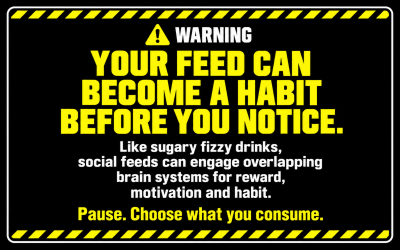
The loop now has several parts: a cue attracts attention; anticipation motivates checking; content provides information, stimulation or reassurance; social feedback rewards participation; repetition strengthens familiarity. These mechanisms interact, but they are not one chemical event. Some reactions involve threat or discomfort. An upsetting headline need not be pleasurable to keep someone engaged.
Habit can eventually reduce the need for a fresh reward. Wood and Rünger describe how repeated actions in recurring contexts become relatively automatic (2016). Waiting for a train, waking up or encountering a difficult task can become occasions for checking. The hand reaches for the phone before a clear informational purpose forms.
This is where the cola metaphor becomes most useful. A pleasant drink is not inherently a problem. Neither is a match report, an official announcement or a technology update. The issue is whether consumption remains responsive to purpose, or repeatedly continues after that purpose has been met.
The costs are also different. A drink delivers a finite serving. A feed can continually introduce another unresolved question. After an hour, someone may feel informed because many things have happened emotionally, while retaining little context or verifiable knowledge. Intensity creates a convincing impression of significance, but the two are not equivalent.
Breaking this pattern means changing the conditions of consumption. Decide what you want to learn before opening the feed. Follow a match without treating every rumour as necessary. Read official claims alongside independent evidence. Assess technological announcements through demonstrated capabilities, limitations and reproducibility. Give each category a question it must actually answer.
For consequential claims, inspect the original source before sharing. Research by Calvillo and Smelter found that considering headline accuracy during initial exposure reduced the later influence of repetition on perceived accuracy (2020). Establishing accuracy as the task can help interrupt the slide from familiarity into belief. It is a practice, not immunity.
It also helps to create stopping points: the completed article, the verified result, the answered question. Reduce cues that repeatedly reopen an activity you intended to finish. These changes address attention and habit without pretending that dopamine is a toxin to eliminate. The same motivational systems support learning, relationships and meaningful achievement.
The challenge is therefore editorial as well as personal: publishers and platforms should ask whether their measures of success reward informed audiences, or simply audiences who return more often and react with greater intensity.
Sports. State or Geopolitics. Tech hype as Pepsi. There are other ones. Gaming, Shopping, Comics. The three I highlighted are the three big ones from my experience living at least in India and the UK. In India – Sports and Geopolitics are unusually “loud” in the media cycle. Tech often takes a backseat and is replaced by Bollywood news. This has to do with the price of a Bollywood cinema hall ticket versus a tech gadget price I believe. Every country will have a different mix. The underlying mechanism is the same. Anticipation and irregular reward.
Different flavours can satisfy different interests while participating in similar cycles of anticipation and return. The worthwhile question is what each serving contributes: understanding, enjoyment, connection, or merely another reason to keep consuming.
A thoughtful information diet leaves room for pleasure and excitement. It also asks for evidence, context and an ending. Before the next refresh, pause long enough to distinguish the desire for another update from a reason to need one. The feed can always offer another sip. Attention becomes yours again when you choose whether to take it.
References
- Berridge & Robinson (2016). Liking, wanting, and the incentive-sensitization theory of addiction.
- Schultz, Dayan & Montague (1997). A neural substrate of prediction and reward.
- Fiorillo, Tobler & Schultz (2003). Discrete coding of reward probability and uncertainty by dopamine neurons.
- Cialdini et al. (1976). Basking in reflected glory: Three (football) field studies.
- Kunda (1990). The case for motivated reasoning.
- Fazio, Rand & Pennycook (2019). Repetition increases perceived truth equally for plausible and implausible statements.
- Bromberg-Martin & Hikosaka (2009). Midbrain dopamine neurons signal preference for advance information about upcoming rewards.
- McClure et al. (2004). Neural correlates of behavioral preference for culturally familiar drinks.
- Robertson et al. (2023). Negativity drives online news consumption.
- Lindström et al. (2021). A computational reward learning account of social media engagement.
- Brady et al. (2021). How social learning amplifies moral outrage expression in online social networks.
- Wood & Rünger (2016). Psychology of habit.
- Calvillo & Smelter (2020). An initial accuracy focus reduces the effect of prior exposure on perceived accuracy of news headlines.
Related Topics
Related Posts