
The Counterargument to the DSA’s Position on Israel
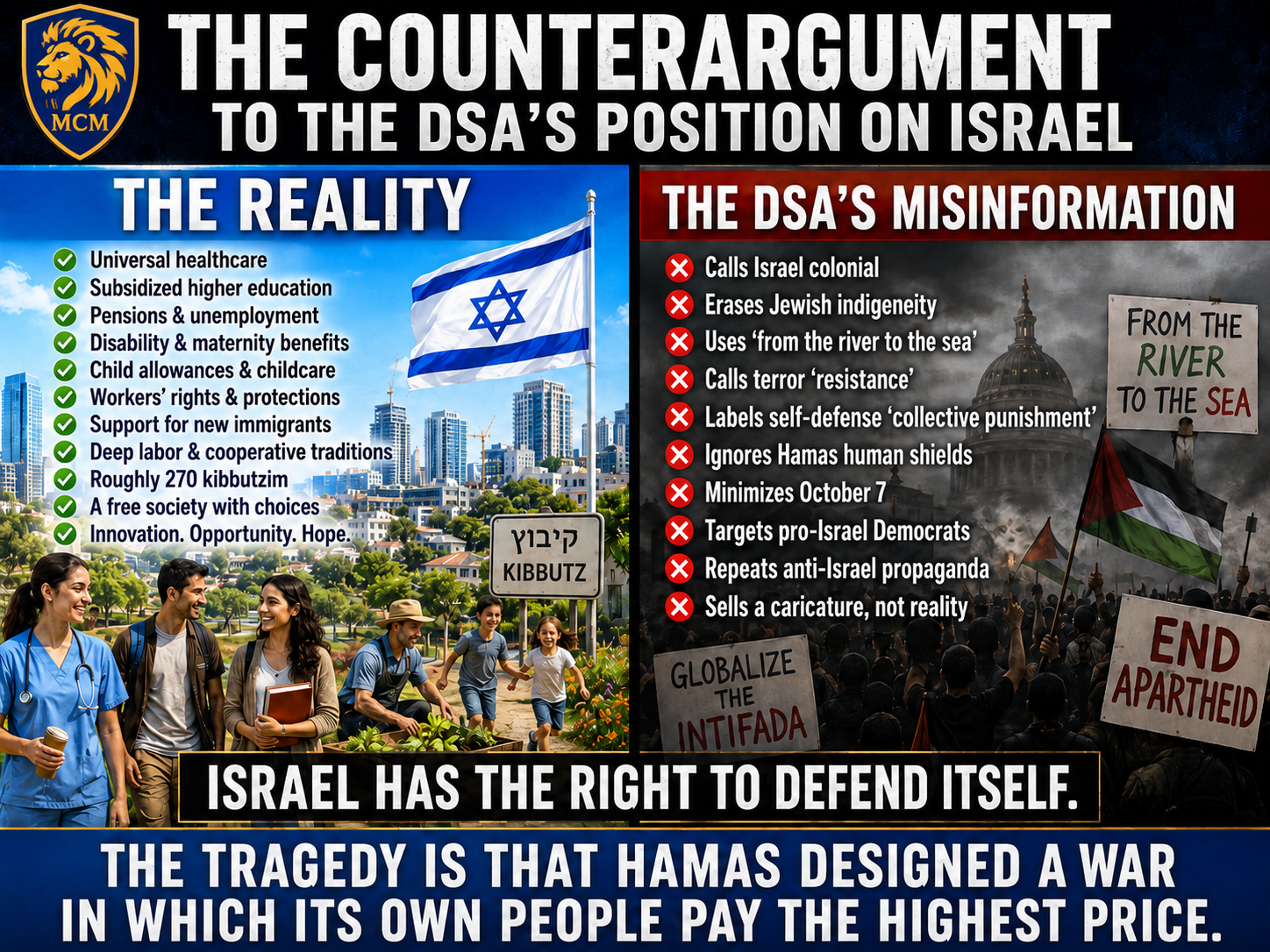
The DSA says, at best, that Israel has the right to defend itself. Then it condemns virtually every effective method Israel uses to exercise that right.
What was Israel supposed to do after October 7?
Hamas fired approximately 5,000 rockets into Israel, invaded southern communities, murdered about 1,200 people, kidnapped roughly 250 hostages, and injured thousands, and openly promised to repeat the attack.
What would a “proportionate response” have looked like?
Should Israel have killed exactly the same number of people, destroyed an equivalent amount of property, and then stopped? Should it have left Hamas armed, organized, governing Gaza, holding hostages, and preparing to carry out another massacre?
That would not have been self-defense. It would have given Hamas permission to survive and prepare the next attack.
Critics answer with the phrase “collective punishment.” It is an emotionally powerful accusation, but it avoids the reality of how Hamas deliberately constructed this war.
Hamas embedded fighters, weapons, tunnels, command centers, and booby-trapped buildings throughout civilian areas. Its fighters operated from homes and public infrastructure. Hamas fighters sometimes drew Israeli soldiers into buildings, escaped through tunnels, and then detonated explosives after the soldiers followed them inside. Those tactics killed Israeli soldiers while also destroying more of Gaza.
Hamas built an enormous tunnel network to protect its fighters, commanders, weapons, and hostages. It did not open those tunnels to Gaza’s civilians, even though it knew civilians would become casualties in the war Hamas started.
Israel repeatedly issued evacuation warnings before attacking buildings and neighborhoods Hamas was using to conduct military operations. Hamas repeatedly kept civilians close to military targets because civilian casualties served its propaganda strategy.
Do Israel’s critics understand that Hamas fighters have fired upon Israelis while Palestinian women and children stood between them? Are they comfortable with Hamas using hospitals, schools, homes, and densely populated neighborhoods as military cover?
Those questions cannot simply be brushed aside by repeating “collective punishment.”
Hamas had the ability to end the war. It could have released the hostages and surrendered.
Instead, Hamas chose to continue operating among civilians. It chose not to use its tunnels to shelter Palestinians. It glorified civilian deaths as martyrdom and turned Palestinian suffering into one of its most valuable political and propaganda weapons.
Hamas also staged misleading images and scenes for the media to distort the reality of the war it started. Children suffering from terrible diseases or severe medical conditions were sometimes presented as though their appearance alone proved widespread starvation. Civilians were photographed holding empty dishes and begging for food in scenes designed to create the impression that no food was available.
The reality is that substantial amounts of food entered Gaza, but Hamas commandeered much of it and sold it back to civilians at inflated prices. Palestinian suffering became part of Hamas’s propaganda strategy as well as a source of revenue and control.
And there is another question Israel’s critics rarely answer: What other country supplies food and humanitarian aid to a population governed by the enemy it is fighting while that enemy continues holding its citizens hostage and attacking its soldiers?
Israel could not answer October 7 with a merely symbolic or supposedly proportionate response. Its mission was to destroy the military organization that carried out the massacre while limiting civilian casualties in one of the most difficult urban battlefields imaginable.
War is horrific. Innocent people suffer. Every civilian death is tragic. But Hamas began this war, shaped the battlefield, embedded itself among civilians, and deliberately maximized the danger and casualties inflicted upon its own population.
In addition to rescuing the hostages, Israel had to prevent Hamas from retaining the military capacity to carry out another October 7.
Leaving Hamas intact would never have brought a peaceful end to the war. It would have rewarded the massacre and invited another attack.
Bernie Sanders condemned Hamas and acknowledged that Israel had both the right and the obligation to defend itself. But that acknowledgment becomes meaningless if every military action capable of weakening Hamas is subsequently characterized as immoral, disproportionate, or criminal.
A country does not possess the right to defend itself when it is permitted only to make symbolic responses that leave the attacking force in power.
The DSA’s description of Israel bears no resemblance to reality. It presents Israel as colonial, inherently racist, uniquely cruel, fundamentally illegitimate, and sometimes even compares it to a Nazi regime.
The reality is that Israel provides many of the social programs the DSA proposes for America.
Israel has universal healthcare and heavily subsidized higher education. It provides old-age pensions, unemployment assistance, disability support, maternity benefits, child allowances, workplace protections, rehabilitation services, assistance for new immigrants, subsidized childcare, and public education beginning at a young age.
It has strong workers’ rights, cooperative institutions, public investment, and a broad social safety net rooted in social-democratic values.
Israel also has roughly 270 kibbutzim, collective communities where residents share ownership, responsibilities, services, and income. Many operate farms, factories, tourism enterprises, technology companies, and other businesses collectively.
Internally, a kibbutz can function as a socialist community. Externally, it competes in Israel’s free-market economy.
How many other countries have made communal living not only legal, but socially accepted, economically productive, and woven into the national story?
For people who genuinely want to live within a collective economic system, Israel offers that choice. For people who want to build private companies, Israel offers that choice too. Israelis can participate in labor unions, cooperatives, kibbutzim, private businesses, or combinations of all four.
The DSA should be studying Israel. It should examine how a democratic nation created universal healthcare, subsidized universities, organized labor, cooperative communities, and one of the world’s most innovative technology and start-up economies while absorbing waves of immigrants and surviving extraordinary security threats.
Instead, the DSA ignores all of this because its understanding of Israel has been corrupted by jihadist propaganda. I explained that argument more fully in my earlier article, “I Call the DSA Corrupted by the Worldwide Jihadist Movement”:
https://blogs.timesofisrael.com/i-call-the-dsa-corrupted-by-the-worldwide-jihadist-movement/
The DSA says it supports Israel’s right to defend itself, but its rhetoric leaves Israel with no effective means of exercising that right. It condemns Israel’s military response while minimizing the battlefield Hamas intentionally created. It focuses overwhelmingly on Israeli actions while treating Hamas’s use of civilians as secondary background.
This is not a serious analysis of war. It is a framework in which Israel is always guilty, Hamas is always explained, and no Israeli response is ever permitted to succeed.
I do not accept the claim that Israel’s response was simply “collective punishment.” I see a democratic nation confronted by an enemy that massacred its civilians, kidnapped its people, embedded itself among Palestinians, and deliberately transformed Palestinian deaths into a political strategy.
The tragedy is not that Israel refused to allow Hamas to survive intact.
The tragedy is that Hamas designed a war in which the civilians of Gaza would pay the highest possible price.