


CEO of Time to Stand Up for Israel
The Country That Never Existed
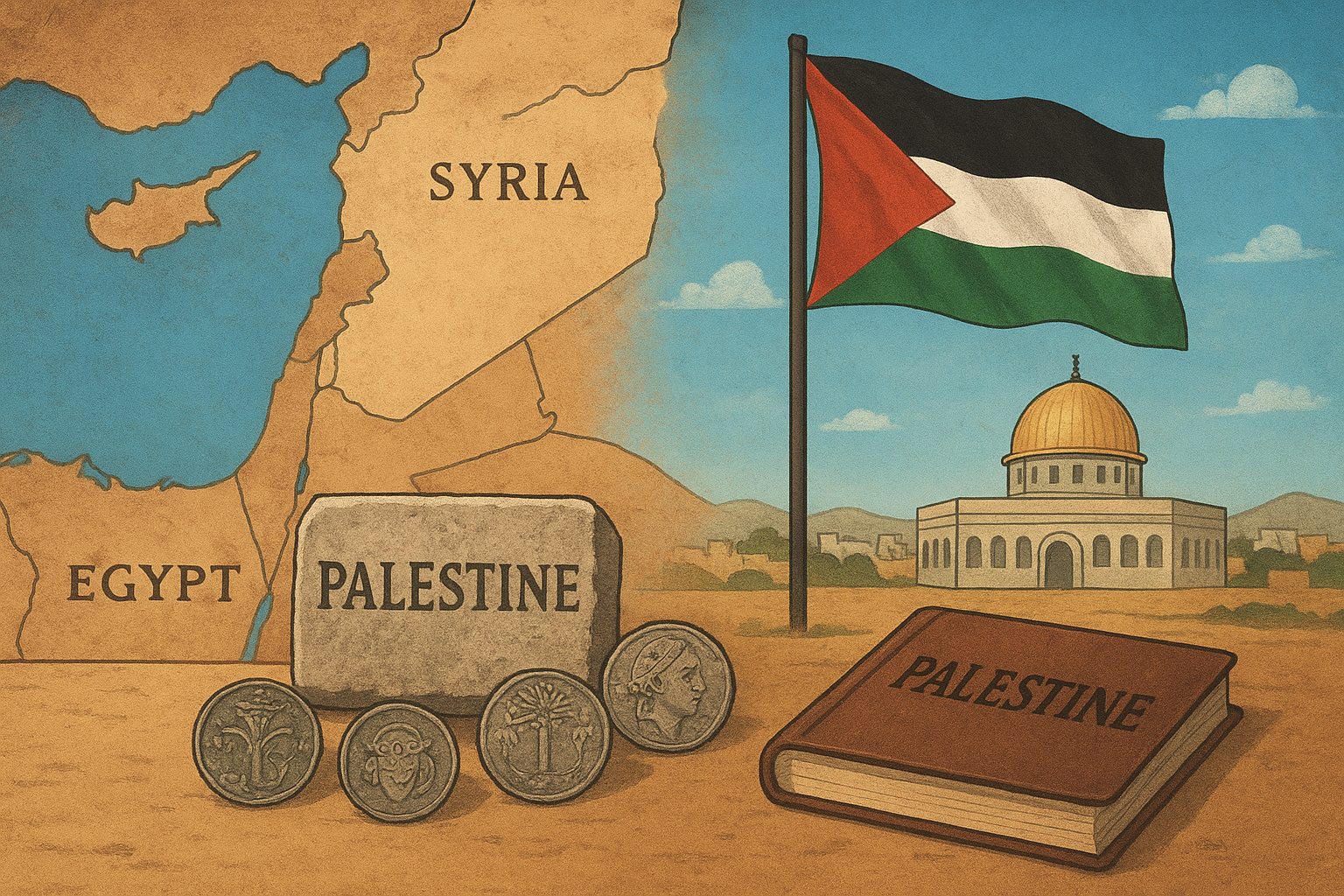
Photo Credits: Sabine Sterk (AI)
The Country That Never Was: Debunking the Myth of Arab Palestine
The world keeps hearing about “Palestine,” as if there was once a sovereign Arab nation that was conquered, colonized, or stolen. But here’s the undeniable truth: there has never been a sovereign Arab country called Palestine. Not in ancient times, not under Islam, not under the Ottomans, and not before 1948.
The name Palestine has a long history but it was always a geographic term, never a national one. It referred to a region, not a country. To understand the power of this historical distortion, we must go back to where it began.
From Judea to “Syria Palaestina” and Rome’s Act of Erasure
After crushing the Jewish Bar Kokhba revolt in 135 CE, the Roman Emperor Hadrian sought to erase the Jewish identity of the Land of Israel. He banned Jewish practice, destroyed Jerusalem, and renamed both the city (Aelia Capitolina) and the land itself calling it “Syria Palaestina.”
This was not the birth of an Arab Palestine; it was the deliberate Roman attempt to erase “Judea.” The name “Palestina” came from the ancient Philistines, long extinct by then. There was no “Palestinian people” in the modern sense just a Roman label imposed on a conquered land.
Empires Came and Went, But Never a Palestinian State
Over the next 1,800 years, the region was ruled by a long line of empires:
- Byzantine (Christian Roman)
- Arab Caliphates (Umayyad, Abbasid)
- Crusaders
- Mamluks
- Ottoman Turks
- British Empire
In every era, “Palestine” was a province, district, or region, never an independent political entity. There were no kings or parliaments of Palestine, no Palestinian currency, no embassies, no borders, no treaties signed by a Palestinian ruler.
When the Ottoman Empire ruled from 1517 to 1917, the area we now call Israel, Gaza, and the West Bank was divided among three administrative regions (sanjaks) within Greater Syria. The word “Palestine” was barely used at all.
In fact, most local Arabs identified as Syrians, Muslims, or members of tribal clans, not as “Palestinians.” The very idea of a “Palestinian national identity” was virtually unknown.
The British Mandate: When the Name Returned
After World War I, the League of Nations awarded Britain the Mandate for Palestine (1920–1948). This was the first time in centuries the term “Palestine” was used officially again and ironically, it referred to a territory meant to become the Jewish national home, as promised in the Balfour Declaration (1917).
During this time, Jews proudly called themselves “Palestinians.”
There were Jewish institutions like the Palestine Electric Company, the Palestine Symphony Orchestra, and the Palestine Post (now the Jerusalem Post).
In contrast, the Arab population rejected the name “Palestine.” Prominent Arab leaders demanded that the region be reunited with Syria or Jordan.
One of them, Awni Abd al-Hadi, testified before the British Peel Commission in 1937:
“There is no such country as Palestine. ‘Palestine’ is a term the Zionists invented. Our country was for centuries part of Syria.”
Let that sink in. The same Arab leadership that now claims a historical “State of Palestine” openly denied its existence less than a century ago.
Where Are the Artifacts of “Palestine”?
If an Arab Palestine had ever existed, archaeologists would have found evidence; coins, flags, royal seals, government decrees, treaties, or national archives.
None exist.
Not one.
Instead, all evidence found in the land from coins engraved with “Yehuda” and “Jerusalem” to Hebrew inscriptions and synagogues, confirms a continuous Jewish presence and sovereignty in this land for over 3,000 years.
Even the Arabic name “Filastin” is borrowed from the Roman “Palaestina.” There is no archaeological, linguistic, or historical trace of an indigenous Arab nation called Palestine.
The Modern Reinvention: 20th-Century Politics
The concept of a “Palestinian people” as a separate Arab nation emerged only in the mid-20th century, largely as a political tool against Jewish sovereignty.
After Israel’s rebirth in 1948 and even more after the 1967 Six-Day War, Arab leaders reframed their struggle, no longer as a pan-Arab one, but as a local national cause.
This was not born of deep historical roots, but of political necessity.
The Soviet Union and its allies played a major role in shaping and financing the modern Palestinian narrative, turning it into a weapon in the Cold War propaganda against the West and Israel.
Even the Palestine Liberation Organization (PLO), founded in 1964, predates Israel’s control of the West Bank and Gaza meaning its goal was not liberation from “occupation,” but from Israel’s very existence.
The Double Standard of Global Education
And yet, despite all the overwhelming historical and archaeological evidence, schools, universities, media, and political leaders across the world have repeated the myth that “Palestine” was an Arab country taken from its native people.
This falsehood has seeped into textbooks, classrooms, documentaries, and news reports. It is now treated as “accepted history”, even though it has no basis in fact.
Children in Europe and North America are being taught to mourn the “loss” of a country that never existed.
Universities invite activists who rewrite history with slogans and emotions, but without evidence.
Politicians and journalists repeat the same fabricated narrative afraid to challenge it, afraid to lose votes or social approval.
A Call for Historical Honesty
It is time, long past time, for truth to replace propaganda.
We call on:
- Schools and universities to teach verified history, not political mythology. Include primary sources, maps, and archaeological findings that reflect reality not slogans.
- Politicians to stop legitimizing the myth of an ancient Arab Palestine and instead acknowledge the region’s actual history and Jewish continuity.
- Media outlets to apply the same critical standards they claim to use elsewhere. Words like “occupation” and “indigenous” must be based on historical fact, not ideology.
Truth Matters
History is not a political choice. It is evidence, recorded by time itself.
There was no Arab Palestine. There was Judea, Samaria, and a land that has been home to the Jewish people for millennia, through exile, persecution, and return.
The world can no longer afford to build diplomacy, education, and public opinion on a historical lie.
For the sake of truth, peace, and intellectual integrity, we must restore honesty to the conversation and stop teaching our children that a myth is a nation.
Am Yisrael Chai…The People of Israel Live.
And their story, unlike the myth of Arab Palestine, is written in the stones, scrolls, and soil of the Land of Israel itself.
About Time To Stand Up for Israel
Time To Stand Up for Israel is an independent foundation dedicated to fighting misinformation, countering antisemitism, and providing clear, fact-based education about Israel. We do not engage in internal Israeli politics. We stand on two core principles: Israel has the right to exist. Israel has the duty to defend itself. Support our work: Donate and/or subscribe at: www.timetostandupforisrael.com
Related Topics
Related Posts
