
Welcome to the Ongoing Situation
Featured Post
Israel’s most unwanted continuing education program
We rapidly learned how to navigate the wartime adjustments, like which shelters are best. What's tricky is making sure they don't become normal
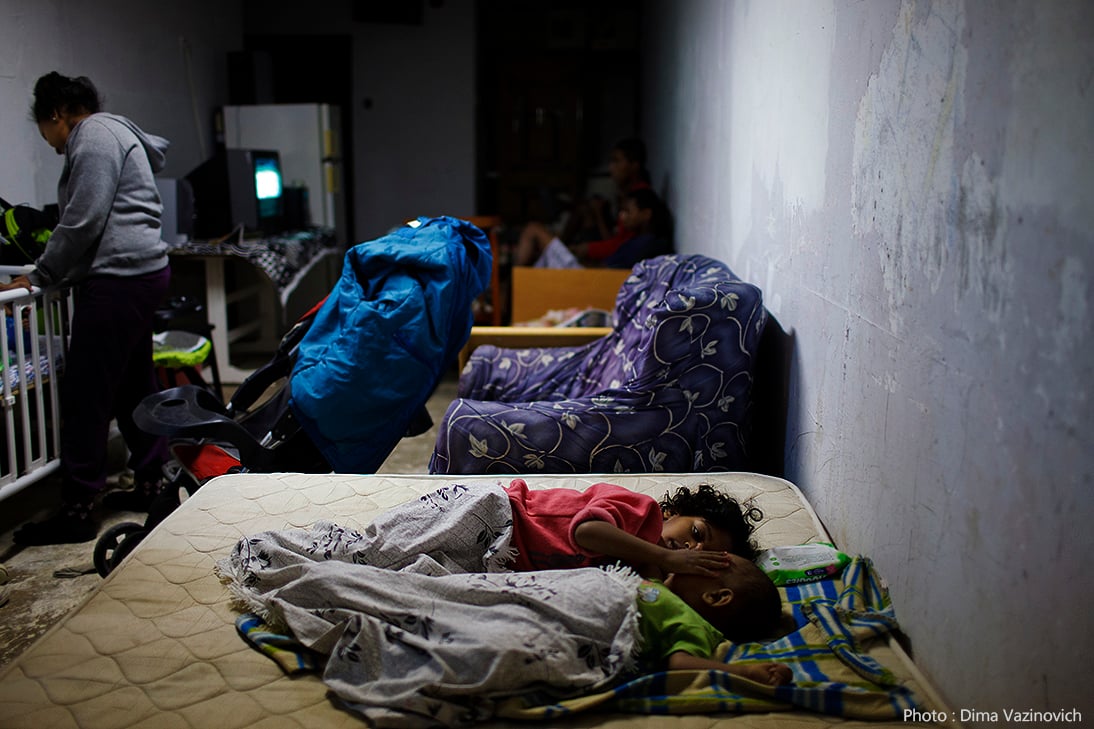
Israeli family sleeps in a bomb shelter. (Photo by Dima Vazinovich/Wiki Creative Commons)
There are certain skills a person expects to acquire in adulthood.
How to file taxes. How to negotiate a salary. How to cook something besides pasta. How to keep a plant alive for more than three weeks.
There are other skills you hope never to need.
How to identify the sound of an incoming missile. How long it takes to reach a shelter from your bedroom. Which wall in your apartment is safest. How to continue a conversation while wondering whether the siren will go off.
Yet over the past weeks, Israelis have once again demonstrated an extraordinary ability to master things no society should ever have to learn.
Within hours of the first alerts, people were exchanging practical advice with the efficiency of seasoned professionals. Which stairwells offer the best protection. Which apps deliver notifications fastest. Whether it is worth sleeping in clothes. How to carry a sleeping toddler and a phone charger simultaneously at three in the morning.
By now, most of us know the routine.
We know which neighbor will already be in the shelter when we arrive. We know who forgets their keys. We know which children cry and which ones somehow sleep through everything. We know exactly how many seconds of denial we can indulge before accepting that yes, this siren is real, and yes, we actually have to get up.
The remarkable thing is not that Israelis adapt. The remarkable thing is how quickly adaptation begins to feel normal.
Human beings are astonishingly good at adjusting to almost anything. It is one of our greatest strengths and one of our most troubling qualities.
Give us enough time and we will create routines around the absurd.
We will organize group chats about missile trajectories.
We will compare shelter conditions.
We will debate the optimal location for emergency snacks.
We will develop preferences.
Last night, I overheard a conversation in which two people compared different safe rooms the way others might compare hotels.
One had better ventilation. The other had more comfortable chairs.
Neither seemed to find the conversation particularly strange. That may be the most Israeli thing of all.
Not resilience itself. The normalization of resilience.
The speed with which extraordinary circumstances become ordinary life.
This is not unique to war. Israelis have spent decades adapting to realities that would seem incomprehensible elsewhere. We adjust to reserve duty, political crises, terrorist attacks, rockets, elections, more elections, and the persistent feeling that history is unfolding slightly too close to home.
Then we go to work. We complain about traffic. We argue over restaurant reservations.
We continue.
For years, international observers have admired Israeli resilience, often treating it as a national superpower. There is truth in that; resilience is real. It matters.
But resilience also comes with a hidden cost.
The more adaptable a society becomes, the easier it is to forget how abnormal its circumstances actually are.
At a certain point, survival stops feeling exceptional and starts feeling administrative.
You update your emergency kit. You charge your power bank. You check whether your building’s shelter has Wi-Fi.
You absorb another layer of contingency planning into everyday life.
And because everyone around you is doing the same thing, it begins to seem entirely reasonable.
This week, I found myself mentally calculating how many seconds it would take to get from my son’s room to the shelter while carrying him half asleep.
The calculation arrived automatically, without drama.
That frightened me more than the sirens.
Not because the thought itself was irrational, but because it felt so rational.
So practiced. So familiar.
There is a temptation, especially in Israel, to celebrate this kind of adaptation without qualification. To hold it up as evidence of national character. To point proudly to our ability to function under pressure.
And perhaps we should.
But we should also allow ourselves to acknowledge something else.
It is strange. All of it is strange.
The children sleeping in shelters. The emergency alerts. The casual expertise.
The fact that millions of people have become proficient in circumstances they never asked to encounter.
The goal of resilience is not to make the abnormal feel normal.
The goal is simply to get through it.
Because there should remain a part of us that refuses to become entirely comfortable with the things we have learned to survive.
We call it resilience because the alternative is admitting how strange it is to become good at surviving.
Related Topics
Related Posts