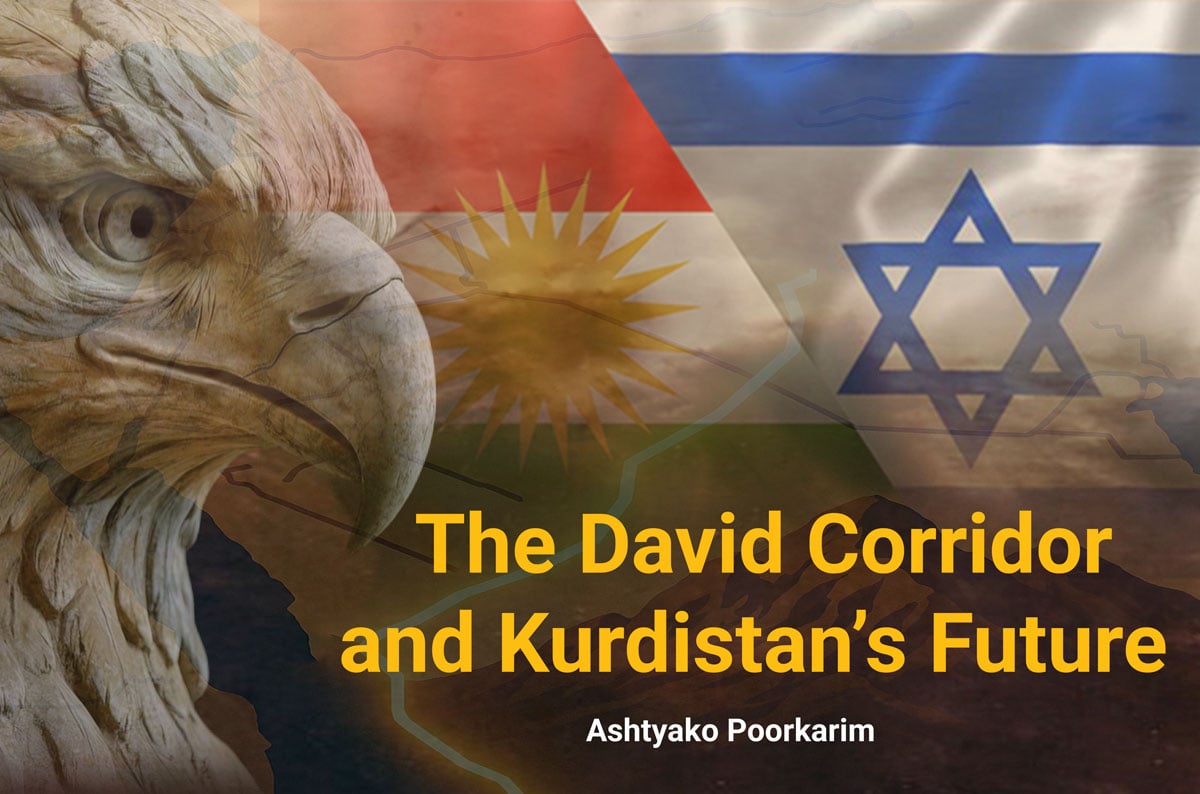
The David Corridor and Kurdistan’s Future
The New Middle East and the Necessity of Kurdistan’s Independence in Light of the “David Corridor”
By Ashtyako Poorkarim (“Jamal”)
Leader, Kurdistan Independence Movement
More than a century has passed since the Sykes–Picot and Lausanne agreements, yet the wound of “statelessness” remains fresh on nations such as the Kurds, Baloch, Azeris, Ahwazi Arabs, Turkmens, and Druze. The paper borders drawn by colonial powers in the early twentieth century not only prevented the formation of real nation-states but also planted the seeds of perpetual tension in this region. Today, as many of the states in the region have become worn out and dysfunctional, the idea of “geopolitical corridors” instead of rigid borders has become the axis of governability and development. At the center of this transformation shines a simple truth: as long as Kurdistan remains within the occupation of Iran, Iraq, Syria, and Turkey, the cycle of violence, discrimination, and instability will continue. The independence of all four occupied parts of Kurdistan is a prerequisite for peace and order in the new Middle East.
What is the David Corridor and why is it vital for structural peace?
The “David Corridor” is a strategic project that begins in the Golan Heights, passes through eastern Syria and the areas of Rojava Kurdistan (“Kurdistan under Syrian occupation”), reaches Kurdistan under Iraqi occupation, and then connects to the Mediterranean. This route can build a new bridge between Israel, Kurdistan, and the West—a bridge with simultaneous economic, security, and political capacities. For Israel, this corridor provides strategic depth and access to new routes of energy and trade. For the Kurdish nation, it is a historic opportunity to exit the status of “transit land” and become a “geopolitical knot”—an actor with decision-making and regulatory power, not merely a space that others pass through. For Europe and the Western world, the meaning of this corridor is diversification of energy and reduction of dependence on routes under the influence of Iran and Turkey.
In the past two decades, many corridor projects have been proposed in the region: from Zangezur between Azerbaijan and Turkey to the North–South corridors of Iran and Russia. But none has given a meaningful answer to the needs of stateless nations. From this perspective, the “David Corridor” is unique because it simultaneously combines the interests of Israel, Kurdistan, and oppressed minorities—including the Druze—and moves from the level of political slogans toward institutional, economic, and security architecture.
Kurdistan’s independence: the key to unlocking lasting peace
The core argument is clear: as long as the Kurdish nation is divided and oppressed in four occupying countries, the region’s security structure will remain built on quicksand. The independence of all four occupied parts of Kurdistan is not merely a national demand but a structural solution to reduce proxy wars, contain extremism, and end the zero-sum border games. Such independence provides other occupied nations with a model of legal and political liberation, and for Israel and its Western allies, it creates a belt of stability and cooperation stretching from the Golan to the Mediterranean.
The David Corridor as an engine of state-building and development
At the economic level, the David Corridor facilitates the connection of oil and gas resources from present-day eastern Syria and the Bashur (Southern) Kurdistan region to Mediterranean ports—initially through staged land and sea transport, and in the mid-term by evaluating harder infrastructure. This connection strengthens transparent revenues, taxation capacity, and regulatory power for Kurdish institutions and brings the criteria of statehood—sustainable population, defined territory, effective governance, and foreign relations—one step closer to reality. The clear message of the 2017 referendum in Bashur Kurdistan—with its decisive vote for independence—was that the political will exists; what is needed is institutional, legal, and economic support to transform this will into sustainable structures.
Shared Kurdish–Jewish–Druze interests and ending the logic of marginalization
One of the strategic advantages of this project is turning historic Kurdish–Jewish–Druze alliances into real mechanisms of participation: from layered route security and digital customs to joint committees for social and human rights oversight. When border communities themselves are stakeholders with a clear share of benefits, security arises not from “hard external presence” but from social legitimacy and economic transparency. This marks the decisive break from the failed models of the past, which saw local people of transit routes merely as “obstacles,” not as “owners and partners.”
Addressing challenges: from opposition of central governments to transparency regimes
It is obvious that Iran, Turkey, Iraq, and Syria will oppose any arrangement that strengthens Kurdish independence. But experience shows that through phased design, legal transparency of contracts, joint escrow accounts, pre-agreed arbitration, and the presence of international observers, the cost of sabotage can be raised and the incentives for cooperation increased. Most importantly, the “principle of host sovereignty” in each segment of the route—together with “limited operational immunity” solely for infrastructure and transit—can reduce legal pretexts for confrontation while paving the path for Kurdistan’s independence in practice.
Why is peace impossible without the independence of all four parts of Kurdistan?
The chronic instability of the Middle East is the product of suppressing the rights of historic nations and instrumentalizing them in proxy wars. A divided Kurdistan, instead of enjoying the right to self-determination, has become the arena of security competition among regional powers. The result is clear: recurring waves of repression, displacement, extremism, and human capital flight. Only by recognizing and realizing the independence of all four occupied parts of Kurdistan can this cycle be broken; because in that case, the “irresponsibility of central states” is replaced by “accountability of a sovereign actor” that answers both to its own society and the international community.
Synergy with Europe’s energy security and Eastern Mediterranean stability
At a broader level, the David Corridor can mitigate two parallel crises: Europe’s fragile dependence on limited corridors and high-risk actors, and the lack of coordination between Eastern Mediterranean gas capacities and the real needs of the market. Stepwise connection to Mediterranean ports and synergy with regional export projects reduces geopolitical pressure on routes under Tehran and Ankara’s influence and helps stabilize prices and supply. This is precisely the point where the interests of Israel, Kurdistan, and Europe align.
Proposed governance architecture for measurable peace
For the David Corridor to become a platform for Kurdistan’s independence and not a “permanent line of contact,” transparent governance architecture is needed: a Corridor Steering Organization with seats for Kurdish, Arab, and Druze representatives from the route, the hosts (Kurdistan, Israel, transitional Iraq/Syria), and international observers (such as the European Union or development banks). Binding human rights annexes, public complaint mechanisms, environmental standards, and public disclosure of contracts regenerate trust and increase the cost of corruption and political blackmail. Corridor security must be “smart, layered, and low-friction”: safe transit, digital customs, logistic tracking, and minimal hard presence.
Conclusion: the path passes through independence
The future Middle East will not be governed by the imposed borders of the twentieth century but by corridors that tie together the real interests of nations. But no corridor—from David to any other plan—will lead to structural peace without the independence of Kurdistan and the recognition of the rights of occupied nations. If Kurdistan is not freed from the occupation of Iran, Iraq, Syria, and Turkey, the region will continue to revolve around proxy wars, systemic discrimination, and extremism. Conversely, the independence of all four occupied parts of Kurdistan, backed by the David Corridor, can stabilize the balance of power, strengthen Europe’s energy security, turn Kurdish–Jewish–Druze partnerships from slogans into mechanisms, and transform the hope for peace and prosperity from an idea into a program.
This is not merely an infrastructural project but a roadmap for liberation and order: linking Kurdistan’s independence with Israel’s security, the welfare of occupied nations, and the stability of the Middle East. Without it, the future is nothing but a repetition of the past; with it, a real window opens toward coexistence, accountability, and development.