
The Death of the Middle East: The Abraham Accords and the Birth of the Med East
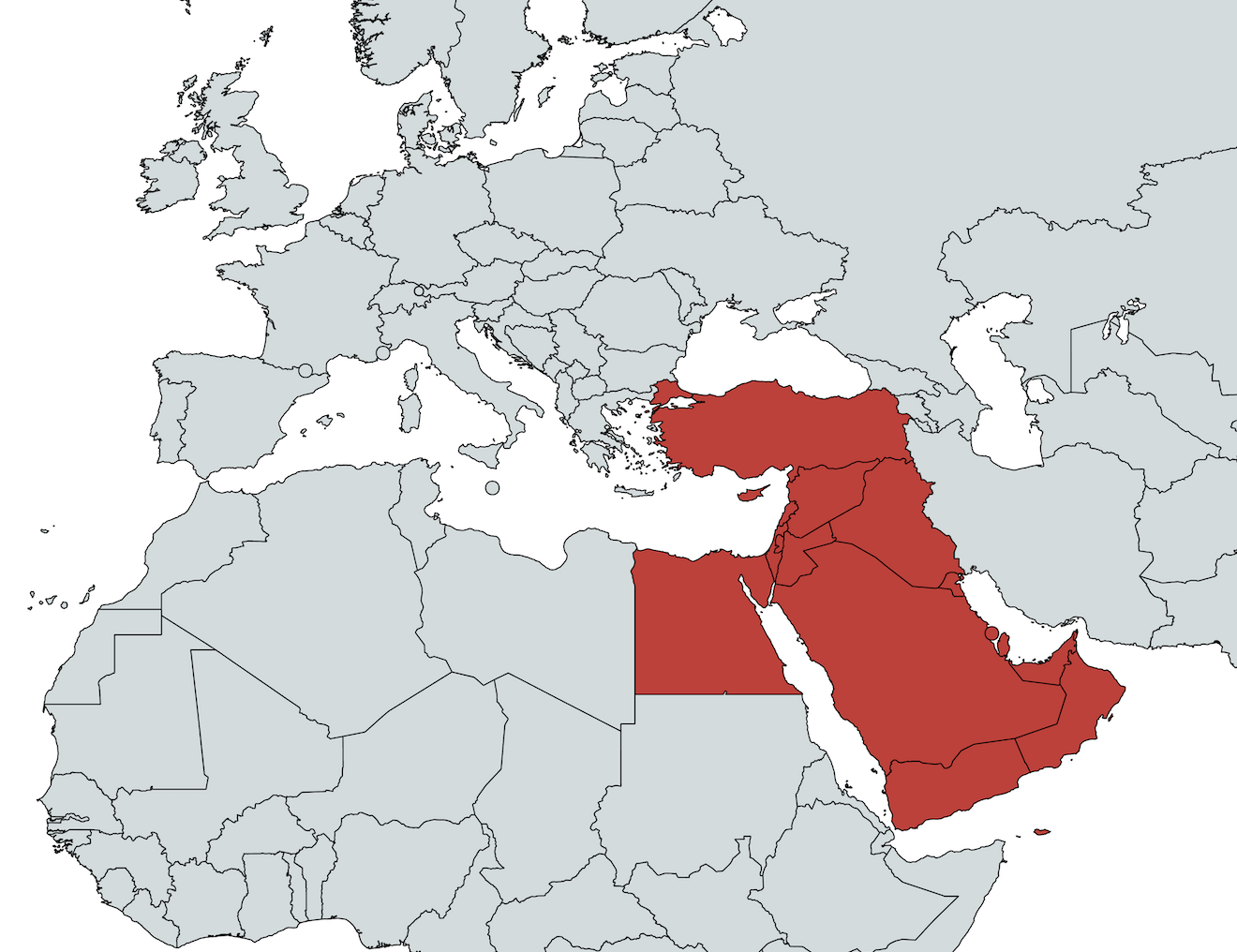
The Abraham Accords were not only a diplomatic breakthrough. They were the first clear sign that the region long called the “Middle East” had begun to outgrow the map that gave it that name.
“Middle East” was never a native geography. It was a strategic term inherited from imperial cartography, a way of describing the lands east of the Mediterranean in relation to routes to India and Asia. It viewed the region from the outside. It fused the Levant, Arabia, Iraq, the Gulf, Iran and sometimes lands far beyond them into one vague theater of crisis. Its logic was distance: Europe looking east, Asia looking west, and the region itself treated as the space in between.
That map is now dying. Not because the phrase will disappear from newspapers, but because the assumptions that made it useful are collapsing.
The old Middle East rested on three premises. First, that Israel would remain largely excluded from the Arab economic system. Second, that Arabian energy would remain concentrated around the Gulf and the Strait of Hormuz. Third, that the region would be managed less as an integrated geography than as a set of crises between outside powers, oil chokepoints and unresolved wars.
The Abraham Accords broke the first premise and weakened the other two. By bringing Israel into open relations with the UAE and Bahrain, and then into wider normalization frameworks involving Morocco and Sudan, the Accords did more than create embassies. They ended the monopoly of boycott logic over Arab-Israeli geography. They made it possible to imagine Israel not as an alien enclave surrounded by rejection, but as a usable node in the region’s infrastructure, trade and security systems.
The Accords were Abrahamic in name and symbolism. Their strategic consequence is Mediterranean. Their deeper promise, however, is civilizational. They point toward the possibility that the children of Abraham need not remain organized politically around suspicion, boycott and inherited siege narratives. Cooperation among Jews, Christians and Muslims can become more than diplomatic tolerance; it can become the dawn of an Abrahamic renaissance.
That renaissance would rest on a more enlightened understanding of the shared Abrahamic inheritance carried through Moses, Jesus and Muhammad. This does not require collapsing Judaism, Christianity and Islam into one faith, nor does it ask any tradition to surrender its truth claims. It asks something more practical and more humane: that the spiritual progeny of Abraham learn to build together rather than merely remember together, grieve together or fight one another through inherited categories.
In that sense, the Med East is not simply a new geopolitical label. It is the political geography of a possible neo-Enlightenment. The old Middle East asked the world to manage conflict among religious civilizations. The Med East asks those civilizations to construct a common future through ports, railways, energy grids, universities, technology ecosystems, tourism routes and institutions of mutual recognition. The Abraham Accords were Abrahamic in symbolism; the Med East is what they become when that symbolism is translated into geography.
The Med East is not a branding exercise. It is the name for a different geography emerging east of the Mediterranean. It begins with the fact that Arabia is not merely a peninsula. Arabia is the great arid desert basin stretching from the eastern Mediterranean and Syrian steppe through Iraq, the Arabian Peninsula, the Gulf, the Red Sea and the Arabian Sea. The Levant, Iraq, the GCC states and Yemen are not disconnected theaters. They are parts of one lowland system historically linked by caravan routes, ports, pipelines, trade corridors and desert ecologies.
For decades, that system was trapped in the vocabulary of the Middle East. The result was fragmentation. The Levant was treated as one crisis zone, the Gulf as another, Iraq as a buffer, the Red Sea as a separate theater, and Israel as an exceptional military frontier. The physical geography that connects them was obscured by the political geography that divided them.
The Abraham Accords made a different map thinkable. Once Arab states normalized with Israel outside the old formula of comprehensive Arab-Israeli settlement first, Israel’s role changed. It could no longer be understood only as a fortress state. It became a potential western outlet for Arabia into the eastern Mediterranean.
That is the key to the Med East. Israel sits at the natural western aperture of the Arabian desert system. Haifa, Ashdod and associated transport corridors could connect Arabian energy, rail freight, electricity, data infrastructure and investment flows to Mediterranean terminals and European markets. Israel’s importance in this framework is not merely military. It is geographic.
The strategic necessity is clear. Arabia remains dangerously dependent on the Strait of Hormuz. In 2024, roughly one-fifth of global petroleum liquids consumption flowed through that narrow passage. A crisis around Iran therefore threatens not only Gulf exporters, but global energy prices, shipping insurance, Asian industrial security and European inflation. A serious regional order cannot depend on one vulnerable chokepoint.
The answer is not war with Iran. It is redundancy. Arabia needs multiple exits: south toward the Arabian Sea, west through the Red Sea, and northwest toward the Mediterranean. Saudi Arabia’s East-West pipeline and infrastructure at Yanbu, the UAE’s Fujairah route outside Hormuz, and Iraq’s Development Road ambitions all point in this direction. But without a stable Mediterranean anchor, these routes remain partial. Israel gives the system that anchor.
This is why the India-Arabia-Europe Corridor matters. Announced in 2023, this is the first major infrastructure concept to express the Med East logic openly. It links India to Arabia, and Arabia to Europe, with rail, ports, electricity cables, digital connectivity and clean hydrogen infrastructure running through the UAE, Saudi Arabia, Jordan, Israel and Europe. Its map says “Med East.”
That Corridor cannot be separated from the Abraham Accords. Without normalization, an Arabian-to-Mediterranean corridor through Israel is a fantasy. With normalization, it becomes a strategic option. The Accords are therefore not merely one diplomatic file among many. They are the political precondition for corridor geography.
This also explains why Saudi Arabia is central. Saudi-Israeli normalization would not simply add one more state to the Abraham Accords. It would complete the architecture. Saudi Arabia is the land bridge between the Gulf, the Red Sea and the Levant. The UAE is the Indian Ocean-facing commercial platform. Bahrain is the Gulf financial node. Jordan is the overland hinge. Israel is the Mediterranean outlet. Morocco gives the framework an Atlantic and western Mediterranean dimension. Together, these pieces point toward a post-Middle East regional order based less on ideological solidarity and more on physical connectivity.
But this is not an argument for bypassing Palestinians. It is the opposite. The Gaza war has shown the limits of normalization without a credible Palestinian horizon. No durable Med East can be built over Palestinian humiliation, statelessness or economic suffocation. A corridor that links Gulf capital to Israeli ports while leaving Palestinians trapped in permanent precarity would not create stability. It would place resentment beneath the infrastructure.
For the Med East to be real, Palestinians must be incorporated into the emerging geography through dignity, sovereignty, mobility, investment and credible political settlement. Economic geography cannot replace justice. But it can alter the incentives that make justice possible. A region linked by ports, grids, railways, tourism, universities, technology and energy systems has more to lose from permanent conflict than a region defined only by borders and grievances.
The same is true spiritually. An Abrahamic renaissance that excludes Palestinians would betray its own premise. If the shared inheritance of Abraham means anything politically, it must include Palestinian dignity alongside Israeli security and Arab sovereignty. The neo-Enlightenment promised by the Med East cannot be a public relations language for old exclusions. It must be a wider moral architecture in which cooperation becomes a path toward justice rather than a substitute for it.
The old Middle East was the geography of confrontation. The Med East must be the geography of settlement.
That is why the death of the Middle East should not be misunderstood. It does not mean the death of peoples, cultures, religions or states. It means the death of an external and conflict-driven category. The Middle East was a map of distance and dependency. The Med East is a map of adjacency and integration.
The Abraham Accords are the hinge between the two. They did not solve every dispute. They did not end the Palestinian question. They did not abolish Iranian power or erase Arab suspicion of Israel. But they exposed the inadequacy of the old map. They showed that Israel and parts of the Arab world could move from rejection to connection, and that connection could take physical form through corridors, ports, grids and supply chains.
They also showed something more profound: that the Abrahamic traditions can be summoned not only as memories of division, but as sources of renewal. The shared progeny of Abraham, expressed through the traditions of Moses, Jesus and Muhammad, can lend a hand to a more enlightened political imagination. In a century marked by civilizational anxiety, sectarian suspicion and technological dislocation, that possibility matters far beyond the region itself.
The twenty-first century will not be shaped only by armies and treaties. It will be shaped by infrastructure: rail links, pipelines, electricity interconnectors, data cables, ports, logistics chains and energy routes. But infrastructure alone is not enough. Corridors require trust. Ports require peace. Markets require law. Shared prosperity requires a moral vocabulary capable of persuading peoples that cooperation is not betrayal.
That is the larger meaning of the Med East. It is a corridor system, but it is also a civilizational proposition. If the Abraham Accords mature from normalization agreements into a regional architecture, they could mark the dawn of a neo-Enlightenment for the entire world: a demonstration that religious civilizations once treated as locked in permanent rivalry can become partners in material renewal, political settlement and human dignity.
The Middle East framework encourages fragmentation and dependency. The Med East framework encourages connectivity, redundancy and renaissance. The Abraham Accords are the moment the old framework began to lose its authority. The Med East is what comes after.