
Middle East Analyst
The Debate Over AI Intelligence Systems Misses the Point
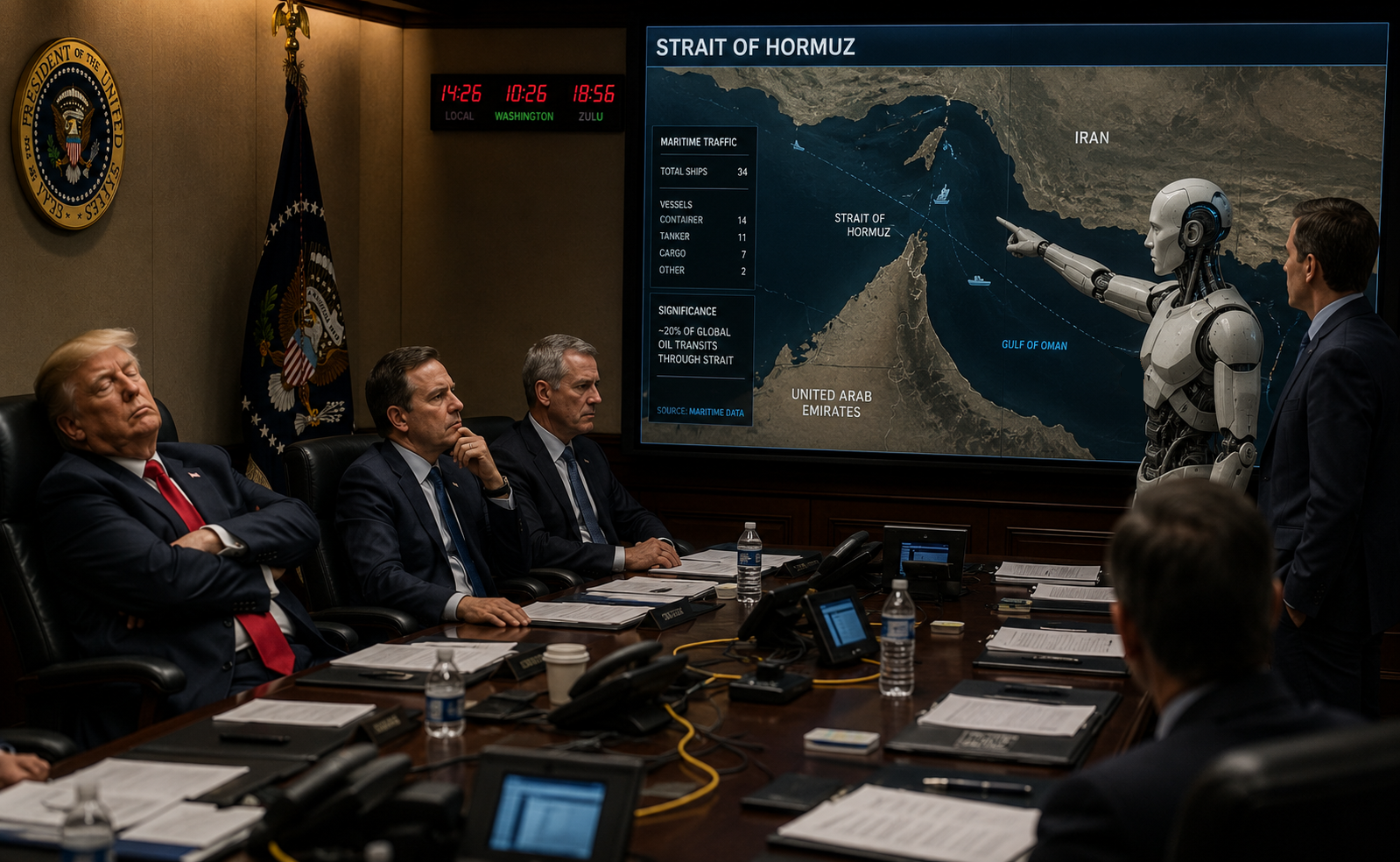
by author (AI)
A Technology Problem That Is Not a Technology Problem
In boardrooms, legislative chambers, academic journals, and newspaper opinion pages, the debate about artificial intelligence is almost entirely framed as a debate about artificial intelligence. We argue about model alignment, guardrails, training data, compute governance, and autonomous weapons. We convene summits and publish white papers. We task regulators with understanding systems that even their architects cannot fully explain — because the emergent properties of large AI systems genuinely surprise the people who build them. The conversation is technically rigorous, yet strategically blind. It is focused, with great sophistication, on the wrong thing.
The core danger of artificial intelligence is not artificial intelligence. It is us. More precisely, it is the profound and widening gap between the velocity of our technological evolution and the maturity of our political and institutional capacity to govern it. Until that gap is honestly acknowledged and deliberately addressed, every technical safeguard, every regulatory framework, and every ethical guideline will remain an impressive structure built on sand.
The Amplifier Problem
Artificial intelligence does not originate decisions. It amplifies the decisions of the humans who deploy it — and critically, it collapses the time those humans have to recognize and correct their mistakes. This is not a temporary limitation awaiting a technical fix. It is the defining characteristic of every powerful technology humanity has ever produced. The printing press amplified both the Reformation and the propaganda of tyrants. Industrial weaponry amplified both the defense of democracies and the ambitions of fascism. Nuclear technology amplified both the potential for deterrence and the possibility of civilizational extinction.
AI is not different in kind. It is different in degree — and the degree is significant. A system capable of synthesizing vast intelligence streams, compressing decision cycles, identifying patterns invisible to human analysts, and executing at machine speed will amplify whatever judgment sits at the top of the chain of command. Sound judgment becomes more effective. Poor judgment becomes catastrophic faster, with less opportunity for the institutional friction that has historically allowed course correction before consequences become irreversible.
Think of it this way: AI is a power steering system attached to a vehicle with a broken driver. The steering is extraordinarily responsive. The problem is not the steering.
Consider the deeper irony embedded in our current moment: we are constructing super-analysts — AI systems of extraordinary perceptivity and synthesis — at precisely the historical moment when we have never been more institutionally prone to ignoring the human analysts we already have. The problem is not that AI might someday override sound human judgment. The demonstrable, present-tense problem is that sound human judgment is in scarce supply at the level where it matters most.
The Lag That Threatens Everything
Humanity has always suffered from a lag between technological capability and political wisdom. We have generally survived it — though not without enormous cost — because previous technological inflection points allowed time, however brutal, for adaptation. The century of religious warfare that followed the printing press eventually produced frameworks for pluralism. Two world wars produced the United Nations, arms control treaties, and international humanitarian law. The Cold War’s nuclear standoff produced deterrence doctrine and crisis management protocols through decades of painful learning.
The pace of artificial intelligence development may not allow that adaptation window. What we face now is less a policy gap than a race between machine velocity and institutional decay. The technology is advancing faster than the institutions designed to govern it can comprehend, let alone regulate. More troublingly, it is advancing at precisely the moment when those institutions are most degraded.
Public trust in government has collapsed — not along partisan lines, but across them. Polling consistently shows that citizens of democracies worldwide share a deep and widening skepticism that their governments are capable of managing complex challenges competently or honestly. This is not merely a perception problem. Confidential CIA assessments recently delivered to the Trump administration —reportedly concluding that Iran retained approximately 75% of its prewar missile stockpiles and could withstand the U.S. naval blockade of the Strait of Hormuz for months — were publicly contradicted by the very officials who received them, who declared instead that Iran’s military was “mostly decimated” and that the United States had effectively won. The intelligence existed. It was delivered. It was ignored in favor of a preferred political narrative. This is the environment into which we are deploying our most powerful analytical systems.
The Dangerous Distraction
The current AI safety debate, despite its genuine seriousness, functions partly as a distraction from the prior and harder problem. We debate model guardrails while ignoring whether the humans empowered to override those guardrails possess any. We design oversight frameworks while the institutions that would implement them are being hollowed out. We publish ethics guidelines in an environment where ethical accountability in public life has become genuinely optional.
The specific controversy surrounding AI contracts with the military and intelligence community makes this visible with unusual clarity:
One AI company declined to agree to terms permitting its technology to be used for autonomous weapons or mass domestic surveillance without human oversight. It was designated a supply chain risk — a label historically reserved for companies affiliated with foreign adversaries — and replaced by competitors willing to accept far broader terms. The technical debate about what the AI could or could not do was rendered nearly irrelevant by the political decision about what humans were authorized to instruct it to do.
The guardrail question was always a human governance question — a crisis of agency masquerading as a crisis of algorithms. The AI was almost incidental.
The Only Sequence That Has a Chance
When confronted with an overwhelming problem that appears to have no solution, the discipline of intelligence work demands a specific response: define the problem accurately, resist the temptation to address symptoms, and set achievable priorities in the right sequence. Applying that discipline here produces an uncomfortable but clarifying conclusion.
The technology will advance with or without our blessing. No regulatory body will stop it. No international agreement will halt it. Attempting to govern AI before governing ourselves is not merely ineffective — it is a misallocation of the limited political energy and public attention available for these problems. The achievable priority is not better AI. It is better governance.
This means rebuilding the institutional independence of scientific and intelligence advisory functions, so that expert analysis reaches decision makers honestly and retains some protection from political subordination. It means establishing narrow cross-partisan consensus on genuine absolute limits — what might be called the Mutually Assured Destruction of Truth: even adversaries agree on a map when both are standing in a minefield. It does not require trust or goodwill. It requires only the shared recognition that some failures are too catastrophic to risk, regardless of which side triggers them.
It means investing seriously in civic and technical literacy so that democratic publics can hold leaders accountable for catastrophic failures of judgment on technological questions. And it means demanding, loudly and persistently, that the people making decisions about AI deployment be held to at minimum the same standards of scrutiny, accountability, and ethical constraint that we apply to anyone else granted access to extraordinarily powerful and dangerous tools.
The Only Realistic Hope
None of this is reassuring. The obstacles to managing artificial intelligence responsibly are not primarily technical. They are political and civilizational — which means they are harder, slower, and less amenable to the kind of elegant engineering solutions that the technology industry favors. There is no algorithm for institutional trust. There is no model update that produces wisdom in a political leader. There is no training run that generates the kind of patient, humble, evidence-responsive judgment that consequential decisions require.
The honest assessment is that this may be too late. The race between machine velocity and institutional decay may already be lost before most people have recognized it as a race. That possibility must be named and faced directly, not papered over with optimistic techno-solutionism.
And yet — there is only one approach that offers any realistic chance of success. We spend enormous energy asking how we align AI to human values. We have spent almost none asking how we align human institutions to reality. That inversion is not a footnote to the AI debate. It is the debate. The dangers of artificial intelligence cannot be successfully addressed without first rehabilitating the political systems that must ultimately govern it.
Until that resequencing happens — until the question of human institutional alignment precedes the question of machine alignment in our priorities, our funding, and our public conversation — we are not solving the problem. We are decorating it.
Related Topics
Related Posts