
Middle East Analyst
Trump’s Gaza Plan — The Only Game in Town
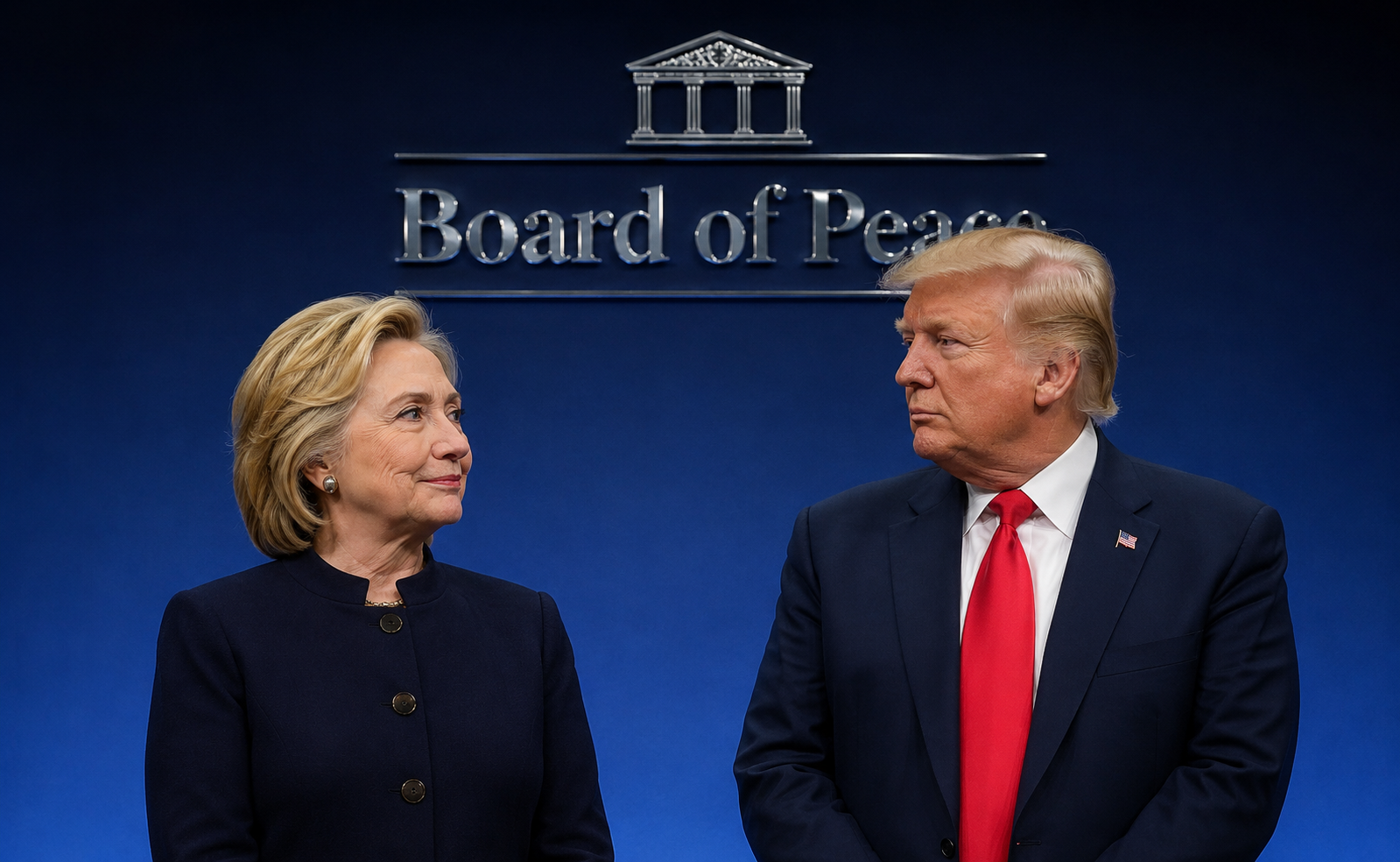
by author (AI)
Hillary Clinton is probably not the person most people expected to make one of the strongest arguments for Donald Trump’s Gaza policy.
Speaking with The New Yorker’s David Remnick at New York’s 92NY in June, the former secretary of state said Trump’s 20-point Gaza plan was “a pathway to security for Israel, reconstruction for Gaza, and the possibility of self-determination” for Palestinians. Then she delivered the line that deserves considerably more attention: “It’s the only game in town. There’s nothing else.”
Clinton was not endorsing Trump. She was making an analytical observation. And that observation has become more compelling with time. Trump’s 20-point proposal is no longer simply a Trump proposal. On November 17, 2025, the United Nations Security Council adopted Resolution 2803, endorsing the Comprehensive Plan to End the Gaza Conflict and authorizing the institutional mechanisms designed to implement it. The vote was 13-0, with Russia and China abstaining. In other words, the United Nations did not produce a competing Gaza plan. It effectively took Trump’s plan and gave it an international mandate. That distinction is now central to understanding where Gaza stands.
From Trump’s Plan to a UN Mandate
Resolution 2803 incorporates the Trump plan as its framework. It welcomes the establishment of the Board of Peace and authorizes an International Stabilization Force for Gaza. It provides for transitional governance, reconstruction, security, demilitarization and, ultimately, the return of Palestinian governance under specified conditions. The resolution is therefore much more than another Security Council call for a ceasefire. It is an attempt to answer the question that has defeated every previous Gaza initiative:
What happens the day after the war?
The answer is remarkably comprehensive. Gaza is to become a demilitarized and terror-free territory. Hamas is to be disarmed. An international stabilization force is to help provide security. A technocratic Palestinian administration is to oversee Gaza’s transition. Reconstruction is to proceed. The Palestinian Authority is expected to undertake reforms. And after those conditions are met, the plan contemplates a credible pathway toward Palestinian self-determination and statehood. That last element is particularly important because it is now becoming the central point of Israeli resistance.
Point 19 of the plan says that once Gaza’s redevelopment has advanced and the Palestinian Authority’s reform program has been faithfully carried out, “the conditions may finally be in place for a credible pathway to Palestinian self-determination and statehood.” Point 20 then calls for a U.S.-established dialogue between Israel and the Palestinians to establish a political horizon for peaceful coexistence. Those provisions were not added by critics of Israel. They are part of the plan that became Resolution 2803.
A Remarkable International Consensus
There is another reason Clinton’s “only game in town” observation matters. The plan has acquired an unusually broad international constituency. The Security Council endorsed it. The Palestinian Authority has accepted the framework. Major Arab and Muslim states backed the diplomatic effort that produced the resolution, and the Organization of Islamic Cooperation has supported implementation of the UN-backed framework. European governments have also supported the Security Council resolution and the broader objective of a Gaza transition, even while objecting to the way Trump subsequently structured the Board of Peace.
This is important because Gaza has spent decades producing diplomatic initiatives that were supported by one constituency and rejected by another. Resolution 2803 is different. It has a UN mandate and broad Arab and Muslim diplomatic support. It also has European support for the underlying international framework. That does not mean every government agrees with every provision. It means that the international community has, for once, converged around an identifiable architecture. There is no comparable European plan. There is no separate Arab League plan. There is no alternative OIC plan. There is no competing Israeli plan for the political future of Gaza. And there is no separate Palestinian plan that has the international machinery and resources required to implement it. That is what makes the phrase “only game in town” more than rhetoric.
Israel’s Dilemma
Israel initially welcomed Resolution 2803 because its security provisions aligned closely with Israel’s fundamental requirements: Hamas disarmament, demilitarization, deradicalization and an international force capable of helping secure Gaza. But the political provisions are harder. Israel subsequently rejected Point 19’s reference to a credible pathway toward a demilitarized Palestinian state. That creates a fundamental contradiction. Israel cannot easily accept Resolution 2803 as the mechanism for achieving the security objectives it wants while rejecting the political destination contained in the same resolution. The plan is deliberately constructed as a sequence: disarmament, stabilization, reconstruction, Palestinian reform, and then a credible political pathway.
Israel is entitled to question whether Palestinian reforms will be sufficient. It is entitled to insist that Palestinian statehood cannot be automatic. It can demand stringent security guarantees and verification. But rejecting the very possibility of the political endpoint changes the character of the plan. The issue is therefore not simply whether Point 19 is acceptable to Israel. The larger question is whether Israel can accept the international architecture of Resolution 2803 while refusing one of its central political objectives.
Trump Complicated His Own Plan
Israel, however, is not the only obstacle. Trump himself complicated implementation by transforming the Gaza mechanism into something considerably broader than the UN-mandated architecture. The Board of Peace was initially conceived as part of the Gaza plan. But Trump’s subsequent charter gave the organization a much wider and more ambitious role. European governments objected to what they regarded as an insufficiently multilateral institution, questions about its funding and governance, and the degree of personal authority Trump appeared to exercise over it.
Several major European countries declined to participate. France, Germany, Spain and others were reluctant to join an institution they viewed as inadequately connected to the UN system. Spain’s prime minister explicitly cited multilateralism, international law and the UN system in explaining Madrid’s decision. This was not a matter of European opposition to helping Gaza. It was opposition to the vehicle Trump created for doing it. That distinction matters. The Europeans had supported the underlying international objective. What they resisted was what some regarded as a Trump power grab: an institution whose authority and mission extended beyond the relatively narrow Gaza mandate authorized by the Security Council.
The result was predictable. Without the participation of major Western donors, the Board faced a serious funding and legitimacy problem. A mechanism designed to mobilize enormous resources for reconstruction was struggling to mobilize the political coalition required to provide them. Trump had, in effect, taken the international legitimacy he had obtained through Resolution 2803 and placed it inside an institution that some of the very governments needed to make the plan work did not trust.
Then Came the Iran War
And then the Iran war made an already difficult situation dramatically worse. The International Stabilization Force was supposed to be one of the critical bridges between the end of the war and implementation of Phase II. But its success depended heavily on Muslim-majority participation and on governments being willing to associate themselves publicly with a U.S.-backed security operation in Gaza. The war with Iran changed those political calculations. Indonesia, which had pledged a substantial contingent, suspended its commitment after the U.S.-Israeli attack on Iran. Other troop commitments also stalled. AP reported that none of the initial pledging countries had deployed substantial forces and that the Iran conflict had undermined Arab and Muslim cooperation with Washington and Jerusalem.
The consequence is larger than the fate of the ISF itself. Without a credible stabilization force, Phase II cannot function as designed. Without Phase II, reconstruction becomes harder. Without reconstruction and governance reform, the conditions for Palestinian political transition cannot develop. And without that transition, Point 19 remains theoretical. The Iran war therefore did not simply distract Washington from Gaza. It damaged one of the institutional mechanisms through which Trump’s Gaza plan was supposed to become reality.
But Where Is the Alternative?
This brings us back to Hillary Clinton. The remarkable thing about the failure to implement the plan is not that it has encountered obstacles. Of course it has. Israel objects to the political destination. Europe objects to Trump’s expanded institutional framework. The Arab and Muslim states face domestic political constraints. The Board of Peace has struggled with funding and legitimacy. The International Stabilization Force has struggled to assemble. And the Iran war has disrupted virtually every regional calculation on which the Gaza architecture depended. But none of those obstacles has produced an alternative. That is the uncomfortable reality. The international community has spent decades demonstrating its ability to describe what it wants Gaza to become. It has been much less successful at constructing a mechanism capable of getting there.
Trump’s plan, whatever its flaws, actually attempts to do that. It links security to reconstruction. It links reconstruction to governance. It links governance to Palestinian reform. And it links those reforms to a possible political horizon. One can argue about the sequencing. One can argue about who should administer Gaza. One can argue about the composition of the stabilization force, the role of the Palestinian Authority, the powers of the Board of Peace and the meaning of “credible pathway.” Those are legitimate arguments. But they are arguments about how to implement or modify the plan. They are not an alternative to the plan.
The Choice Nobody Wants
That may ultimately be the central dilemma. Trump’s Gaza plan has been undermined in part by Israel, in part by Trump himself, in part by European resistance to his institutional ambitions, and now by the consequences of the Iran war. Yet the collapse of the implementation machinery has not caused the international community to converge around another framework. It has simply left Gaza waiting. That is why Clinton’s phrase deserves to be taken seriously.
“The only game in town” does not mean the game is good. It does not mean Trump has solved Gaza. It does not mean Israel should accept every provision without negotiation, or that Palestinians should accept the plan without demanding meaningful political guarantees. It means something much simpler. There is currently no other plan with a comparable combination of American power, UN authorization, Arab and Muslim support, European engagement, a security mechanism, a reconstruction mechanism and a stated pathway toward Palestinian self-determination.
Trump’s Gaza plan is therefore no longer merely Trump’s plan. It is the international framework that the Security Council endorsed. The real question is no longer whether everyone likes it. The real question is whether the parties can stop undermining the only framework they have—and find a way to make it work.
Related Topics
Related Posts