
CEO of Time to Stand Up for Israel
The Decline of the Western World, or Is It the End of the World?
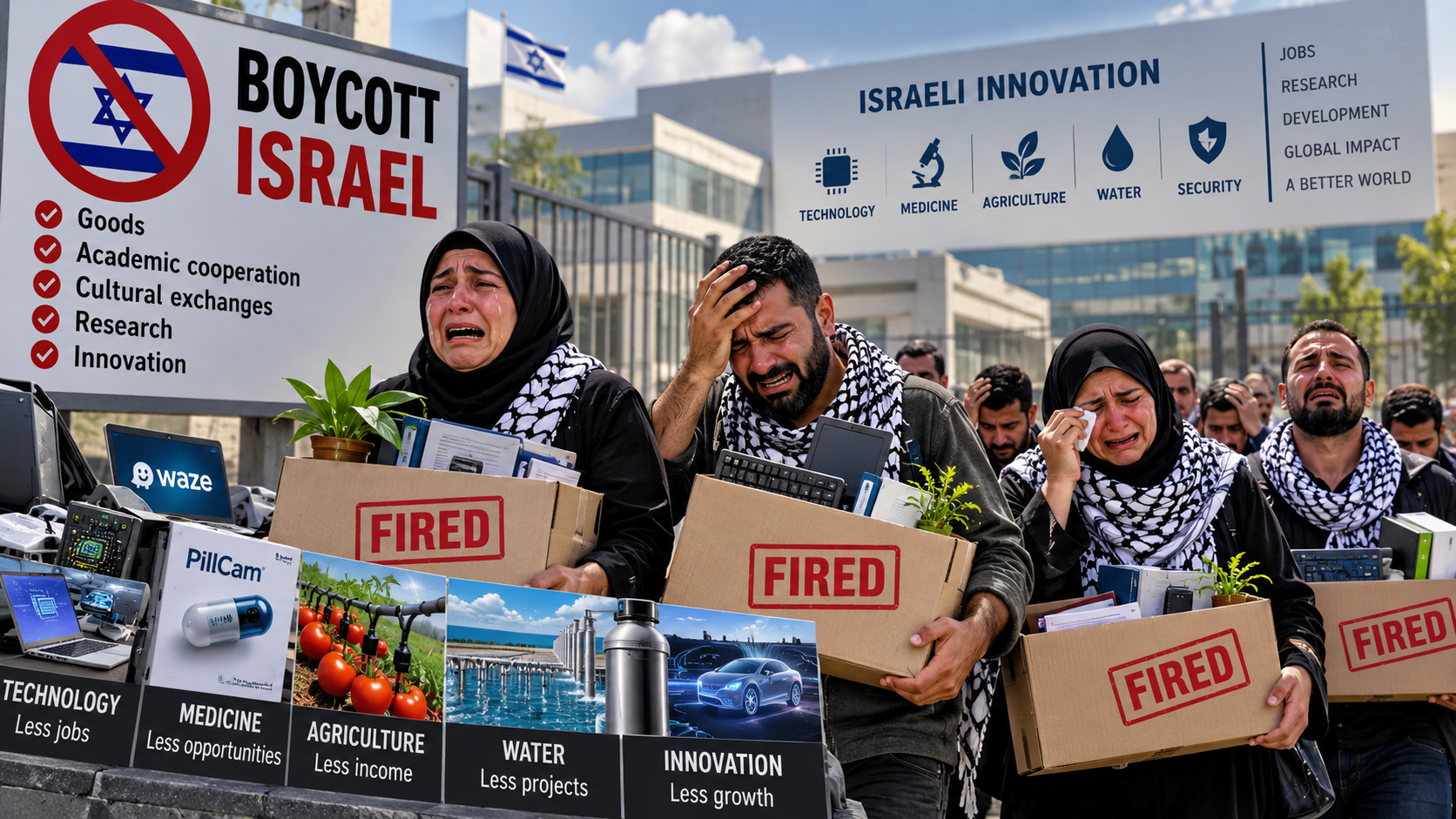
Photo Credits: Sabine Sterk ( AI)
There are moments in history when change happens gradually, almost invisibly, and there are moments when you can actually feel the foundations of society shifting beneath your feet. Looking at the world today, at the wars, the polarization, the erosion of critical thinking, the growing hostility toward Jews and Israel, and the willingness to isolate knowledge because of where it comes from, I increasingly wonder whether we are merely witnessing the decline of the Western world or something much more profound.
Some religious people look at today’s developments and speak about the End Times. I am not going to predict the end of the world, but I understand why people feel that something fundamental has changed.
Israel suffered the horrific terrorist attacks of October 7, 2023, yet much of the international conversation subsequently shifted away from the Israelis who were murdered, kidnapped and traumatized and toward condemnation of Israel’s military response. Israel argues that it is fighting terrorism and seeking to prevent another October 7, while critics argue that the scale and conduct of the war have inflicted unacceptable suffering on Palestinian civilians. Whatever position people take on Israeli government policy, one reality should not disappear from the discussion: Hamas carried out the October 7 attacks, and no lasting peace can be genuinely safe while organizations committed to terrorism retain the ability to repeat them.
Terrorism cannot become an accepted political instrument. Peace that merely postpones the next massacre is not peace.
Meanwhile, something else is happening in Europe that deserves far more scrutiny.
Since September 22, the Netherlands has prohibited the import, purchase and sale of goods originating from Judea&Samaria and the Golan heights, that the Dutch government regards as occupied, while also prohibiting services facilitating such trade and attempts to circumvent those restrictions.
The Dutch government presents this as an implementation of its interpretation of international legal obligations concerning these areas. I see something very different in its consequences. I see another step toward a world in which Israel is increasingly separated economically, culturally and intellectually from countries that have benefited enormously from Israeli knowledge.
The question therefore becomes much larger than whether someone agrees with settlements in Judea and Samaria, opposes them, supports a two state solution or rejects one.
What happens when boycotting Israel becomes normalized?
What happens when the boycott moves from particular products to universities, researchers, cultural institutions, scientists and eventually ideas themselves?
This is where I believe the Western world is playing a remarkably dangerous game.
For years people have complained about declining educational standards and diminishing critical thinking, not only in the Netherlands but throughout the Western world. At exactly the moment when we need universities to become more intellectually curious, more rigorous and more willing to expose students to uncomfortable arguments, we increasingly see demands to exclude people and institutions because of nationality and politics.
Academic boycotts are particularly disturbing because universities are supposed to exist for precisely the opposite purpose.
Knowledge should cross borders.
Science should cross borders.
Medicine should cross borders.
Ideas should cross borders.
A university that refuses knowledge because the researcher producing it is Israeli has not defeated Israel. It has defeated the principle upon which a university should be built.
The absurdity becomes even clearer when we consider how deeply Israeli research and entrepreneurship have contributed to modern life. Israeli researchers, engineers and companies have played important roles in cybersecurity, computer storage, navigation, medical imaging, mobility technology, agriculture, water management and assistive technology.
M Systems helped pioneer USB flash storage. Check Point became an important name in cybersecurity. Waze transformed everyday navigation before being acquired by Google. Mobileye became a major force in advanced driver assistance technology. Given Imaging developed the PillCam, allowing physicians to examine parts of the digestive system through a swallowable camera. ReWalk developed robotic exoskeleton technology for people with lower limb disabilities. Israeli research contributed to medicines such as Copaxone and Doxil, while OrCam developed assistive technology designed to help visually impaired people interact more independently with their surroundings.
Agriculture provides another extraordinary example.
Israel is a country in which water scarcity forced scientists, farmers and engineers to think differently, contributing to major advances in drip irrigation, desalination, wastewater recycling and agricultural technology. These developments did not remain inside Israel’s borders. Knowledge travels, and humanity benefits when it does.
That is exactly why the growing obsession with boycotts concerns me so deeply.
Of course, refusing an Israeli product tomorrow will not suddenly make computers disappear, cancer treatments vanish or navigation systems stop functioning, and it would be intellectually dishonest to claim otherwise. The danger is more subtle and therefore, in my opinion, much greater.
If political disagreement becomes justification for severing scientific cooperation, researchers stop exchanging knowledge. If universities decide that nationality determines whether collaboration is acceptable, potentially valuable research partnerships disappear. If companies are increasingly pressured to exclude Israeli technology, innovation becomes subordinate to ideology. If cultural institutions decide that Israeli artists are unacceptable because of their passport, art becomes another battlefield.
That is not progress.
It is intellectual retreat.
The irony is that many of the people demanding isolation of Israel continue using technologies that emerged from Israeli companies and research environments, benefit from medical advances involving Israeli scientists and live in societies whose cybersecurity, agriculture, mobility and healthcare have all been influenced by Israeli innovation.
You cannot build a better world by systematically narrowing the exchange of knowledge.
There is another development that concerns me equally: the way younger generations increasingly consume history through algorithms, social media and artificial intelligence.
Artificial intelligence can provide extraordinary access to information, but it is not an oracle. AI systems are trained on enormous quantities of human generated material, which means they can reproduce errors, disputed assumptions and biases contained in those sources. Social media algorithms create an additional problem because popularity and repetition can easily be mistaken for truth.
Students therefore need more critical thinking, not less.
They need to understand the complicated history of the British Mandate, the Ottoman period, Jewish communities throughout the region, Arab nationalism, Zionism, the wars following Israel’s establishment, Palestinian nationalism, terrorism, diplomacy and the repeated attempts at resolving the conflict. They should encounter competing historical interpretations and learn how to evaluate primary sources rather than being taught that a slogan is an adequate substitute for history.
Instead, we increasingly reward certainty without knowledge.
That may ultimately be the most dangerous boycott of all: the boycott of intellectual curiosity.
October 7 should have reminded the world what happens when extremist ideology is underestimated. The wars and upheavals surrounding us should remind Europe that stability is not guaranteed, democracy is not indestructible and civilization does not automatically move forward simply because we live in the twenty first century.
Progress can reverse.
Knowledge can disappear.
Tolerance can deteriorate.
Antisemitism can return in new language while carrying ancient prejudices.
Universities can stop educating and start indoctrinating if ideological conformity becomes more important than intellectual freedom.
The decline of civilizations rarely begins with everyone announcing that they have chosen decline. It begins when societies gradually abandon the principles that made them successful, when emotion becomes more powerful than evidence, when ideological loyalty replaces curiosity, when people become afraid to question their own side and when exclusion becomes easier than discussion.
Israel will survive boycotts. Jewish history has demonstrated an extraordinary capacity for survival under circumstances far worse than anything we are witnessing today.
My greater concern is what these boycotts say about us.
The West became successful because ideas could be challenged, knowledge could travel, scientists could cooperate across borders and universities were supposed to teach people how to think rather than what to think.
If we begin dismantling those principles in the name of political righteousness, we should at least understand what we are sacrificing.
Perhaps we are not witnessing the end of the world.
But when a society starts boycotting knowledge, innovation, dialogue and critical thought, it may very well be participating in the decline of its own world.
Related Topics
Related Posts