
The Dream, The Love and the Struggle
Remember Godley & Creme?
The two talented Jewish boys who helped shape the sound of 10cc — and who, in 1976, released a song called The Things We Do for Love. Why mention that song? Read on.
Back in the mid-80s, my friend Eddie told me about his younger brother, Andy — a man who fell in love for the very first time. Head over heels. Eddie even tried talking him out of it, insisting she was out of his league, but to no avail — he could see Andy was completely swept up. Once Andy decided she was “the one,” there was no shifting him. And no wonder: she was an Italian model, the kind of woman whose presence could rearrange a man’s sense of gravity — a dream in every sense.
He quietly began reshaping himself in her image. It started small: her favourite aftershave. Then came the suits — sharp lapels, narrow cut, the style she admired. And finally, the grand gesture: he found a second-hand red Alfa Romeo — the exact model she loved — and had it fully detailed and freshly repainted so it could look far more glamorous, at least from a polite distance.
Yes, love has a way of turning perfectly sensible people into enthusiastic amateurs in personal reinvention. And all this — every scent, every stitch, every buffed and polished inch of that car — was done before they even had their first date. Yes, really.
The day arrived. Andy stepped out looking every bit the leading man in his own romantic comedy. The venue was a prestigious Italian restaurant in Central London — the sort of place where the lights are low, the waiters glide, and the pasta costs more than a week’s groceries.
He stood outside holding a bouquet of flowers. And lo, the heavens opened — it began to drizzle. With no coat, all Andy could do was smile and try to look cool.
He waited. Half an hour. One hour.
A waiter stood at the doorway, glanced at the rain, then finally stepped outside and said gently:
“Would you like to wait inside? You don’t want to be too wet for your date.”
Andy gave a nervous little chuckle and politely declined.
Two hours. He made excuses for her — traffic, a delayed train, or perhaps she’d simply misplaced a mascara wand; these things happen. By the third hour, even the flowers were drooping in empathetic defeat.
Eventually, with the dignity of a man determined not to appear crushed, Andy made his way home. His family were surprised to see him back so soon. All he could manage to say was,
“She didn’t show up.”
Eddie smiled and said, “Well… something productive came out of it.”
Andy stared. “What are you talking about? What was productive?”
“Your flowers,” Eddie said. “You did water them.”
Our age hardly has an exclusive claim to dramatic love stories.
The things we do for love — the dignity, the devotion, the risks of the heart — reach back far deeper than our own time.
In this week’s Torah portion, we meet a man whose devotion sets a standard few can match. Yaakov enters the portion not as a figure of confidence but as a fugitive, escaping his brother’s fury. Yet between two extraordinary encounters, the foundations of a nation are already beginning to form: the hidden world of his dream — a ladder, angels ascending and descending, and the promise of the land; and the revealed world he will face later, wrestling in the dark until he earns the name that will shape his descendants — Israel.
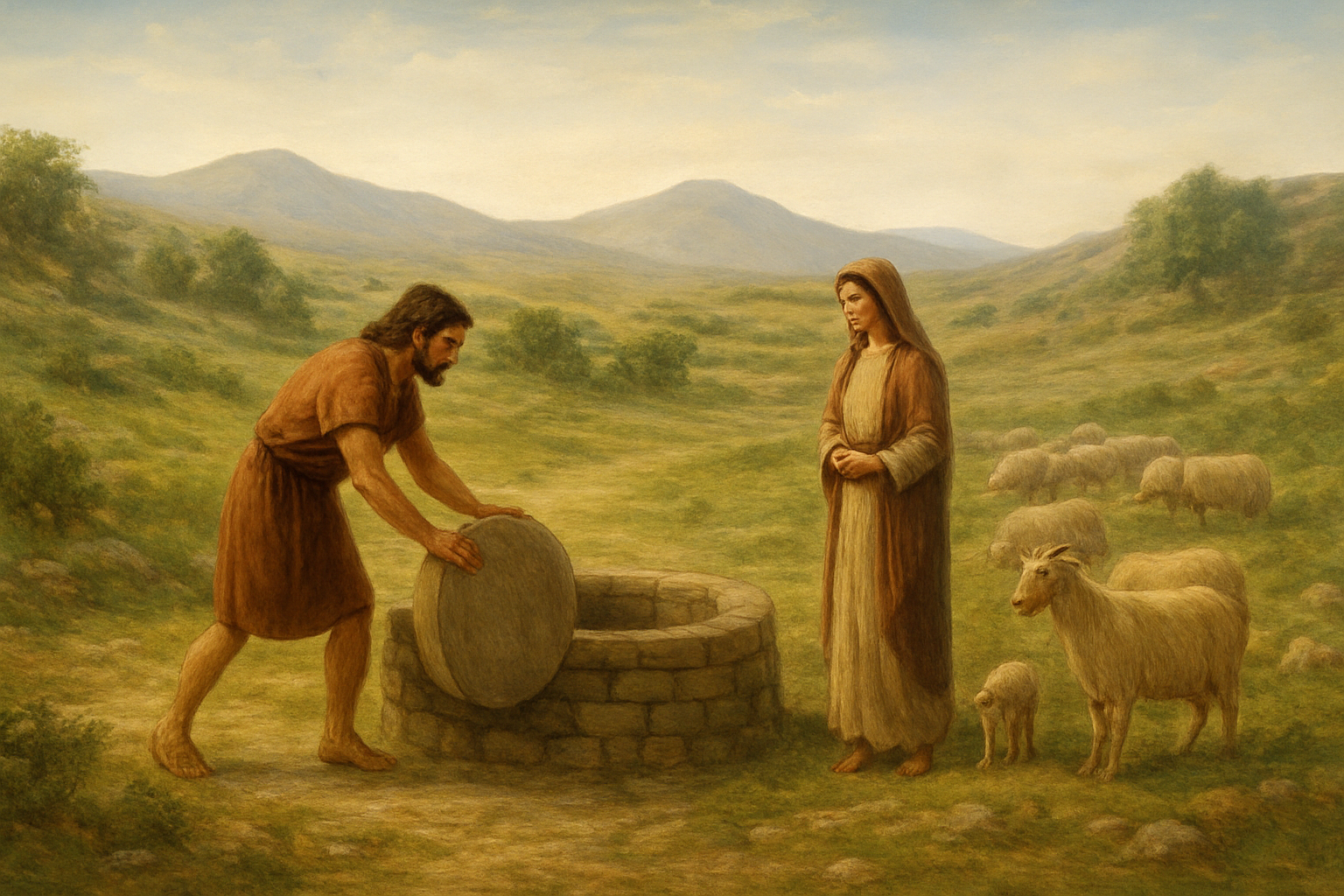
Yaakov arrives at a well, and the moment he sees Rachel, it is love at first sight.
────────────────────────────────────────────────────
 The Wellspring of Love
──────────────────────────────────────────────────── [IMG-AI]
With the strength of several men, he rolls the stone from the well, waters her flock, kisses her, and is welcomed into the family home. When Lavan later asks him to name his wages, Yaakov does not hesitate:
I will serve you seven years for Rachel, your younger daughter.
וַיֹּאמֶר יַעֲקֹב, אֶעֱבָדְךָ שֶׁבַע שָׁנִים בְּרָחֵל בִּתְּךָ הַקְּטַנָּה
(Bereshit 29:18)
And the Torah adds that these years “seemed to him like only a few days, because of his love for her.”
But love rarely follows an easy path.
On the night of the wedding, Yaakov is given a veiled bride — and in the morning discovers it was Leah. Yet he does not humiliate her or walk away. He completes the wedding week with dignity and then commits to work another seven years for Rachel.
Fourteen years of devotion — a labour of love unmatched anywhere in the Torah.
Only after this turning point — after the heartbreak, the switch, and the renewed commitment — does the deeper structure of Yaakov’s journey emerge.
The Zohar describes two worlds within Yaakov’s family: Leah embodies the hidden — alma d’itkasya — and Rachel the revealed — alma d’itgalya.
Each mother expresses her love through the names she gives her children — names that reveal her longing and her hope. These are not merely ancient family dynamics; they reflect two dimensions of spiritual life: the inner work of the soul and the outward work of action.
Among their children, three sons in particular illuminate these two worlds — two shaped by the hidden, one by the revealed.
From Leah, associated with the quiet and concealed:
Levi, representing kehuna (כְּהֻנָּה) — the priesthood, the spiritual heart of Israel.
Yehuda, embodying malchut (מַלְכוּת) — kingship, the lineage from which Mashiach will one day descend.
Their destinies unfold like a quiet river, carving their path unseen, shaping the future with patient force.
From Rachel, associated with light and immediacy:
Yosef, whose leadership embodies hanhaga (הֲנָהָגָה) and gevurah (גְּבוּרָה) — revealed guidance and moral strength.
His path shines outward, bold and visible, shaping the world through integrity and wisdom.
Yaakov’s life weaves together two forces — the inner world that grows in silence and the revealed world that demands strength. At their meeting point, destiny takes shape. And from that place of tension and transformation, his story turns toward ours.
Like Yaakov, we fled into exile, dreamed of a way forward, rebuilt again and again, and wrestled with the darkness that tried to define us. Yet the dream endured. The people endured. And in our time, we have returned home to the land that waited for us.
In the days ahead, the struggle of the ingathering will be upon us, yet we will prevail, for the path home has already begun to open.
The living waters will once again stream from Yerushalayim and through its gates, carrying love and peace across the land.
And the dream will no longer remain a dream. From the place where the heavenly ladder touched our world, a new House for the L-rd our G-d will rise.
And the light of the menorah will shine again, dispelling the darkness and unveiling the hidden radiance through which G-d’s glory will spread across the earth.
Nations shall walk by your light, and kings by the brightness of your rising.
וְהָלְכוּ גּוֹיִם לְאוֹרֵךְ, וּמְלָכִים לְנֹגַהּ זָרְחֵךְ
(Yeshayahu 60:3)
שבת שלום
שמואל