
The Fallacy of ‘A Two-State Solution’
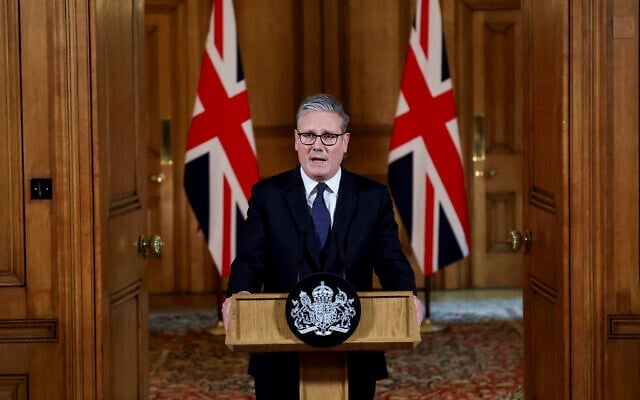
Why Starmer’s Palestinian Statehood Push is a Political Charade
Sometime when I need a good laugh, I turn to comedians. These days, some European leaders and former allies of Israel have started sounding like comedians when it comes to the issue of Palestinian statehood.
The latest comedy act came courtesy of UK Prime Minister Keir Starmer. His recent announcement that the UK will recognize a Palestinian state by September should surprise no one – he was merely playing to the gallery. Starmer knows that this announcement won’t move the needle. It is utterly meaningless.
Let me set the scene: Starmer, often labeled as the worst UK prime minister in recent memory, is desperate for Muslim votes to have any chance of winning the next general election. His political standing is so poor that polls suggest up to four members of his cabinet would lose their parliamentary seats if an election were held today. So, recognizing Palestinian statehood in this climate is nothing more than a move to gain favour with a crucial voting bloc.
But here is the kicker – Starmer’s new-found support for Palestinian statehood is based on political expediency, not a genuine pursuit of peace. It is not about justice; it is about survival in the cutthroat world of politics. The public knows this, and so does he. And in a twist of bitter irony, this gesture, coming at the cost of Israel’s security, is nothing more than a distraction from his abysmal performance as prime minister.
There is an elephant in the room that no one seems to want to talk about – the one glaring issue that proponents of the ‘two-state solution’ conveniently ignore. A ‘two-state solution’ would require Israel to give up all of Judea and Samaria, also known as the West Bank, to create a Palestinian state. And while the idea may sound appealing to some, it misses a few crucial realities that we cannot afford to overlook.
Let me start with history. Judea and Samaria are the heartland of Israel. They are home to some of the most significant historical, religious, and cultural sites in the Jewish world. Think about Hebron – this is not just any old city; it is the burial place of Abraham, Isaac, Jacob, and their wives. David set up his kingdom here, laying the foundation for Israel’s history as we know it. Shiloh, where the Tabernacle rested for 369 years, was once the center of Israelite worship, and all of Israel would gather there three times a year. Shechem is the burial place of Joseph, a site bought by Jacob himself. Then there is Bethel, the traditional place of Jacob’s dream, and Elon Moreh, where God promised the land to Abraham. There is also Sychar, closed to Jacob’s well, in Samaria, where Jesus Christ visited. These are not just ancient landmarks; they are the very essence of Israel’s identity.
But let me not stop there. Judea and Samaria are not just important because of the past – they are vital for Israel’s security. Without them, Israel would be reduced to a narrow strip of land, just 9 miles wide in places. Imagine that – Israel’s only defense would be a thin sliver of land, with the mountain ranges of Judea and Samaria providing a direct line of sight to Israel’s international airport and major cities. This territory provides strategic depth and high ground, a critical element in Israel’s defense. In a region as unpredictable as the Middle East, losing this land would be a catastrophic risk to Israel’s security.
So, here is the issue with the so-called ‘two-state solution.’ It asks Israel to give up these historically significant and strategically vital territories in exchange for the promise of peace. But peace with whom? The reality is that this plan does not address the root causes of the conflict – it simply sets Israel up for future vulnerabilities. We have seen this play out before, where land concessions have led to more aggression, not less. What is more, the Palestinian leadership, including groups like Hamas, has shown time and again that they are not interested in peace – they are interested in Israel’s destruction.
Despite Starmer’s attempts to play the diplomatic game, Israel stands resolute. The country’s resilience and renewal, despite ongoing threats from Hamas, Hezbollah, and other forces, are the real stories here. While Starmer’s announcement might grab headlines, it is Israel’s unwavering determination and innovation that will shape its future. This move by Starmer does not advance peace – it undermines the very foundation on which true progress can be built.
The two-state solution has been touted for decades, but it is clear that it is not the pathway to peace many think it is. Recognizing Palestine while Hamas still controls Gaza – and while they hold hostages – is not a step towards resolution. It is an act that rewards terror, and worse, it sets a dangerous precedent. We cannot allow violence to be rewarded with legitimacy. We cannot allow a terrorist organization to be seen as a legitimate partner in peace, especially when their actions have proven they are far from it.
Starmer’s approach is not about solving the Israeli-Palestinian conflict; it is about political maneuvering. The Palestinians, their struggles, and their dreams for self-determination are being treated as pawns in a larger geopolitical game. Starmer’s actions are reminiscent of historical attempts to negotiate with regimes that thrived on violence and terror. When we look at the world’s history, we see that real peace comes from acknowledging the legitimacy of nations, not from placating terror groups.
In his recent comments, Starmer also declared that Hamas must have no role in a future Palestinian state. This rhetoric ignores history, where groups once deemed “terrorist organizations” later transitioned into legitimate political actors – think Sinn Féin in Northern Ireland in the UK. But that is a discussion for another time. The crux of Starmer’s failure is his refusal to recognize Hamas for what they are today: a terrorist group that uses violence to further their political goals, not a partner in peace.
To put too fine a point on it, Starmer’s position is morally bankrupt. While he claims that recognizing a Palestinian state is a step towards peace, he is doing the opposite. In his rush to appease one side, he forgets the lives of those caught in the crossfire. He is turning a blind eye to the hostages still in Gaza, to the families of the victims, and to the suffering of Israeli citizens who have lived under constant threat for decades.
In fact, many of the families of the hostages still held in Gaza have condemned Starmer’s push for statehood, calling it “shameful.” Their grief and anger are palpable, and rightly so. To recognize a Palestinian state while hostages remain in Gaza, held by Hamas, is not an act of diplomacy; it is an endorsement of terror. And that endorsement sends the wrong message to the world—one that says violence and terror are acceptable tools in international relations.
The reality is that Israel has never been about simply surviving; it is about thriving. Even in the midst of a brutal war, Israel’s tech sector continues to innovate, its military remains one of the most advanced in the world, and its people have demonstrated time and time again that their resilience can turn the darkest moments into opportunities for growth and renewal.
Instead of encouraging the international community to recognize a Palestinian state without conditions, Starmer should be focusing on the need for peace negotiations that hold all parties accountable. The world must demand that Hamas release the hostages. The world must push for a peace process that is rooted in justice and not in the distorted political games played by those like Starmer who refuse to take a clear moral stance.
Israel’s future is about more than surviving political theater; it is about shaping a future where peace and innovation can coexist. Starmer’s latest stunt does not contribute to that vision. It only fuels division and perpetuates a flawed narrative. The international community needs to stop rewarding terror and instead work towards a future where Israel’s resilience can be met with global support, not empty gestures and false promises of statehood.
So, as Starmer – now joined by Canada’s equally misguided Prime Minister Carney – tries to play his cards in a game that he does not understand, Israel continues to innovate, to rebuild, and to lead. And that, my friends, is something worth betting on.