The few, the brave, the Haredim: These soldiers are heroes
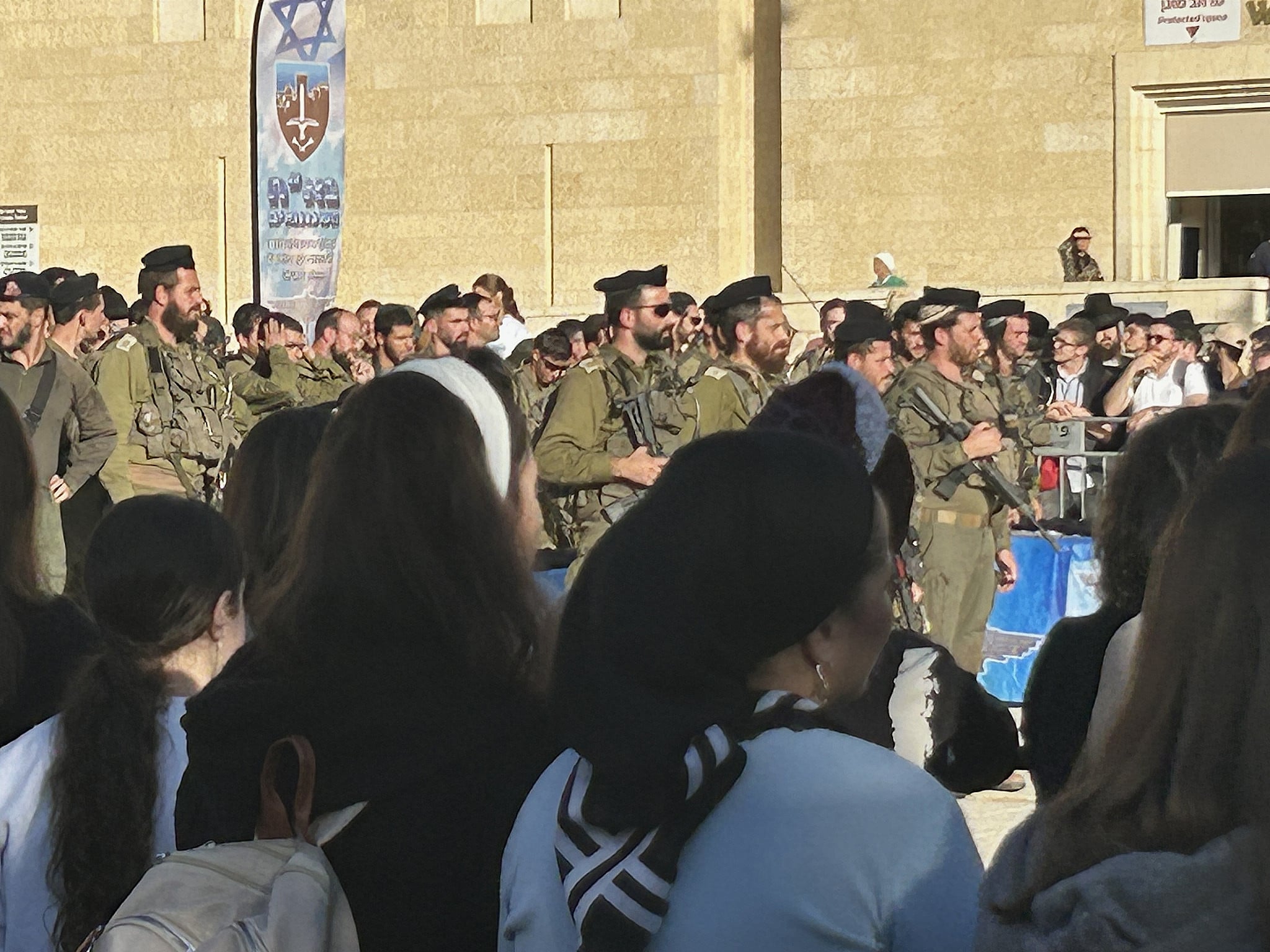
The Western Wall plaza is perhaps the most quintessentially Israeli space – a crossroads where holiness and national tension constantly collide. Thursday morning, arriving for Shacharit, the morning prayer, I witnessed that collision in sharp relief.
Before me, a large contingent of IDF soldiers stood in formation, the solemn tones of a military ceremony – the closing of a masa kumtah (‘beret march’) – filling the courtyard. I quickly realized this was no ordinary event. The soldiers, most bearded and many with full peyot (side curls), were inductees into the new Hashmonaim Brigade, an initiative designed to enable Haredi men to serve fully in the army while maintaining their religious standards. The families gathered to watch – black hats, long skirts, children with peyot – were unmistakably Haredi. Here, beneath the ancient stones, was a powerful, visible symbol of change and integration.
Yet just steps away, in the men’s prayer section, a much larger crowd of young men in the traditional black-and-white uniform of ultra-Orthodox life was gathered for their morning prayers. They were early arrivals for a mass demonstration later that day, protesting the government’s push to draft even a small share of their community – an exemption they have historically enjoyed. Their prayers were especially loud, seemingly meant to drown out the military music and speeches. It felt like a deliberate acoustic confrontation.
But amid the religious fervor and the socio-political statement, I saw something else in the black-clad crowd. Now and then, heads turned toward the soldiers, a flicker of curiosity, perhaps even admiration, crossing their faces.
This striking juxtaposition – the loud, defiant prayer and the proud army ceremony – captures Israel’s national dilemma, one made even sharper since the Hamas atrocities of October 7, 2023. The longstanding Haredi exemption from military service has created deep, festering resentment within the broader Israeli Jewish population. With reservists – many parents of young children – having served hundreds of days, and with more than 1,100 dead and countless wounded, the imbalance is no longer theoretical. It is written in blood and burden.
The creation of units like Hashmonaim is a crucial step towards mending the rift, but it is a monumental task. We must recognize the immense courage of the young men who choose this path. To break from this ingrained worldview and societal consensus requires a profound act of personal conviction and moral bravery.
Imagine the upbringing of a Haredi young man. His educational and social framework has instilled a profound conviction that his full-time devotion to Torah study is not merely a personal religious pursuit, but the ultimate spiritual defense of the Jewish people – more vital, even, than physical combat. Secular society, and by extension the army, is often portrayed in his community as toxic, a place where religious observance is compromised and modesty standards are dangerously low.
To break from this ingrained worldview and societal consensus requires a profound act of personal conviction and moral bravery. These are young men who are choosing to shoulder a national responsibility that their entire social world has educated them to shun, even to disdain. They are going against their rabbis, their parents, and their peers.
It is one thing for a secular or national-religious Israeli, raised to view army service as a supreme national value, to don a uniform. It is quite another for a young man from Bnei Brak or Me’ah She’arim to trade his black hat for an IDF beret. When these soldiers come home for Shabbat, they are not returning to parades and applause, but to an environment that is, at best, confused, and at worst, actively antagonistic to their choice.
If those of us outside the Haredi world truly want these efforts to thrive, our focus must shift. Rather than highlighting our understandable resentment at the hundreds of thousands protesting the draft, we must shout our support for the few hundred who are volunteering.
These Hashmonaim soldiers and their families are not just fulfilling a national quota; they are potential agents of change. They are modeling a new paradigm: that one can be a committed, full-fledged Haredi Jew – with the beard, the peyot, the meticulous observance and dedication to Torah study – while simultaneously being a dedicated defender of the nation. By enabling them to succeed without compromising their religious ideals, we are helping to demonstrate a way forward for the next generation of Haredim.
The highlight of my morning came when the army ceremony concluded. The soldiers dispersed, not in search of confrontation, but for prayer. They flowed into the men’s section of the Wall, quietly organizing their own public prayer service. Here was the balance embodied: their religious commitment and their national commitment, side by side.
I couldn’t resist. I went over, shook each soldier’s hand, and offered a sincere blessing: “Tizke le-mitzvot” – May you continue to merit God’s commands.
They are heroes, not despite their Haredi identity, but because of the immense internal and external challenges they have overcome to affirm it alongside their service. Let us celebrate their courage and help them succeed.