The Fight You Were Born For
Every year, when we begin the Torah again and return to the story of Adam, I go back to my childhood. For a short time, my father and I would learn talks of the Rebbe together on Shabbos afternoons. Although I don’t believe we kept it up for very long, I still remember the first Sicha we learnt, and its powerful lesson still impacts how I understand human struggles until today.
But before we get to that lesson, there is a fascinating detail about the Garden of Eden that many people have never heard. Despite the famous paintings and children’s books, the Torah never says that Adam ate an apple.
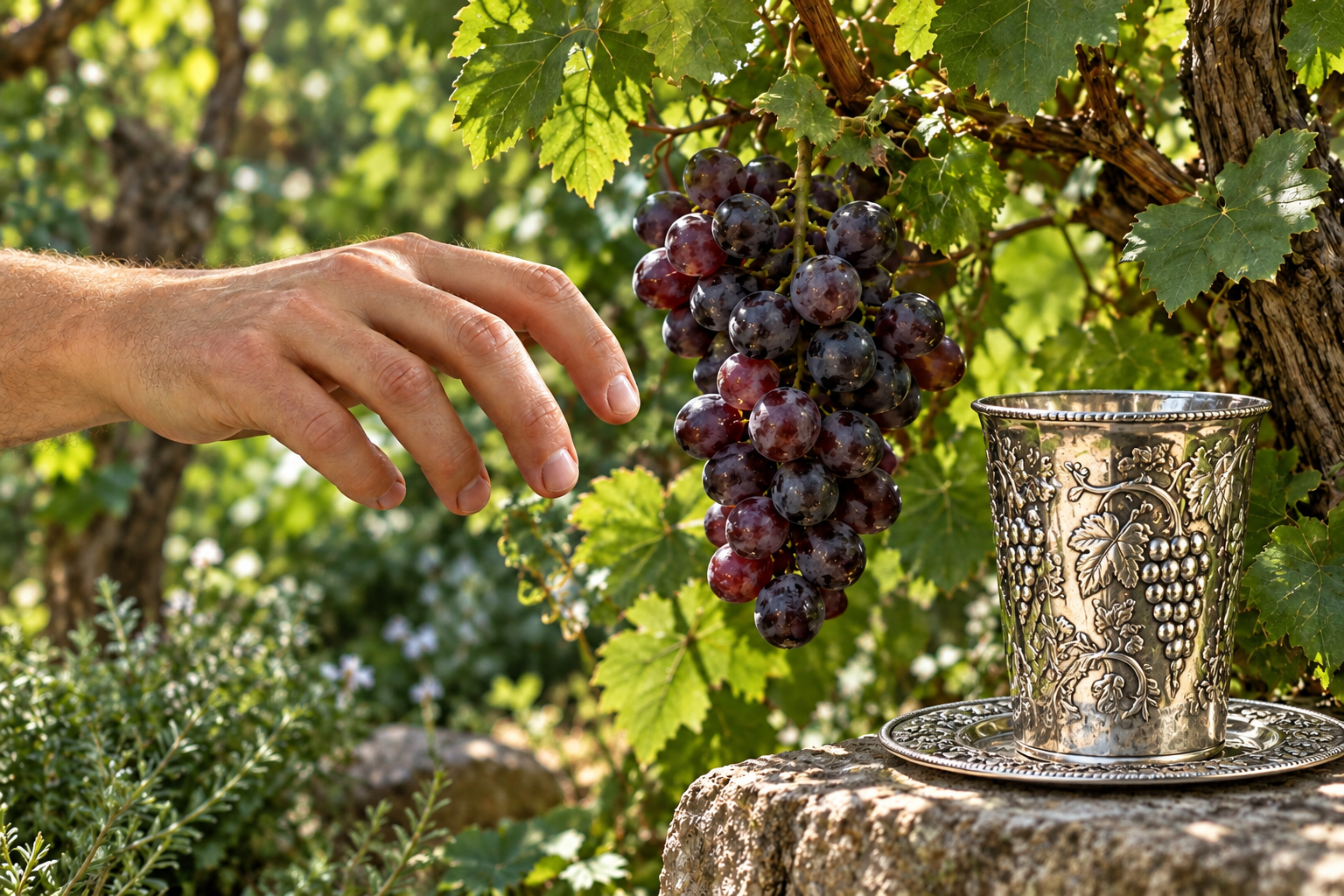
While our sages offer several different opinions about what indeed the forbidden fruit was, Rabbi Meir explains that the forbidden fruit was actually a cluster of grapes.
What makes this teaching about grapes so remarkable is that the prohibition against eating from this Tree of Knowledge was temporary. According to the Kabbalah, Adam was commanded to not eat this fruit only until Shabbos began. The plan was for him to wait from Friday afternoon when he was created, until Shabbos was to begin. He would then have used the wine from these very grapes to make Kiddush.
It’s an amazing mystical twist. The fruit that became the source of humanity’s downfall was actually meant to be lifted in a cup of wine to sanctify the world forever. The peace and holiness of Shabbos would have brought Adam, Eve, and the entire world, into a deeper awareness of G-d’s presence.
Within the holy space of Shabbos, wine could have been enjoyed the way G-d intended.
All Adam had to do was to wait, obey G-d, and allow that first Shabbos to complete the spiritual work of creation. Had he done so, humanity would have entered an era of lasting peace and happiness. The world would have been spared the death and suffering that followed his sin.
Imagine how differently our story could have unfolded. All the tears, all the graves, all the painful goodbyes that humanity has known could have been avoided. Forever.
And all that stood in the way was three hours. That was all Adam had to wait before he could make Kiddush and welcome a world that would never know death.
What makes this even harder to understand is knowing just how great Adam was. G-d Himself fashioned his body and personally breathed life into his nostrils. His soul contained the souls of all humanity, including the greatest and holiest people who would ever live.
Plus, there were plenty of other trees and other fruit to enjoy. He had a whole Garden of Eden to choose from!
Surely, he could leave one tree alone until Friday night. Especially considering that he had heard the command not to eat this fruit directly from G-d Himself.
And yet he couldn’t. Before Shabbos arrived, they already ate from the grapes, and the course of human history changed.
 How could someone so great stumble over something that seems so simple?
The Rebbe’s explanation not only explains Adam, it explains so much about our seemingly simple struggles, and about the inner battles we can’t seem to win.
Every soul has a mission and objective that is uniquely its own. We each have a piece of creation that only we can complete.
The “Yetzer Hara – Evil Inclination” knows exactly where that piece is. And that is exactly where the voice of temptation and our inclination to resist what is right concentrates all its efforts.
The test of the Tree of Knowledge was not difficult because the fruit was so exceptional.
It was so difficult because the stakes were so critically important.
Precisely because so much depended on those few hours, the evil inclination fought that particular battle with such extraordinary force.
We know this from our own lived experiences as well.
You might find it easy to give generously, yet terribly difficult to hold back a hurtful comment. Someone may feel tremendous love for G-d, yet struggle to make time to pray. Some can turn off their phones for 25 hours, but they can’t hold back from watching inappropriate things for 25 minutes.
Perhaps you can be gracious with everyone at work, but you lose your patience the moment you walk through your front door. Or perhaps you would gladly help any stranger, but you cannot bring yourself to apologize to that one particular person.
We each have that place where doing what we know is right somehow becomes so difficult. That Mitzvah we keep pushing off, even though we know how much it matters.
From the outside, we wonder. Why can’t I manage something so small? How can I do so much good for others, and care so deeply about my Judaism, and yet keep falling over the same simple obstacle, again and again?
And that’s because the strength of a temptation does not reflect how difficult the mitzvah looks from the outside. It reflects how much of your soul’s perfection depends on fulfilling it.
The “Yetzer Hara” inside us, our inclination to resist and procrastinate, it knows exactly which Mitzvah is the one our soul came to this world to complete. That’s exactly where it puts up the greatest fight.
So we make a sincere resolution, manage to be better for a while, and then make the same mistake. Again. Even though we really meant it when we said we would change.
Eventually, we start thinking that this one weakness is ruining everything. We may even begin to question whether all our other efforts count. If this “small thing” is so hard for us, maybe we are not so holy and righteous after all?
So how do we know precisely which struggle of life is our soul’s destiny and mission?
Think about a game of chess. Good players pay close attention to their opponent. Where he positions his pieces and focuses his attacks gives you important clues about what he has planned.
Our greatest struggles give us a similar clue. When our evil inclination fights especially fiercely in one area, that resistance tells us to pay attention. There may be something particularly precious at stake here, something our soul came into this world to accomplish.
The fierceness of the battle is the clue to its spiritual importance.
Adam’s test was so difficult because the stakes were so high. What looked like a small request of just three hours, was actually carrying the weight of an entire world.
So this Friday night, when you lift your cup full of wine for Kiddush, think about Adam’s grapes. Think about the holiness that was waiting to enter the world through one act of self-control and discipline. All depending upon one choice.
Adam’s three hours are behind us. But our moment is right in front of us.
That one little thing you are about to give up on because it seems so unbelievably hard for you to do…. THIS may be the very action that deserves your soul’s greatest effort.
May our next victory be the one that brings all of humanity to its eternal Shabbos of peace and happiness, with the coming of Moshiach.
Good Shabbos,
Rabbi Yankie & Chana Denburg