
Bridging faith. Defending truth. Confronting hate
The Fourth Clock: Why the West Misunderstands Iran’s Wars
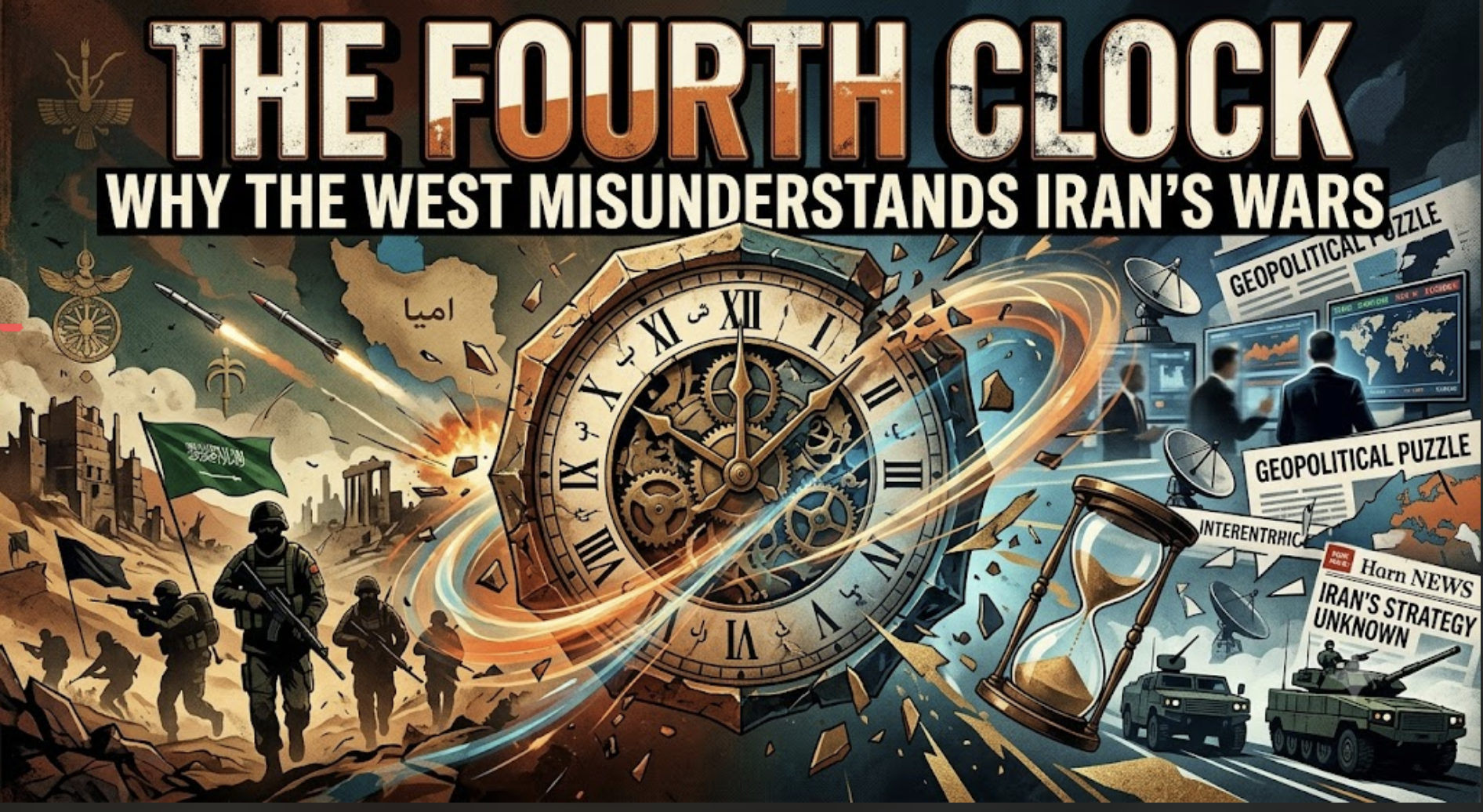
Image created from Google Gemini by Tim Orr
I begin this article with an odd statement, which is an idea I borrow from Mark Dubowitz, from the Foundation for Defense of Democracies, who believes that wars run on clocks, and opposing sides are rarely watching the same one. If you are a Westerner, time is of the essence. Our lives are ordered firmly by clock time, and we tend to think in terms of a single clock. Wars do not operate that way. Opposing sides rarely experience time in the same manner, and each may be watching a different clock.
The first clock is the military clock. The military clock measures the rate at which armed forces can achieve strategic objectives. It asks how long will it take to render the enemy incapable of continuing the war? This is where military planners look at markers like the opposition’s infrastructure, weaponry, and capacity to keep fighting, then estimate how long it will take to destroy the enemy.
The second clock shifts from the battlefield to political survival. It asks a different question than the military clock: not who is winning the war, but whether the opposing regime can stay in power. It is how long the opposing regime can endure military setbacks, economic pressure, and growing unrest before its authority begins to fracture. In some cases, a regime may have an incredibly weakened military, yet still survive politically. Conversely it may be strong militarily while weakening internally.
A government can lose on the battlefield without immediately losing its grip on power. Just as importantly, military strength alone cannot guarantee a regime’s survival. Internal conflict, economic hardship, and eroding public confidence can prove just as dangerous.
The third clock is democratic political will, things like elections, public opinion, and the financial cost of keeping a war going. Democratic societies are concerned with and must account for elections, public opinion, financial costs, casualties, coalition pressures, and competing national priorities. A country may still have the military strength to continue, but these factors often determine whether it does.
But there is another kind of clock, what I call the Fourth Clock, that Western policymakers and strategists tend to miss. It does not measure weapons, political survival, or the voting booth. It measures whether those involved believe they possess the moral and religious authority to declare the conflict over. If God has assured victory, then the war is not over until victory is reached. Thus, the leaders don’t possess the political, religious or moral authority to declare the conflict the struggle has legitimately ended and that further fighting is no longer required. I call this the Fourth Clock, the theological clock.
The Fourth Clock is different because it is not governed primarily by military realities or political calculations. It is governed by theology. This clock is what many Western experts can’t wrap their head around. The problem looks very different when those leading the war believe they do not have the authority to end it. There can be negotiations that take place, and agreements can be reached, and even a cease fire can be announced, but this doesn’t mean peace is on the horizon. If the divine purpose has not been completed, then ending it becomes more than a political decision. It becomes a theological one.
In the case of the Islamic Republic of Iran, this question cannot be separated from the regime’s understanding of divine sovereignty, sacred obligation, and history. If Iran’s leaders believe the Mahdi, who is hidden from the world (in occultation) and therefore unreachable, is the only authority who can legitimately end the war, and that he has commanded them to fight against those he considers usurpers of his rightful rule, then how can the war ever end? Military setbacks may prolong the struggle, political pressures may complicate it, and public opinion may fluctuate, but none of those factors alone determines when the conflict has reached its legitimate conclusion. Why? It is because God is on the side of the regime, and no matter the current setbacks, he assures success.
This is one reason Western strategists often misjudge the staying power of ideological regimes. Analysts assess the war through the prism of a cost/benefit analysis and conclude when costs exceed benefits or when negotiations produce an acceptable political settlement. Underlying this assessment is a Western assumption that governments—not religious authority—can decide when compromise serves the national interest. But Iran’s revolutionary ideology is different. Their leaders look at their roles differently than Westerners. Instead of seeing themselves at the authors of a particular strategy, they see themselves as stewards of a divine mission. For them, the central question has little to do with if continuing is a prudent strategy, but whether ending it would constitute disobedience to what they understand to be God’s will.
I’m not arguing that Iran ignores military realities and economic pressures, or even the politics happening within its own country. A ceasefire may be seen as a tactical necessity, and negotiations may happen to gain a strategic advantage. But neither signals that the conflict has been morally or religiously concluded. As long as the regime believes that its mission remains unfinished, the struggle is not over. Instead, it is just suspended. The Fourth Clock therefore measures something the first three cannot: the perceived theological legitimacy to declare that history’s sacred task has been completed.
–
Dubowitz, Mark. Interview by John Spencer. “No March on Tehran: The Military Logic of the Iran War.” The Iran Breakdown. Foundation for Defense of Democracies. April 23, 2026. https://www.fdd.org/podcasts/2026/04/23/no-march-on-tehran-the-military-logic-of-the-iran-war/
Related Topics
Related Posts