The Fourth Palacsinta Is Drafting
On Wednesday, my daughter is drafting into the IDF.
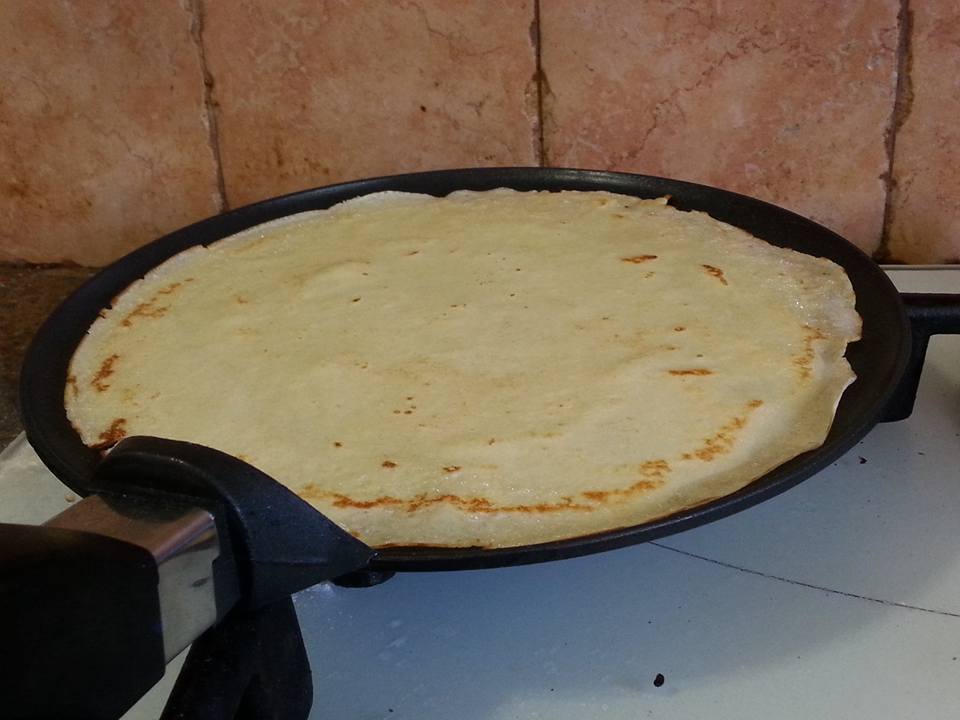
My fourth palacsinta.
The secret of successful Hungarian palacsinta is passed down from generation to generation and across continents. My grandmother taught my mother, and my mother taught me. “Mix the soda water into the batter to make the palacsinta thin and light. Carefully scoop into the pan and at that very moment, flip it. Do not fret that the first few are not perfect. They will still taste great. You will get the hang of it. Usually by the fourth palacsinta.
Tonight, for reasons I still cannot fully explain, I reopened a piece I wrote in June 2015 for Kveller, just a month before we returned to Israel. I had not read it in years. I thought I remembered it. I did not.
It broke me.
Not because of the writing, but because of who she was in it.
She was seven. In second grade. In Ms. King’s classroom in Richmond Heights, California. A quiet, gentle, structured world. A classroom where time moved slowly enough for a child to notice that it was passing.
In that Kveller piece, she saves her Star Student candy and says she will remember the moment forever because she will never be in second grade again. When I wrote it, I thought I was capturing a sweet insight. Tonight, I realized I was capturing a goodbye.
One month later, we returned to Israel.
She was not an immigrant. She was a returning citizen. But she might as well have been both. She had left Israel at five. By the time we came back, she all but had forgotten how to speak Hebrew. She could not read it. She could not write it. She had to relearn a language she was technically born into.
It was one of the hardest moves of my life. It was also one of the hardest moves of hers.
She returned without the language. Without the cultural codes. Without the social protection of a soft educational environment. The Israeli public school system was loud, crowded, blunt, and demanding in comparison. No one meant to be cruel, but intention does not erase impact.
And I was not at my best.
I was struggling with the return, with identity, with exhaustion, with fear, with things I did not yet know how to name. And children always feel when a parent is not steady, even when that parent is trying very hard to appear strong.
Her joy changed. It did not disappear, but it was no longer effortless.
Then came COVID in seventh grade. Then came the war in 2023. And now, somehow, we are here. Ten years later. And she is drafting.
She is drafting years after two of her older brothers had already completed their mandatory military service. Years after her third brother began spending much of his life on airplanes, traveling nonstop for wheelchair basketball and the Israel National Team, often away far more than he is home. She is not stepping into this moment in a vacuum. She is stepping into a family story shaped by service, risk, resilience, and movement.
And still, this moment is entirely hers.
Rereading that old Kveller piece tonight reminded me not only of who she once was, but of what she carries at her core. Presence. Sensitivity. An instinct for meaning. A deep, natural optimism that never came from denial, only from connection.
Only now, that optimism is no longer innocent. It is earned.
She learned Hebrew the hard way. She learned social survival the hard way. She learned resilience before she ever asked for it. She learned how to remain soft without becoming fragile.
That is not a small thing.
On Wednesday, she will put on a uniform. She will enter a system that is rigid, demanding, and emotionally heavy. I do not romanticize this. I only know this.
She is ready.
The real question sitting in my chest tonight is not whether I trust who she has become. Of course I do. It is whether I am ready to fully let go of who she once was.
Am I ready to finally release the second grader in Ms. King’s classroom. Am I ready to stop clinging to the version of her that fit so easily inside my arms. Am I ready to accept that the palacsinta stack keeps growing whether my heart stretches fast enough to contain it or not.
I look at her now and I see all the versions at once. The child with the candy. The returning citizen who had to reclaim her mother tongue. The girl who learned to navigate a new social world. The COVID pre-teen. The teenager who grew up inside war. The young woman about to serve.
And I will stand on the sidelines, holding every version of her inside me, knowing she was shaped by many worlds, and hoping the world she is stepping into now will prove worthy of the strength, empathy, and light she carries with her.