
The Friendship Crisis of Olim and Israelis
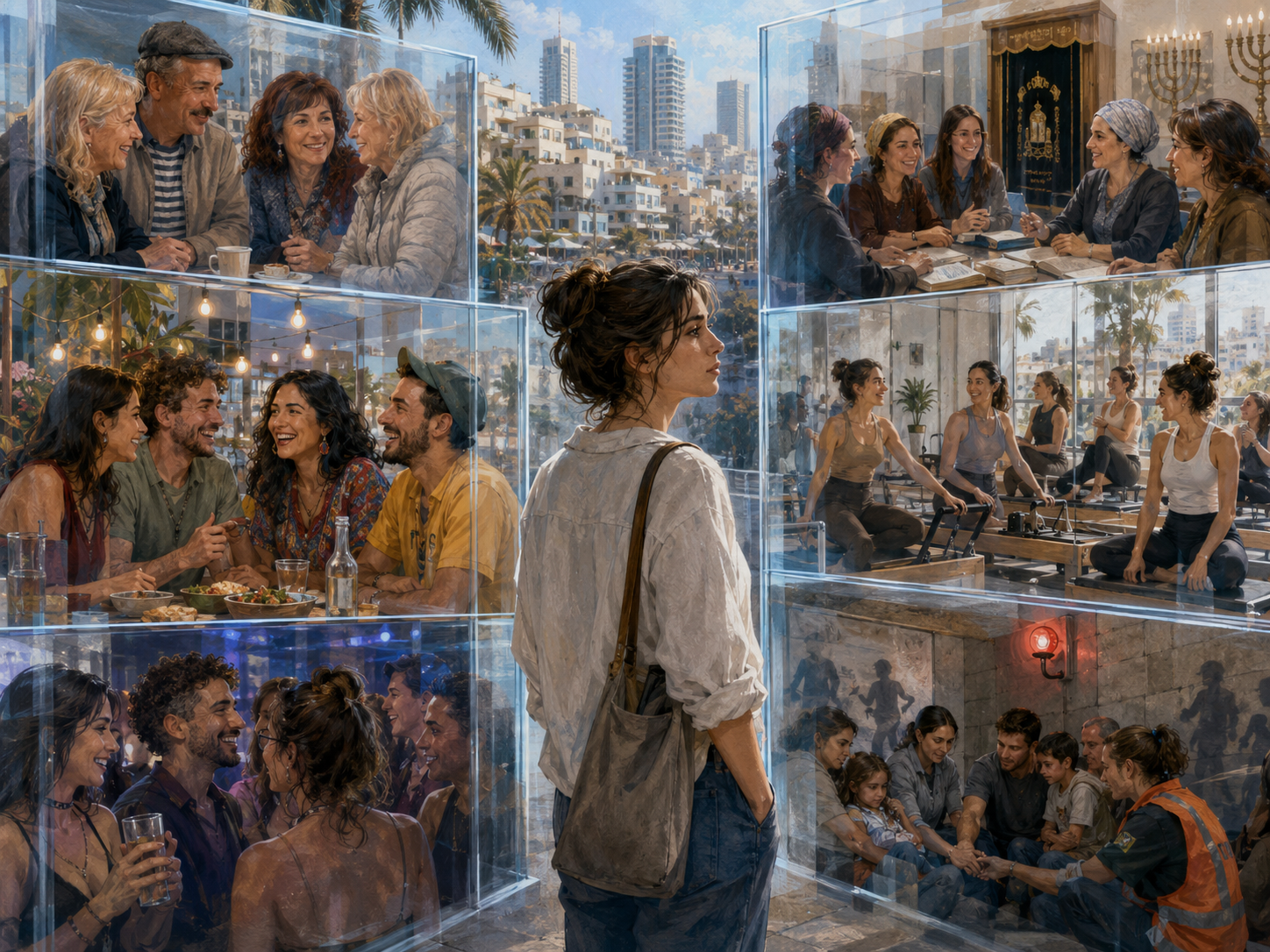
I’ve been in Israel for four years. In these four years I’ve changed friend groups more times than I’ve changed apartments, from fellow post-Soviet olim like me, to Latin American communities, to party Tel Avivians, to a religious circle built around a particular synagogue, to a Pilates-class WhatsApp group, to colleagues and volunteers. Each circle gave me something real. None of them, if I’m honest, gave me the thing I’m actually looking for: deep, strong friendships like the ones I had in the country where I was born. A tight, family-like group of Israelis and olim who could help me stop feeling like a guest in my own homeland.
Here’s what I’ve been thinking about.
Olim arrive expecting that building a life here means building a community, and on the surface, it’s easy. Israel is small, warm, and relentlessly social. What’s hard is turning that easy sociability into one deep, consistent friendship. Even people who’ve served in the army, who speak fluent Hebrew, who’ve lived here a decade, often describe the same quiet feeling of standing just outside the glass.
We are, meanwhile, extraordinary at one specific kind of connection: the crisis kind. We show up for each other in shelters, grab a stranger’s hand during a siren, volunteer. But that intensity rarely survives what’s supposed to happen after. The undramatic, repeated, slightly boring contact that turns an acquaintance into someone who shows up in your life regularly and deeply. That’s the part we’re collectively bad at. Israel does not lack social warmth. It lacks accessible pathways from warmth into durable belonging, especially for immigrants outside native-born Israeli networks of army, school, family, and childhood friends.
Some of this is exhaustion rather than character. A population carrying a real trauma load doesn’t have endless reserves left for the patient, repetitive work that friendship actually requires. But underneath the exhaustion is something more structural, and less talked about: we are all living in our own bubbles, constantly running into cultural gaps that build an invisible glass wall between us. Invisible, that is, until we, olim, feel it with our foreheads. And so Slavic olim end up friends with Slavic olim, Americans with Americans, French with French.
That wall has a name in linguistics: high-context versus low-context communication. Slavic-speaking olim often read American friendliness as pleasant, but hollow performance, a kind of social politeness that doesn’t mean what it says. Americans, in turn, often read Slavic directness as cold or even rude. Israeli sabra culture adds a third layer: the linguist Tamar Katriel spent a career studying what Israelis call dugri — blunt, straight talk that insiders read as authenticity and outsiders read as aggression. So the American hears the Israeli as harsh. The Israeli hears the Slavic oleh as cold. The Slavic oleh hears the American as fake. Nobody is wrong. Everyone is fluent in a different emotional language and assumes everyone else speaks it too.
But what does it mean to actually be Israeli, then? Aren’t olim, the people who left everything and came here, supposed to be Israeli like everyone else, if not more, given that the country itself was built by olim? If the entry price for belonging is generations of family history in this land, then the founders themselves would have failed the test.
So how do we bridge this gap, and find what we, Israelis and olim from all over, actually share? Jewishness is not a magic solution to these cultural gaps, it is the shared starting point that should make us more responsible for crossing them.
So how do we actually shape a new Israeli mentality that puts stitches in these social and cultural cracks, not just enough to get each other, but enough to actually become friends, for life? Maybe we should start treating cross-cultural friendship as a skill worth building on purpose?
Because here’s the part worth saying plainly: too often, what passes for cross-cultural friendship remains surface-level and inconsistent. It’s shelter solidarity, or a clubbing group, or a Pilates WhatsApp: warm, but rarely built to last, and rarely deep enough to survive a hard conversation or a bad year. What we actually need is to look past our differences on purpose, lead with being Jews and Israelis first, and give each other real space and real chances to build long-term, soul-level friendships, not just crisis bonds or surface-level meetups.
That kind of friendship is also where we’d finally work out what “being Israeli” means, together, instead of guessing at it alone. It’s the kind of social infrastructure that would make more people want to stay here, would make the country more resilient not just under fire but in ordinary life, and would be good, very simply, for everyone’s mental health.