Connecting Philanthropy & Capital with Israel
The Future of Christian Philanthropy to Israel
The Paradox of Proportions
For the past decade, Jewish philanthropy has been the overwhelmingly dominant source of foreign funding for Israel, consistently exceeding $3 billion annually. Christian philanthropy, by comparison, remains a minority presence. Evangelical donors contribute an estimated $350 to $450 million per year, roughly 10 to 12% of total foreign giving to Israel, a share that bears almost no resemblance to the size and resources of the global Evangelical community.
The clearest window into that figure is the International Fellowship of Christians and Jews, which raised $271 million in 2023 and $318 million in 2024, with 92% of its donor base identifying as Christian. Beyond that, a harder-to-track stream of funding flows directly into Christian ministries operating within Israel, conservatively estimated at $50 to $100 million annually.
Some might attribute the gap to Evangelicals simply giving less. But that argument collapses quickly. Christian philanthropy worldwide exceeds $200 billion annually, with over $145 billion contributed in the United States alone. The giving capacity is not the problem.
Two explanations present themselves. The first is relational: perhaps the disparity reflects the deeper, ancestral bond the Jewish people carry to the land, forged over millennia. The second is structural: the infrastructure connecting Israel to the broader Christian world, the pipelines, relationships, narratives, and institutions that convert conviction into contribution, simply has not been built to the scale the moment demands. The first explanation may be true. But it is the second that is actionable. And it is the second that this paper sets out to address.
Early Christian Zionism
Christian giving is propelled by theology and prophecy, by the conviction that what happens in Israel is not only politically significant but cosmically so. And Christian giving to Israel is not a new idea. It is woven into the very origins of modern Zionism.
Theodor Herzl was not a religious man. He approached Jewish nationhood as a political problem requiring a political solution. In the early years he lacked the one thing political movements cannot manufacture: legitimacy. It was an Anglican clergyman named William Hechler who changed that.
Hechler was deeply versed in scripture and had spent years mapping biblical prophecies onto the political landscape of the Middle East. When Herzl published “The Jewish State” in 1896, Hechler read it not as a political pamphlet but as a prophetic sign. When Herzl first visited Hechler’s study in Vienna, he recorded his astonishment in his journal. Every wall was lined floor to ceiling with Bibles. The desk was covered in color-coded maps of Palestine, the product of years of careful study. Hechler greeted Herzl with a declaration: “We have prepared the ground for you.” He was not speaking metaphorically.
What followed was a strategic alliance that shaped history. Hechler had served as private tutor to the children of Frederick I, Grand Duke of Baden, and that relationship gave him access to European royalty that Herzl could never have obtained alone. Hechler arranged a meeting with the Grand Duke, who then facilitated something far more consequential: a direct audience between Herzl and Kaiser Wilhelm II in Jerusalem in 1898. Almost overnight, Herzl went from pamphleteer to statesman.
The key was the frame Hechler placed around Herzl’s vision. Herzl was making a secular argument: the Jews needed a state for reasons of safety, dignity, and self-determination. That argument was compelling but insufficient to move monarchs. Hechler translated it into prophetic language, giving the German royal household not merely a political rationale for supporting Jewish statehood, but a theological one. The secular vision needed the sacred frame, and without Hechler, it might never have found one.
The lesson for our era is not subtle. Christian support for Israel has always been most powerful when it operates at the intersection of conviction and relationship, when the biblical narrative and practical infrastructure are built together by people who understand both.
Modern Christian Zionism
Today, Evangelical Christianity is broadly rooted in an understanding of Israel’s centrality to the Christian faith, though the nature of that commitment varies. For many Christians, supporting Israel is simply an act of obedience, a response to the scriptural instruction to bless Israel and receive blessing in return. The giving is real but largely devotional, an expression of faith rather than a strategic investment.
For others, Israel is not peripheral to their faith but its very epicenter. Within this group are Christians who understand the return of the Jewish people as a precondition for the return of Jesus the Messiah, drawing on Matthew 23:39, where Jesus states he will not return until Jerusalem welcomes him. For these Christians, every Aliyah flight that lands at Ben Gurion, every family that rebuilds in the Negev, every Jewish child born in Jerusalem is not merely a demographic fact but a theological one.
This conviction creates a well-known tension with Jewish communities. That tension is real and should not be dismissed. But the mission of seeing the Jewish people return to the land, rebuild it, and fill it with life is one that both Christians and Jews can pursue together, whatever we believe about the Messiah’s coming. The Christian in rural Texas attending an Israel solidarity event and the Israeli farmer replanting his fields in the Galilee may not understand it, but they are aligning with the same prophets. We need not agree on the destination to walk the same road.
For many Christians, support for Israel is an act of ingrafting. The word comes from Romans 11, where Paul describes non-Jewish believers as wild olive branches grafted into a cultivated tree, made part of the same root and the same promise. An ingrafted branch does not observe the tree from a distance. It draws life from the same source. The Christian who understands themselves as ingrafted into the story of Israel does not give the way one gives to a disaster relief fund, from a safe remove. They give the way a family member invests in a family home: because it is theirs too, because its flourishing is their flourishing.
For nearly two thousand years, many in the Church made a consequential error: they began to see themselves as the replacement for Israel rather than partners in covenant. This thinking, supersessionism, has shaped centuries of Jewish-Christian relations. Paul was direct with the non-Jewish believers in Rome who were tempted toward that same arrogance.
His warning in Romans 11:18 remains as relevant today: “Do not be arrogant toward the branches. Remember it is not you who support the root, but the root that supports you.” The root has not changed. Israel’s restoration does not signal that Christians have inherited the covenant. It signals that the covenant was never abandoned. Donors who give from that identity give for a lifetime.
Philanthropy in Israel During the War
Over the past year, I have noticed a recurring pattern among Israel’s largest philanthropically sustained organizations. Quietly, urgently, they are all searching for the same thing: the next narrative.
Before October 7, the familiar themes held. Aliyah. Hasbara. Faith and pilgrimage. Poverty alleviation. These had sustained organizations for decades. Then the attack came and everything shifted at once. The philanthropic ecosystem went into emergency mode. Those with the most urgent narrative, who moved fastest and deployed most efficiently, received the most support. Several organizations that had operated in relative obscurity suddenly found themselves at the center of the story, raising in a single month what had previously taken a full year. The work had not changed. The story around it had.
Other organizations fared differently. Development projects, long-term education initiatives, and tourism programming found themselves waiting as the philanthropic attention of the entire Jewish and Christian world converged on a single point of crisis.
Now, as the acute phase recedes, most organizations are asking the same question: how do we stay relevant? How do we make the case that what we do still matters when it is no longer an emergency? That is the question I hear at every gathering and on every stage where Israel’s future is being discussed.
What Holds for Israel
That conversation became concrete for me one year ago, in the ballroom at Mar-a-Lago, where I presented Israeli humanitarian work and its wartime impact before an audience of significant Israel-supporting Christians. Seated around those tables were representatives from ministries and media organizations whose combined viewership exceeds several hundred million people, fund managers overseeing assets in the billions, and some of the most influential voices in American Evangelical Christianity. These were the people who, when they speak, move markets, mobilize communities, and elect the next President.
And even then, just one year into a war Israel was winning, the question was already being asked with urgency: What comes next? Not out of fatigue, but out of genuine hunger for direction.
A narrative is the story we tell about the work we do. But the best fundraisers understand something deeper. It is not so much storytelling as it is prophesying. Donors are not looking for a recipient of their charity. They are looking for their story, one that leaves a mark and reflects their deepest convictions. The most powerful thing an organization can offer is not a compelling need but a timely narrative that has echoed from ancient Israel to modern Israel. Organizations that position themselves not as askers but as the instruments through which a donor’s values take shape in the world do not fundraise. They make lifelong partnerships.
From that conversation, and from dozens like it, I distilled the emerging narrative into three words: Return. Rebuild. Revive.
Return speaks to the ongoing story of the Jewish people coming home. One of its most striking expressions is unfolding in the Negev, where Soroka Medical Center in Be’er Sheva stands as the anchor institution for the ingathering of Sephardic Jewry.
The prophet Obadiah wrote in chapter 1:20 that “the exiles of Jerusalem which are in Sepharad shall possess the cities of the south.”
Those communities, scattered across North Africa, South America and the Middle East, are returning south. Soroka is not merely a hospital. It is the infrastructure around which a revived Negev Jewish civilization is being built.
Rebuild speaks to the physical and communal reconstruction underway across the north and south. Nowhere is it more visible than in the work of the Kfar Azza Foundation. Kfar Azza was one of the communities hardest hit on October 7. Its residents were killed, taken, or scattered. The Foundation is rebuilding it home by home, creating the conditions under which hostages who return from Gaza can come back to a community that refused to disappear while they were gone. For Christian donors, participating in that rebuilding is not charity. It is sowing into covenant keeping.
Revive speaks to the spiritual and cultural renewal that follows great trauma. Perhaps no organization embodies that spirit more concretely than the Zahal Disabled Veterans Organization (ZDVO). More than 20,000 Israeli soldiers were wounded in this war. ZDVO exists to ensure that the end of their military service is not the end of their story. Through rehabilitation, reintegration, and community, the organization gives injured veterans not just recovery but a future. Revival is something both communities know how to pray for and work toward. Here is a place to do both.
How to Align Giving with Israel
History does not announce itself. More often, it is only recognized in retrospect by those who were present but did not fully understand what they were standing in the middle of. We do not have that excuse.
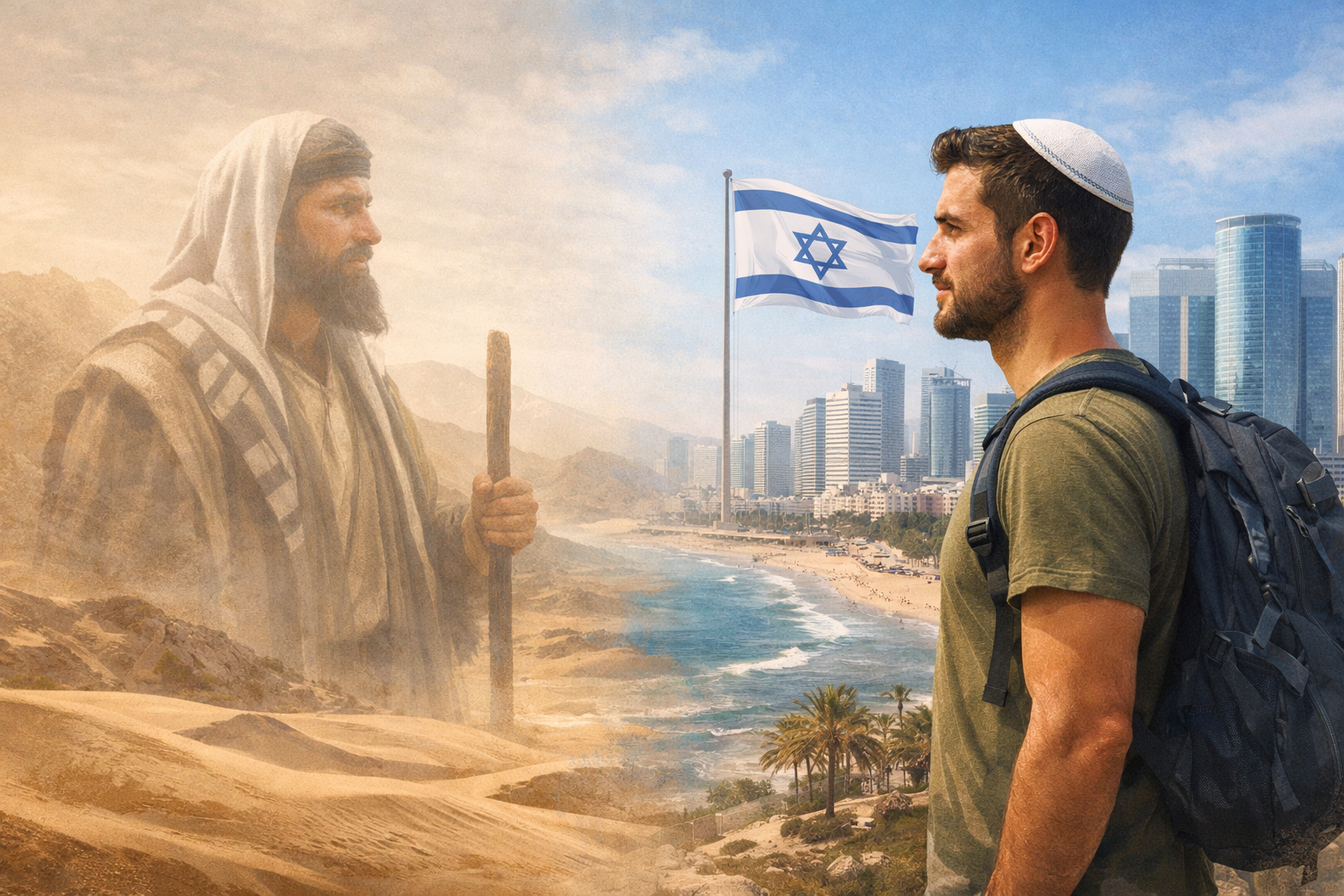
What is happening in Israel today, the return of a scattered people to an ancient land, the rebuilding of communities from rubble, the revival of a nation that has refused to be extinguished, is not ordinary. It is, by any serious biblical reading, exactly what was promised. The exiles returning. The dry bones rising. A nation born again in a day, now pressing through the labor pains of what comes next.
For too long, Christian giving to Israel has been generous but peripheral. Donations sent across an ocean by people who believe deeply but participate distantly. That model served its season. This season demands something different.
The numbers are worth sitting with. Christian philanthropy in the United States alone exceeds $145 billion annually. Evangelical giving to Israel represents a fraction of one percent of that figure. A shift from $400 million to $4 billion annually would not simply fund more nonprofits. It would reshape the economic and spiritual fabric of the nation itself. It would mean Aliyah infrastructure scaled to receive hundreds of thousands of returning Jews. It would fund the schools, absorption centers, and housing that turn Aliyah from a dream into a life. It would mean every displaced community in the north and south rebuilt in years rather than decades. It would mean 70,000 wounded veterans receiving world-class rehabilitation rather than waiting for it. It would expand infrastructure, build communities, create new industries, break poverty cycles, and turn the startup nation into the scale-up nation.
The money would not stay in a portfolio or an endowment. It would flow into a living nation and change what that nation becomes. The physical map of Israel would look different. The spiritual confidence of the nation would be different. It would be a true Israel, revived.
When the Christian world gives in proportion to what it actually believes, it sends a signal that no political statement and no UN resolution can replicate. It says that the people of G-d’s covenant have read and understood their full identity. The early donors who funded the first boats and the first farms were building something they could not fully see. We can see it. The only thing missing is the decision to give from the center rather than the margins.
Zechariah 14:16 saw this moment plainly: “Everyone who is left of all the nations shall go up from year to year to worship the King, the Lord of hosts, and to keep the Feast of Tabernacles.” That vision is not only future. It is already beginning. Every Christian who goes up to Jerusalem for the appointed times is not fulfilling a personal spiritual discipline. They are adding their footsteps to a procession the prophets described and the world is only beginning to recognize for what it is.
As Zechariah 8:23 foretold: “Ten men shall take hold out of all languages of the nations, even shall take hold of the skirt of him that is a Jew, saying, We will go with you: for we have heard that G-d is with you.” The ger who goes up to Jerusalem and then goes home and gives is not performing two separate acts of devotion. They are living one continuous story. And that story, repeated across millions of households in the Christian world, is what proportional giving looks like when it moves from conviction into action.
Give as partakers of the covenant. William Hechler did not write a check and go home. He stood in the study with Herzl. He walked into the palace. He put his relationships, his reputation, and his conviction on the table and said: I am part of this. The Christians who will shape the next chapter of Israel’s story are not the ones who admire it from a distance.
They are the ones who understand, as Hechler did, that they have a role to play and who refuse to leave it unfilled. The ger does not give because the cause is compelling. They give because the people are their people and the land is their land and the story is their story. You are not observing this tree from outside the garden. You are grafted into it. Act accordingly, and reap what you sow.
Give as builders, not as relief workers. The emergency is real and the humanitarian need remains. But the vision for this season is larger than emergency response. Soroka anchoring the prophetic revival of the Negev. The Kfar Azza Foundation rebuilding a home so that former hostages can return.
ZDVO giving 70,000 wounded veterans not just recovery but a future. These are not relief projects. They are world-shaking, nation-building missions. In a hundred years, people will point to this moment and say: this is where the shift happened.
Give in alignment with what you already believe. If you believe that the ingathering of the exiles is a biblical event unfolding in real time, then fund it. If you believe that the rebuilding of Israel is a fulfillment of prophetic promise, then invest in it. Not as someone doing religious duty, but as someone who has read the text, internalized it, and decided to live as though they truly believe it.
Herzl had the vision but not the frame. Hechler had the frame and the relationships. Together they moved the world and sowed the seeds for a nation that waited two millennia to return. What they built in a handful of meetings in the 1890s became one of the greatest revival stories in history. We are not starting from zero. Israel exists. The people are coming home. The rebuilding is underway. What is missing is the alignment of the branches: all those who serve the G-d of Israel, who see clearly what is happening, who understand their own role within it, and who decide to give not from the margins but from the center.
This is not a moment to watch. It is a moment to build. A moment history will celebrate through eternity. The ground, as Hechler once said, has been prepared. The only question now is who will show up to plant. Will you?
Related Topics