
The Greens: an Old Problem in New Language
There is a comforting myth in modern Britain that the worst things that can happen to Jews belong firmly in the past. That the Holocaust was a rupture, an aberration, rather than a culmination. That it arrived suddenly, fully formed, rather than emerging slowly through decades of suspicion, caricature and social exclusion.
History tells a different story. The catastrophe of the 20th century did not begin with camps. It began with language. With the steady normalisation of the idea that Jews were not simply wrong, but corrosive: too powerful, too influential, too embedded, too alien.
You don’t need to be alarmist to recognise the pattern. You only need to be attentive.
Which is why the current trajectory of the Green Party deserves scrutiny, not because it is repeating history in any crude or literal sense, but because it is flirting with something more subtle: a political culture in which suspicion of “Zionism” increasingly risks bleeding into suspicion of Jews.
Symbolic of this shift is Mothin Ali, a figure who encapsulates the Greens’ evolution from a marginal environmental outfit into a louder, more morally absolutist force in British politics. And in a Britain in which many minorities have felt marginalised by mainstream parties, such popularism can appear very enticing.
The Greens were once the party of modesty. Their appeal lay in a kind of ethical restraint—a politics that sought to balance, not inflame. That identity has eroded. In its place is something more strident: a politics of moral clarity, in which complex conflicts are reduced to stark binaries: oppressor versus oppressed, truth versus lies, complicity versus resistance.
Ali’s rhetoric reflects this shift. His speeches and videos are saturated with moral urgency. Politicians are not just misguided, they are “supporting genocide”. Media outlets are not flawed, they are engaged in “propaganda” and deception. Power is not diffuse, it is concentrated, hidden, and often attributed to networks of influence: lobbies, donors, corporations.
None of this is illegal. Much of it is familiar. But it matters.
Because the language of hidden power has a history. And for Jews, it is a history that does not feel safely concluded.
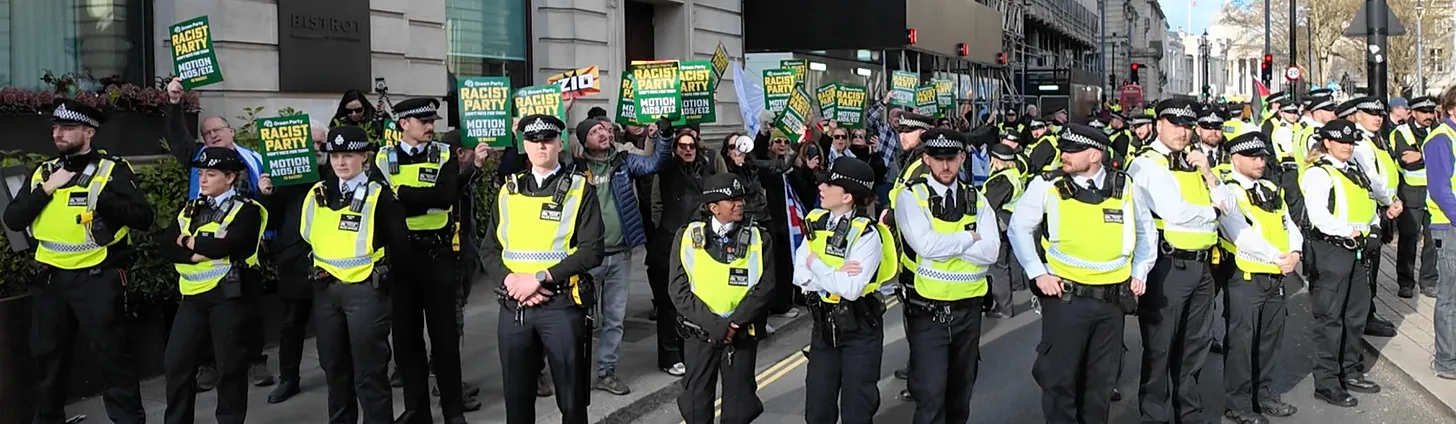
The flashpoint is the party’s internal debate over whether to declare that “Zionism is racism”. That slogan, revived in recent Green Party discussions, may be intended as a critique of Israeli state policy. But it lands differently depending on who is listening.
For many British Jews, Zionism is not an abstract doctrine. It is bound up with family history, collective trauma, and the question of what it means to exist in a world that has not always been safe for Jews. To declare it racist, exceptional to all other nationals movements, is to declare a large part of Jewish identity morally illegitimate.
Defenders of the slogan will insist that this is a category error, that Zionism is political, not ethnic. Politics is intrinsic to any form of nationalism, making such a boundary distinctly unclean.
Ali’s messaging sharpens this tension. He speaks of “Zionist lobbies”, of political parties acting as “proxies”, of systems shaped by hidden influence. He repeatedly associates Zionism with corruption, deception and moral failure.
Again, this is not explicit antisemitism, but implicit meanings can differ from what is overt. It does not openly target Jews as Jews. But it contributes to an atmosphere in which a term closely associated with Jewish identity is persistently framed as malign.
Prejudice rarely announces itself in its final form. It emerges through accumulation. Through the repetition of associations. Through the gradual narrowing of sympathy. Through the subtle programming of minds over extended time frames, primed by fundamental cultural notions epitosed by Shakespeares Shylock, or the Canterbury Tales’s Madame Eglentyne.
For many Jews, this is precisely the anxiety surrounding contemporary anti-Zionist rhetoric. Not that every criticism of Israel is antisemitic, far from it, but that the cumulative effect of certain kinds of language begins to feel uncomfortably familiar.
This would matter less if the Greens were still a fringe movement. They are not. Their support has grown, their visibility has increased, and figures like Ali now speak not just to activists but to a broader public.
With that growth comes responsibility.
The party’s defenders might argue that it is simply reflecting public anger over Gaza, or giving voice to communities that feel unheard. There is truth in that. But representation is not the same as amplification without reflection, and the party must wrestle and acknowledge the indisputable historic misrepresentation of Jews and Jewish life.
Ask any Jew if they have ever used the blood of Christian children in the preparation of their leavened bread for passover, and recognise that however unnecessary the denial, that belief has historically been widespread in the non-Jewish world. Such misrepresentations have cost untold thousands of lives. Jews are weary of libels and the power they have had over them as the tiny minority always in the headlines.
A party that aspires to govern cannot afford to speak only in the language of its most committed supporters. It must also consider how its words are heard by those outside its base, including minorities who feel increasingly uneasy.
For Britain’s Jewish population, the issue is not whether Israel can be criticised. It is whether the terms of that criticism leave space for Jews themselves.
Do they recognise the difference between a government and a people? Between criticism of the policies of a state and a call for its complete dismantlement? Do they understand that this state symbolises a lifeboat in a world historically and repeatedly hostile?
Or do they risk collapsing those distinctions into a single, morally charged category, one that places Jews, however indirectly, on the wrong side of a political divide?
These are not abstract questions. They are lived ones. They shape whether people feel able to participate in public life without qualification or fear.
The Green Party now faces a test of maturity.
It can continue down its current path, leaning into a politics of moral certainty, where language is sharpened for effect and nuance is treated as weakness. Or it can rediscover a more careful voice, one that recognises that clarity need not come at the expense of complexity.
That would mean acknowledging something uncomfortable: that rhetoric aimed at structures of power can still have unintended consequences for communities who hear themselves implicated within it.
It would mean recognising that history casts a long shadow, and that for Jews, the boundary between political critique and social exclusion is not theoretical.
No one is suggesting that the Green Party is on the brink of something catastrophic. History does not repeat itself so crudely.
But it does echo.
And the lesson of the past is not that every criticism of power is dangerous. It is that when criticism becomes saturated with suspicion, when language hardens into moral absolutes, and when entire frameworks of identity are treated as illegitimate, the ground can shift in ways that are not immediately visible.
The Greens may still see themselves as the conscience of British politics, but the ship is at risk of being steered in a perilous direction.
The question is whether, in their current form, they risk becoming something else: a party whose moral clarity obscures the very sensitivities it ought to protect.
That is not a conclusion. It is a warning.
And it is one that Britain’s Jewish citizens are increasingly alive to.