
The Gulf is no longer on the sidelines.
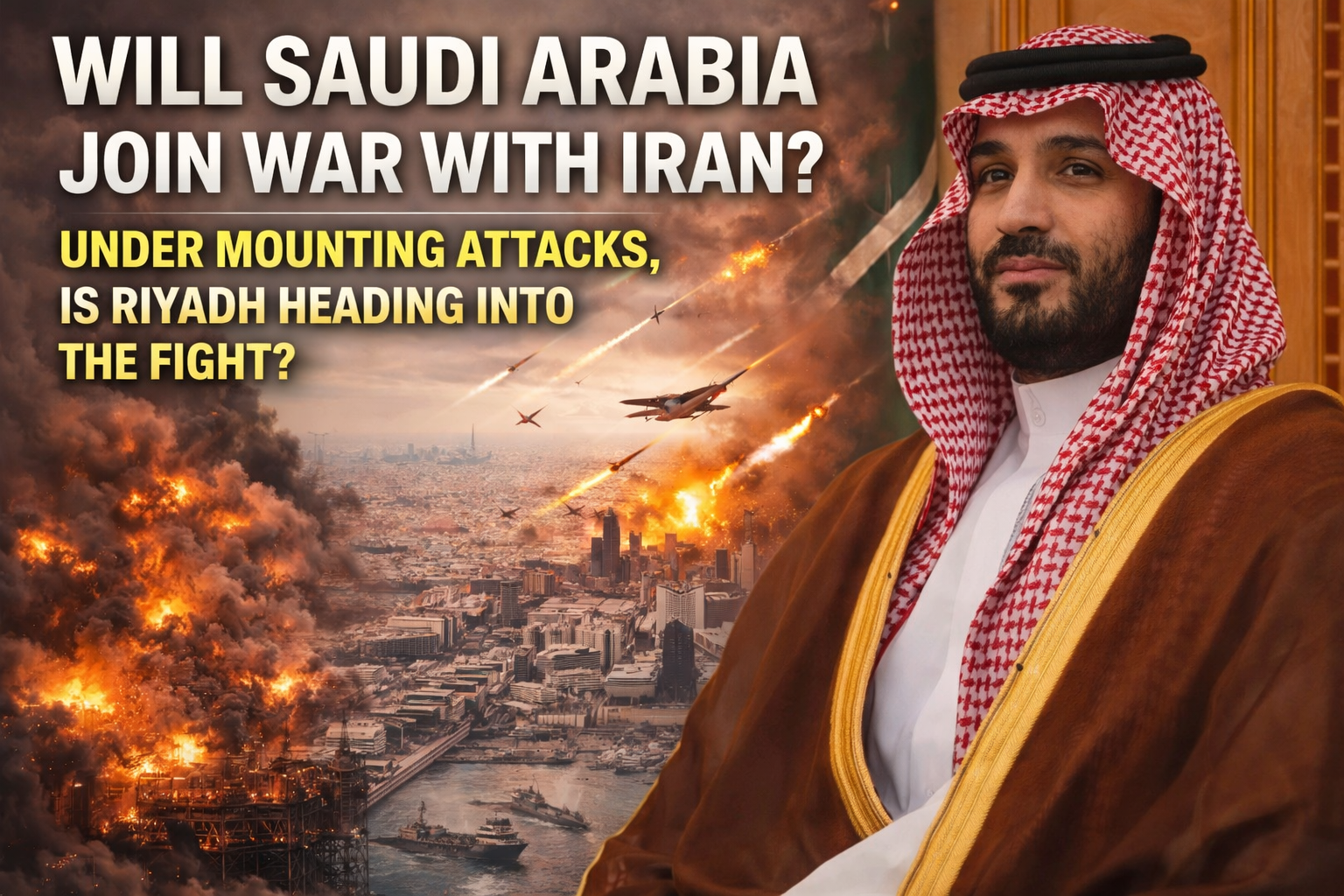
Why Saudi Arabia may be forced into war with Iran
The illusion that the Gulf could remain insulated from a direct confrontation with Iran is collapsing in real time.
For years, countries like Saudi Arabia, United Arab Emirates, Qatar, Kuwait, and Bahrain have attempted a delicate balancing act: maintain economic growth, avoid direct war, and manage tensions with Iran through diplomacy, deterrence, and strategic ambiguity.
That balancing act is now breaking.
What we are witnessing is not a hypothetical escalation. It is a transformation of the Gulf from a geopolitical buffer zone into an active battlefield.
The attacks that changed the calculus
Recent Iranian missile and drone strikes have crossed a critical threshold.
These were not symbolic warnings. They were direct attacks on the economic lifelines and civilian environments of Gulf states:
In Saudi Arabia, ballistic missiles reached the skies over Riyadh. Air defenses intercepted them, but debris reportedly fell near key infrastructure. Civilian alert systems were activated a first for the capital.
In Qatar, strikes targeted Ras Laffan, the world’s largest LNG hub. Even limited disruption there sends shockwaves through global energy markets.
In Kuwait, repeated drone attacks hit the Mina Al-Ahmadi refinery, igniting fires at one of the country’s most critical oil-processing facilities.
In Bahrain, drone attacks injured civilians, including children, in residential areas — a stark reminder that this war is no longer confined to military targets.
The UAE has also faced threats and damage to energy infrastructure, while reinforcing maritime and air defense postures.
This is the key shift: Iran is no longer operating through proxies alone. It is directly pressuring Gulf states at home.
Saudi Arabia: The decision point
If this crisis has a pivot, it is Saudi Arabia.
Riyadh has already taken significant steps:
Expelling Iranian military officials
Publicly reserving the right to retaliate militarily
Elevating national threat levels
Quietly coordinating with regional and international partners
But Saudi Arabia is still holding back from fullscale war.
Why?
Because the stakes are existential.
Saudi Arabia’s Vision 2030 depends on stability, foreign investment, tourism, and uninterrupted energy exports. A regional war threatens all of it. The kingdom understands that once it crosses into direct conflict with Iran, there is no controlled escalation only unpredictable consequences.
And yet, restraint has limits.
A state can tolerate rhetoric.
It can tolerate proxy harassment.
It cannot tolerate sustained attacks on its capital, its oil infrastructure, and its civilians.
If those attacks continue, Saudi Arabia will not be choosing war.
It will be responding to it.
The Strait of Hormus: The global trigger point
The world often underestimates one reality:
What happens in the Gulf does not stay in the Gulf.
The Strait of Hormuz carries roughly a fifth of global oil supply. Any disruption — even partial immediately impacts global prices, supply chains, and economic stability.
Iran knows this.
By targeting energy infrastructure and threatening maritime routes, Tehran is leveraging economic warfare alongside military pressure.
If Gulf states begin participating in coordinated naval protection, convoy systems, or retaliatory strikes tied to maritime security, that will mark a decisive shift from defense to active engagement.
Why the Gulf does not want this war
Despite the escalation, Gulf leadership remains cautious and for good reason.
They understand three hard truths:
1. War with Iran is not limited.
It extends across missiles, drones, cyber warfare, proxies, and global economic disruption.
2. Infrastructure is vulnerable.
Oil fields, desalination plants, ports, and cities are all within range.
3. Victory is unclear.
Even a “successful” military campaign could leave the region economically and politically destabilized.
This is why Gulf states have pushed for international intervention, including raising the issue at global forums and emphasizing that they did not initiate hostilities.
They are signaling clearly: we did not choose this confrontation.
Iran may be making the decision for them
Here is the uncomfortable truth:
Every missile that lands, every drone that penetrates defenses, every refinery that burns reduces the Gulf’s ability to stay neutral.
At some point, deterrence must be restored.
And deterrence, in this context, may require force.
The trajectory is not toward a dramatic declaration of war.
It is toward incremental escalation:
Defensive interceptions
Targeted retaliatory strikes
Coordinated regional military action
Eventual alignment in a broader anti-Iran coalition
Saudi Arabia does not need to announce its entry into war.
It may simply wake up one morning already in it.
The bottom line
The Gulf is no longer a spectator.
It is a target.
Saudi Arabia is not eager to enter a war with Iran.
But continued Iranian attacks are steadily removing every alternative.
This is how regional wars begin — not with a single decision, but with a series of unavoidable responses.
And right now, the line between restraint and retaliation is disappearing.