The Hardest Person I Have Had To Forgive is Myself
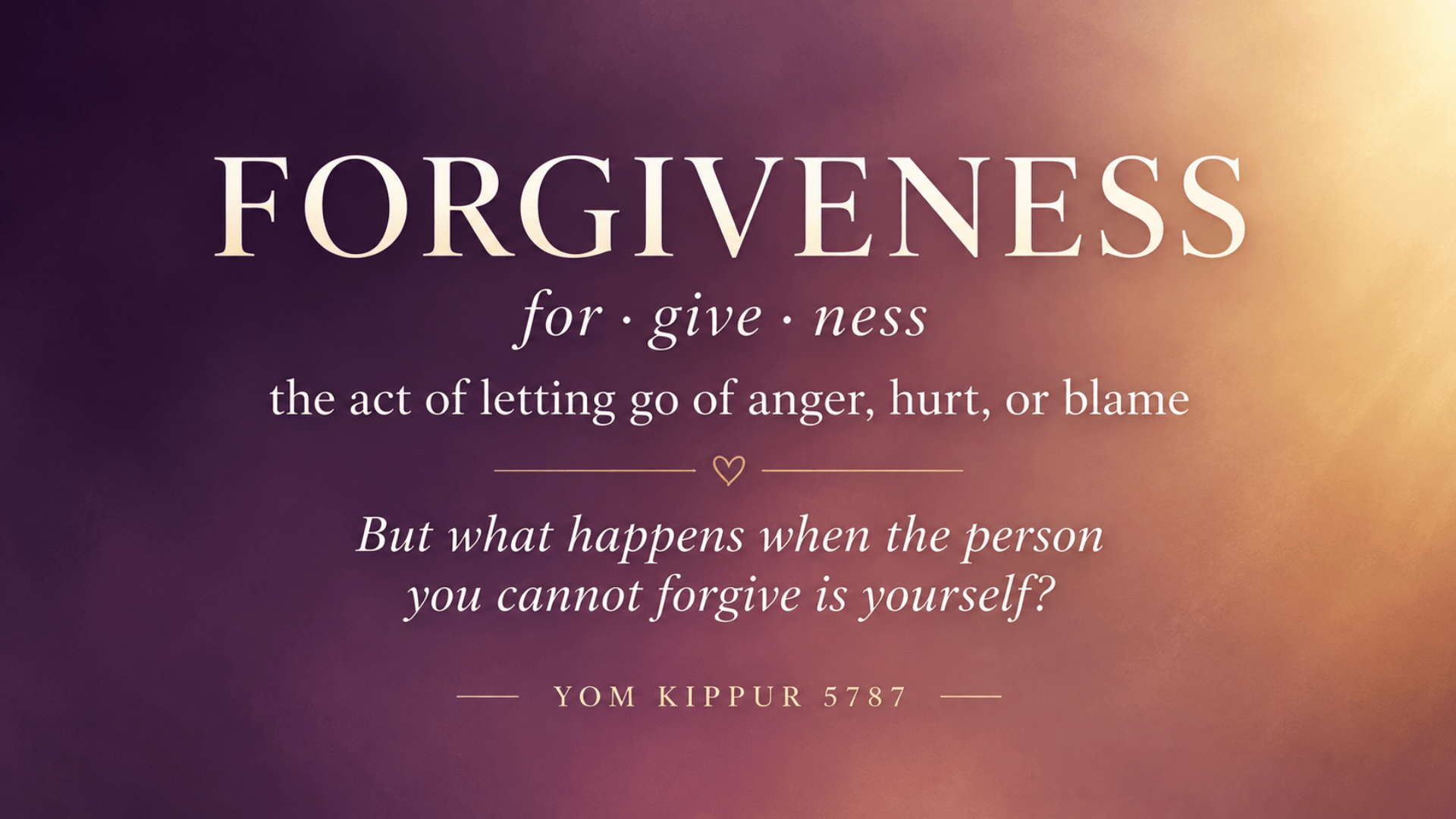
Yom Kippur has always made me think about forgiveness. Who have I hurt? Who deserves an apology from me? Where did I fall short? What could I have done differently? Those are uncomfortable questions, but as I get older, I have realized there is another question that is much harder for me to answer: Can I forgive myself?
The truth is, I am very good at carrying things. I carry words I wish I hadn’t said, decisions I wish I could make again, moments when I should have handled something differently, relationships that changed or ended, people I have hurt, intentionally or unintentionally, and times when I wasn’t the person I wish I had been. I can replay those moments with incredible detail. I can tell myself what I should have said, what I should have done, and what I should have known. And sometimes I judge the person I was years ago using everything the person I am today has learned since then. That isn’t particularly fair, but I do it anyway.
My life has not followed a straight line. Not even close. I have made choices that changed my life and the lives of other people. I have lived with grief, regret, estrangement, and loss. I have survived times when I wasn’t sure I wanted to survive at all. I have had relationships I desperately wanted to fix and learned the painful lesson that wanting reconciliation does not mean I can make it happen. There are parts of my story that I can speak about openly now that took me years to even say out loud. And there are still parts that hurt.
I talk a lot about telling your story. I believe deeply in the power of owning where we have been—the beautiful parts, the painful parts, and the parts we would probably rather leave out. But owning your story also means owning the things you aren’t proud of. That part is harder.
Yom Kippur doesn’t allow us to simply say, “Well, I meant well.” Intentions matter, but so do our actions. If I hurt someone, their hurt does not disappear simply because hurting them wasn’t my intention. If I owe an apology, I owe an apology. If I can make something right, I should try. If my behavior needs to change, then saying “I’m sorry” without changing isn’t enough.
That is teshuvah. We often translate teshuvah as repentance, but it also means return. And I love that, because “return” means we are not expected to remain exactly where we were. We can turn around. We can learn. We can choose differently. We can return to the person we want to be.
What I struggle with is what happens after that. What happens when you have apologized? What happens when you have tried to repair the damage? What happens when you have changed? What happens when the other person doesn’t forgive you, or when there is no longer an opportunity to ask? What happens when the person refusing to let you move forward is you?
I am also learning something that may be even harder: I have to be okay with not being forgiven. I can sincerely apologize. I can take responsibility. I can try to make amends. I can change my behavior. But I cannot make another person forgive me. That belongs to them, not to me. And as painful as that can be, I have to respect it. Their forgiveness cannot be the measure of whether my apology, my growth or my teshuvah was sincere.
And maybe I also have to be okay with the fact that there are things I haven’t completely forgiven myself for yet. I cannot force that forgiveness either. Perhaps the goal isn’t to wake up one morning and suddenly decide that everything is forgiven. Maybe the goal is to stop allowing what I cannot forgive—whether it is someone else’s refusal to forgive me or my own—to keep me from continuing to grow.
I don’t have a perfect answer. I wish I did. I have forgiven people for things I once thought were unforgivable. I have offered grace to people I love because I know human beings are complicated and imperfect. Yet I haven’t always offered myself that same grace. Somewhere along the way, I think I confused forgiving myself with excusing myself. They aren’t the same.
Forgiveness doesn’t mean saying something didn’t matter. It doesn’t erase consequences. It doesn’t rewrite history. It doesn’t mean everyone has to welcome us back into their lives. Sometimes accountability means accepting that another person may never forgive us. But I am beginning to understand that spending the rest of my life punishing myself doesn’t repair anything either. It doesn’t help the person I hurt. It doesn’t change what happened. It doesn’t make me a better human being.
What can make me better is learning from it, doing better, being kinder, listening more carefully, apologizing when I am wrong, trying not to repeat the same mistakes, and accepting that I am still going to get things wrong sometimes. Because I am human.
On Yom Kippur, we don’t stand before Hashem pretending to be perfect. Quite the opposite. We acknowledge that we aren’t. We confess collectively—we have sinned, we have betrayed, we have hurt, we have gone astray. There is something incredibly powerful to me about that “we.” None of us walks into Yom Kippur without something. We all carry something we wish we could undo. I certainly do.
So this year, my prayer is not simply that the people I have hurt will forgive me. It is that I will have the courage to continue doing the work of becoming someone worthy of that forgiveness, while accepting that forgiveness may never come. And maybe I will finally understand that the same is true of forgiving myself. I can continue doing the work even while there are parts of my past that I still struggle to forgive.
Not because everything I have done was right. Not because the past doesn’t matter. But because I am still here. Still learning. Still changing. Still trying. Still becoming. Maybe that is what returning looks like.
For anyone else entering Yom Kippur carrying something heavy, I hope you will ask yourself the question I am trying to ask myself: Have I taken responsibility, made amends where I can, learned from what happened, and tried to become better? If the answer is yes, perhaps the next step isn’t demanding forgiveness—from someone else or from yourself. Perhaps it is learning how to keep moving forward even when forgiveness hasn’t come.
We cannot go back and become the people we wish we had been. We cannot control whether someone forgives us. And sometimes, we may not yet know how to forgive ourselves. But we can decide who we will be from this moment forward.
Maybe, for now, that has to be enough.
G’mar chatimah tovah. May we be sealed for a good year. May we have the courage to ask forgiveness from those we have hurt, the strength to accept when that forgiveness cannot be given, and the grace to continue becoming better people—even when we are still learning how to forgive ourselves.