The Heartbeat of Israel: A Paramedic’s Story
This week at the Jewish Federations of North America General Assembly, I had the profound honor of sitting down with Itai Orion, a Magen David Adom (MDA) paramedic whose life is a living testament to courage, compassion, and service. But as powerful as our conversation was, it hit even deeper because I’ve seen MDA in action — not just in stories, but with my own eyes.
Let me take you back.
It was this past summer. I was in Tel Aviv, celebrating my son’s upcoming bar mitzvah — a joyful moment under the Mediterranean sky. We were walking along the beach around 9 p.m., laughing, when suddenly two bikes raced past us. At first, I thought, What’s going on? Then it clicked: They’re responding to an emergency.
I watched as a Medicycle — one of MDA’s rapid-response units designed for urban and coastal areas — reached a man who’d suffered a heart attack. Within seconds, they were performing CPR. An ambulance arrived moments later. They stabilized him, loaded him in, and sped off — all within minutes.
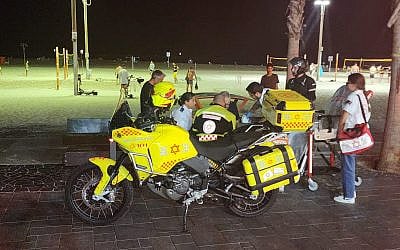
In that instant, I wasn’t just a tourist. I was a witness to something extraordinary: a system so prepared, so agile, that help arrives before disaster takes hold.
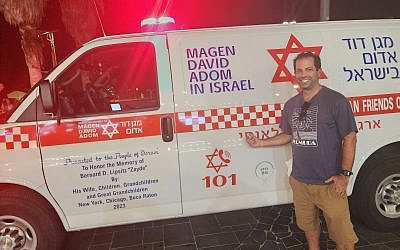
And that’s exactly what Itai Orion embodies.
More Than Medics: The MDA Family
Itai didn’t just tell me about his job — he invited me into his world. Certified through MDA during his army service, he never left. “There’s no higher purpose,” he told me, “than being a paramedic on a Mobile Intensive Care Unit, serving my community, my country, my people.”
His story is deeply personal. He met his wife on an ambulance. Some of his closest friends are fellow medics. MDA isn’t just an organization to him; it’s a family — forged in moments of trauma, loss, and triumph.
“You walk into someone’s life when they’re at their lowest point,” Itai said. “And how that call goes… is up to you. To be part of someone’s most intimate moment — whether they’re losing a loved one or bringing a new one into the world — is a humbling experience.”
Moments of Light in the Darkness
He shared a bittersweet memory: treating a pregnant woman who was shot and tragically lost her baby. Years later, he was invited to the bris of her next child — a testament to resilience and hope.
Then there was the time he responded to a woman in cardiac arrest — only to find her teenage son, an MDA Youth Volunteer, already performing CPR. They shocked her back to life, got her into the cath lab, and within a week, she made a full recovery.
“Now, when I see that kid,” Itai smiled, “we give each other high fives. That’s the MDA family.”
And after seeing that Medicycle on the beach — I get it now. That’s not just efficiency. That’s culture. That’s a nation trained, equipped, and emotionally committed to saving lives.
Innovation That Saves Lives — Every Second Counts
Itai took me beyond the human stories to the technological marvel powering MDA’s success.
- When you call 101 (Israel’s dedicated medical emergency number), a medic or paramedic answers — not a general operator.
- With consent, they receive your live GPS, video feed, and camera access via WhatsApp.
- They guide you through remote helping — talking you through CPR until help arrives.
Even smarter:
MDA’s app integrates a nationwide database of over 50,000 AEDs — including private units in synagogues, gyms, and schools. If someone collapses nearby, dispatchers can direct bystanders: “Turn left, go up two flights, the AED is in the red cabinet — grab it, run back, save a life.”
“It turns any willing person into a first responder,” Itai explained. “We’re not just shortening response times — we’re expanding the circle of care.”
Blood, Bravery, and a Bomb Shelter Blood Bank
I recalled seeing mobile blood drives on Ben Yehuda Street and asked about MDA’s role.
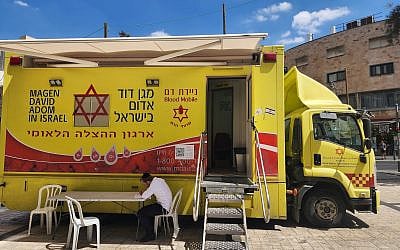
The answer stunned me.
MDA supplies 100% of the blood for the IDF and over 90% of all hospital transfusions in Israel. And because even medical infrastructure is targeted, the Marcus National Blood Services Center — the world’s only underground, bomb-sheltered blood bank — ensures continuity during war.
Since October 7th, MDA paramedics have carried refrigerated blood units directly into the field. This “walking blood bank” has reduced preventable deaths from hemorrhage by more than half compared to previous conflicts.
“That blood,” Itai said, “came from donors like you and me. One donation can save three lives.”
The Cost of Courage — and How We Can Help
The recent Operation Rising Lion, detailed in MDA’s latest Pulse report, saw 1,347 civilians treated in just 12 days of missile attacks. Ambulances operated at maximum capacity. Double shifts became the norm. Operational costs surged by $200,000 per day above budget.
“We’re always preparing for the next crisis,” Itai told me. “Efficiency, agility, technology — that’s how we do more with less.”
But they can’t do it alone.
Whether it’s sponsoring a Life Support Ambulance ($115,000), funding a Medicycle for rapid response, or supporting the Human Milk Bank that nourished infants orphaned after October 7, every contribution strengthens Israel’s lifeline.
What Gets Him Up in the Morning?
I asked Itai what keeps him going through the trauma, the long nights, the losses.
Two things:
- The MDA family — knowing he’s never alone.
- The power to change a life — every single day.
“You get to be there when someone needs a hand,” he said. “That connection — human, real, immediate — that’s what makes it all worth it.”
I used to think of emergency response as something that happens after a crisis.
But standing on that Tel Aviv beach, watching MDA move with precision and purpose, I realized: in Israel, it’s not reactive — it’s relentless. It’s built into the fabric of society.
Magen David Adom is more than ambulances and medics. It’s a testament to a nation that refuses to break — a system built on innovation, unity, and an unwavering commitment to the sanctity of life.
After speaking with Itai Orion — and having seen MDA in action — I’m reminded: heroism doesn’t always wear a uniform. Sometimes, it’s a teenager doing CPR. A donor giving blood. A neighbor grabbing an AED.
You can be part of this mission.
Visit afmda.org to learn how you can sponsor an ambulance, start a crowdfunding campaign, or support MDA’s lifesaving work.
Because in the end, as Itai showed me — and as I witnessed with my own eyes — saving a life isn’t just an act.
It’s a legacy.