
Exploring Jewish heritage through global travel and culture
The Hidden Golden Menorah at Oslo’s Grand Hotel
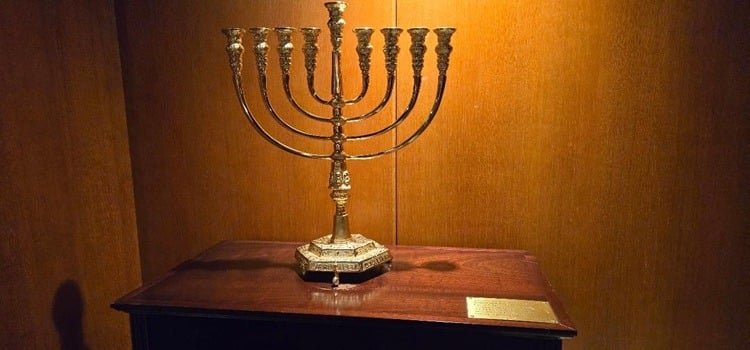
Gold Hanukkah Menorah at the Grand Hotel, Oslo — New York Jewish Travel Guide
An unexpected discovery inside one of Oslo’s most famous hotels reveals a remarkable story of Jewish heritage, family, philanthropy, and the enduring presence of Jewish life in Norway.
Sometimes the most memorable discoveries on a journey are the ones that were never on the itinerary.
During our Jewish Scandinavian Heritage Tour, one of those unexpected moments came while we were walking through the heart of Oslo with our guide, Rami Kafarov.
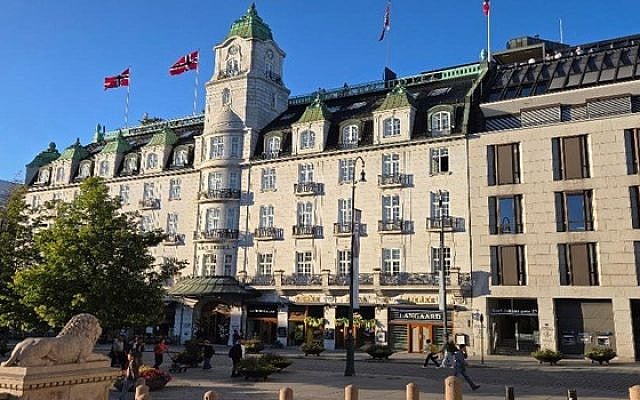
As we explored the city and learned about the history of its Jewish community, Rami mentioned an intriguing detail about one of Oslo’s most famous landmarks: the Grand Hotel.
Inside the elegant hotel, he told us, was a magnificent 24-karat gold Hanukkah menorah.
That immediately caught our attention.
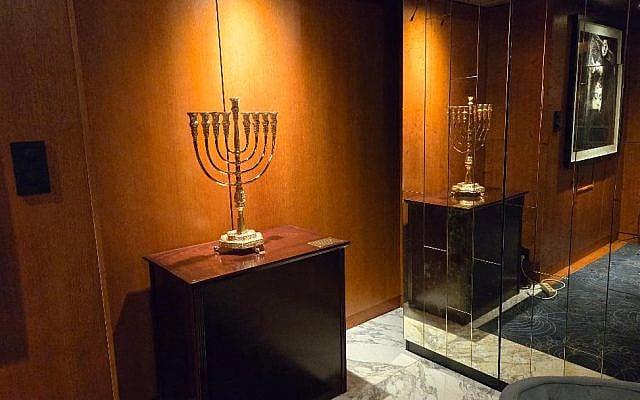
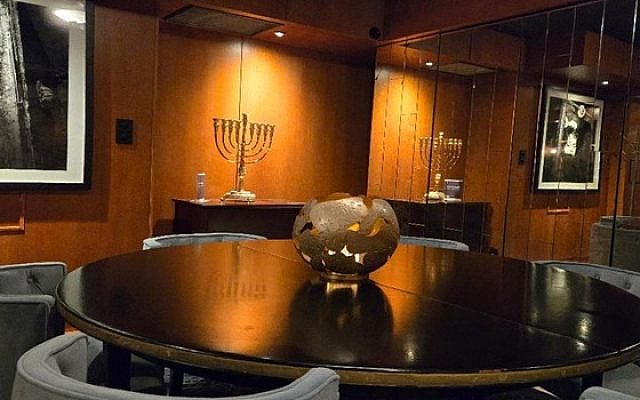
The Grand Hotel was not on our itinerary as a scheduled hotel visit. Rami explained that the menorah was displayed in the hotel’s art gallery, in a somewhat secluded area near the Nobel Peace Prize reception spaces. It was not something a visitor would necessarily notice simply by entering the hotel.
“You have to know where to look,” he explained.
Rather than visiting together as part of the tour, members of our group had the opportunity to go inside independently, at a time convenient for them.
And then came the discovery.
There, quietly displayed in an elegant gallery, was the golden menorah.
It was beautiful. But standing before it, we quickly realized that this was not simply an exquisite piece of Judaica. Behind the gold was a remarkable story about Norway’s Jewish community, a Norwegian Jewish family whose roots reached across the Atlantic to New York, the generosity of Jewish supporters, and an important moment in the public visibility of Judaism in Norway.
This was the Grand Hotel—a landmark associated with Nobel Peace Prize laureates, international diplomacy, and some of the most celebrated figures in Norwegian history.
And within its walls was a Jewish symbol of light, tradition, and perseverance.
The Grand Hotel: Where Oslo’s History Comes Together
Opened in 1874, the Grand Hotel is one of Norway’s most traditional and prestigious hotels. Located on Karl Johans gate, between the Norwegian Parliament and the Royal Palace, it occupies one of the most prominent locations in central Oslo.
For visitors from around the world, the hotel is best known for its extraordinary association with the Nobel Peace Prize.
Since the early years of the prize, Nobel Peace Prize laureates have been associated with the hotel, making it an important part of Oslo’s annual Nobel tradition. Presidents, prime ministers, diplomats, royalty and other international figures have passed through its doors.
But the Grand Hotel’s history extends beyond politics and diplomacy. Its walls have also been associated with celebrated cultural figures, including artist Edvard Munch and playwright Henrik Ibsen, as well as contemporary Norwegian cultural icons such as the internationally renowned band a-ha.
For generations, the Grand Hotel has been a place where art, politics, culture,e and international history have intersected.
Tucked within that remarkable story is another chapter—one connected to Norway’s Jewish community.
The Golden Menorah and Its Story
The menorah stands approximately 65 centimeters (26 inches) high and is made of 24-karat gold. It is a traditional Hanukkah menorah, with eight principal branches representing the eight nights of the holiday and a ninth branch, the shamash, used to light the others.
Its craftsmanship is striking, but its meaning goes much deeper.
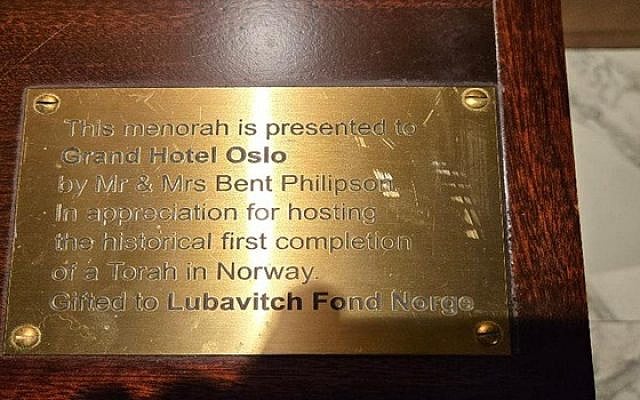
The menorah was donated by the Philipson family, a Jewish family with Norwegian roots who later lived in New York. Their generosity became part of a broader story of support for Jewish life in Oslo and of the enduring relationship between Norwegian Jews and the wider Jewish diaspora.
Rami explained that Chabad has maintained a presence in Norway for more than 25 years and that the organization developed a relationship with the Norwegian Jewish family of Philipson, whose generosity included supporting new Torah scrolls for Chabad in Oslo.
One of the family’s gifts led to a remarkable public celebration: a new Torah scroll was carried through Oslo in a traditional procession of music, dancing and celebration before the community gathered at the Grand Hotel.
According to community elders, such a public Torah procession had never previously taken place in Norway in this way. For the country’s small Jewish community, it was a powerful moment of Jewish pride and visibility.
That story eventually became connected to the golden menorah.
From Torah Celebration to Golden Menorah
The relationship between the Jewish community and the Grand Hotel continued.
In August 2018, the hotel hosted a high-profile dedication ceremony for the golden menorah. The location could hardly have been more symbolic.
The menorah was placed in the hotel’s art gallery, near the reception areas associated with the Nobel Peace Prize, where dignitaries and international guests gather.
The dedication brought together Jewish and non-Jewish guests, community leaders, diplomats and supporters.
For Norway’s small Jewish community, the event represented an important moment of Jewish visibility.
Rabbi Shaul Wilhelm, who served Oslo’s Jewish community beginning in 2004, described the placement of the menorah as a breakthrough in making Judaism visible beyond the boundaries of the Jewish community.
The menorah was not simply an object of beauty. It was a statement of presence.
A Gift Connecting Oslo and New York
The story also illustrates the remarkable way Jewish heritage travels across borders.
The Philipson family had Norwegian roots but later lived in New York. Their support for Jewish life in Oslo demonstrated that leaving a country does not necessarily mean leaving its history behind.
The family, together with friends, supported the Torah celebration as well as the menorah. Their gifts connected generations and continents—Norway and New York, the past and the present, and one generation of Jewish life with another.
For international Jewish travelers, that connection is especially meaningful.
Jewish heritage is rarely confined to one country. Families move, communities change,ge and traditions travel with them.
The golden menorah embodies that continuity.
Why the Menorah Matters
Norway’s Jewish population is small, and Norwegian Jews, like many Jewish communities across Europe, have experienced significant assimilation over generations. Against that background, public expressions of Jewish identity can carry particular importance.
The Torah celebration and the menorah dedication were moments of Jewish confidence and pride.
The Torah inauguration reportedly attracted approximately 400 people, including members of the Jewish community, non-Jewish Norwegians, diplomats, and other guests.
For a small community, such an occasion can have significance far beyond the number of people attending. It affirms that Jewish history is part of Norway’s story and that Jewish traditions have a place in the country’s public life.
The menorah continues that message.
A Jewish Symbol in the House of the Nobel Peace Prize
Standing before the golden menorah, it is difficult not to think about the extraordinary setting around it.
This is a place associated with Nobel Peace Prize laureates and international leaders. Presidents, diplomats, and other prominent figures have gathered here.
And in a nearby gallery stands a traditional Jewish symbol.
Hanukkah is a celebration of light, perseverance,e and the preservation of Jewish identity. In this setting, the menorah carries a message that reaches beyond religion. It speaks to the ability of a small community to maintain its traditions and ensure that they remain visible.
For Jewish visitors, the experience can be deeply personal. For non-Jewish visitors, it provides an unexpected window into Norway’s Jewish history.
Look Beyond the Obvious
One of the great pleasures of heritage travel is discovering that the most meaningful stories are not always the most famous attractions.
Visitors come to Oslo for its museums, historic buildings, waterfront, royal heritage,ge and the Nobel Peace Prize. Jewish travelers may also seek out the synagogue, Jewish community and Holocaust memorial sites.
All are important.
But the menorah at the Grand Hotel offers something different: an unexpected bridge between Jewish history and the wider story of Oslo.
For us, it was revealed during a walking tour by someone who knew the story and understood its significance. Rami could have simply pointed out the Grand Hotel as another historic landmark.
Instead, he told us what was inside.
That small detail changed our experience.
The fact that the menorah was not part of our original itinerary made the discovery even more memorable. Members of our group later went inside the Grand Hotel, each at a time convenient to them, to see it for themselves.
There was no grand announcement or organized unveiling for us.
Just curiosity—and the opportunity to discover something that most visitors might otherwise pass without knowing.
That is the magic of travel. The itinerary can tell you where you are going, but it cannot predict every story you encounter along the way.
If You Visit Oslo, Ask About the Menorah
For anyone exploring central Oslo, the Grand Hotel is an important landmark, known for its history, elegance and connection to the Nobel Peace Prize.
But Jewish heritage travelers have another reason to visit.
The menorah is quietly displayed in the hotel’s gallery, so it may not be immediately visible to visitors. If viewing is permitted, take a moment to see this remarkable 24-karat gold menorah and reflect on the Jewish history and community story it represents.
Our unexpected discovery at the Grand Hotel revealed much more than a beautiful piece of Judaica. The golden menorah connects generations and continents, reflecting family, tradition, philanthropy, and the continuing presence of Jewish life in Norway.
For international visitors, it offers a simple lesson in heritage travel: look beyond the obvious. Some of the most meaningful stories are not found in guidebooks or famous landmarks, but in unexpected places—waiting to be discovered through curiosity and the knowledge of someone who knows the story.
The menorah may be tucked away, but its light—and the story it represents—is impossible to forget.
By Meyer Harroch | New York Jewish Travel Guide
For information about Jewish Copenhagen and its Jewish heritage tours:
Related Topics
Related Posts