
The Hidden Quantum Risk in Infrastructure
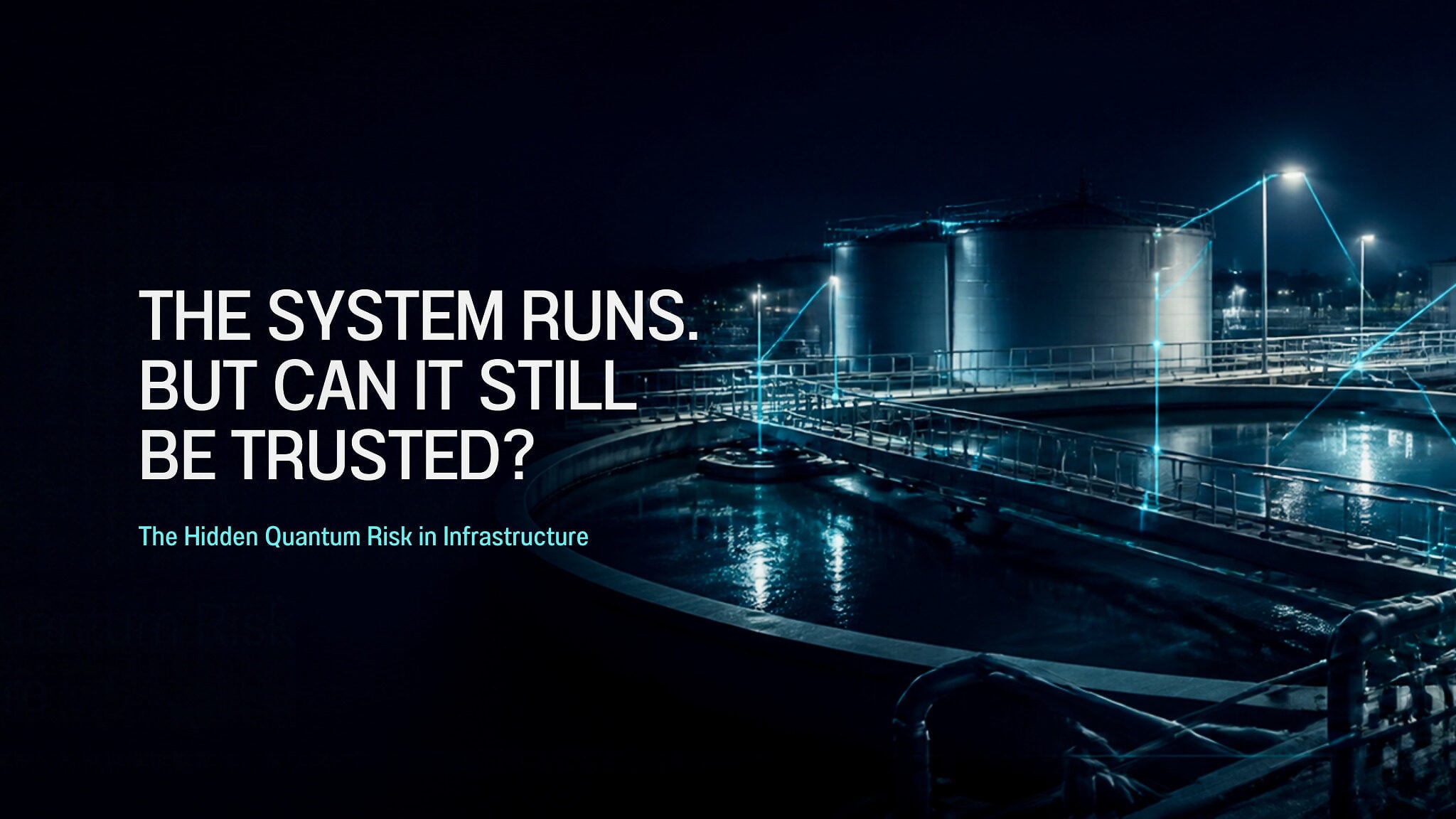
Imagine a water treatment facility operating on an ordinary morning. Pumps are running, sensors are reporting normal conditions, and operators are monitoring the process from a control room. Nothing appears unusual.
Behind that routine operation, however, numerous digital interactions are taking place. A remote system establishes a connection. A device receives a software update. An engineer accesses equipment through a maintenance interface. Each interaction depends, to some degree, on the ability to distinguish legitimate activity from something that should not be trusted.
Now consider what happens if the cryptographic mechanisms supporting some of those relationships can no longer provide the protection they were designed to deliver. The immediate concern is not necessarily that an attacker could shut down the facility. It is that a security assumption on which the facility depends may no longer be reliable.
We often discuss the quantum threat in terms of encrypted information becoming readable. The possibility that sensitive data collected today could be decrypted in the future is a serious concern, particularly for organizations responsible for information that must remain confidential for decades.
But critical infrastructure presents another dimension of the problem. When cryptography helps establish whether a system, command, or software update can be trusted, its failure may have consequences far beyond the confidentiality of information.
The invisible dependencies
Modern infrastructure combines physical equipment with digital systems. Electricity still flows through transmission lines, water moves through pipes, and transportation networks depend on physical assets. Yet the systems responsible for monitoring and coordinating those activities increasingly rely on digital communication.
Some of that communication takes place within tightly controlled operational networks. Other interactions cross organizational boundaries, particularly when external suppliers provide maintenance or specialized support. The security of these relationships may depend on certificates, digital signatures, or cryptographic protocols used to establish authenticated connections.
Not every industrial device uses public-key cryptography, and not every operational communication channel would be directly affected by a quantum attack. Some environments rely on older protocols with little or no cryptographic protection, creating vulnerabilities that already exist today.
The challenge is understanding where cryptographic trust is actually used and what would happen if a particular mechanism became unreliable.
Consider a maintenance gateway that allows an authorized supplier to access industrial equipment. The gateway may rely on public-key cryptography to authenticate the remote connection. If that mechanism becomes vulnerable and the surrounding controls are insufficient, an attacker might have an opportunity to impersonate a trusted party.
The quantum computer would not be controlling the industrial process directly. It would be weakening one of the mechanisms used to determine who is permitted to interact with it.
From a cryptographic weakness to an operational consequence
A successful attack against a cryptographic mechanism does not automatically translate into control of a physical system. An attacker would still need a usable path into the environment and the ability to perform an action with operational consequences.
Network segmentation, independent authorization controls, and other safeguards may prevent compromised authentication from becoming a serious incident. But the existence of additional barriers does not make the cryptographic dependency irrelevant.
Suppose an organization relies on digital signatures to verify software or firmware updates. Those signatures help establish that an update came from an authorized source and has not been altered.
If the signature mechanism becomes vulnerable, and an attacker can exploit that weakness within the update process, the organization may face a risk to the integrity of software it installs. The consequences would depend on the equipment, the update architecture, and the protections surrounding it.
In a conventional office environment, a compromised update could disrupt business applications. In an industrial environment, software integrity may also be connected to the behavior of physical equipment.
This is where a technical weakness can become an operational concern. The significance of a cryptographic dependency is determined not only by the algorithm involved, but also by the function that depends on it.
The problem with systems built to endure
Critical infrastructure has an unusual relationship with time.
Organizations routinely replace laptops and business software. Industrial equipment, by contrast, may remain in service for decades. A system installed years ago can still perform its physical function reliably, even when its digital security architecture reflects assumptions made long before today’s threats were understood.
That creates a difficult modernization problem. The equipment may be operationally sound, but the cryptographic mechanisms embedded within it may eventually need to change. In some cases, the necessary software updates will be available. In others, hardware limitations or supplier dependencies may make changes considerably more difficult.
Post-quantum cryptography introduces new algorithms designed to resist attacks from both classical and quantum computers. Adopting them across critical infrastructure, however, is not simply a matter of installing a new security product.
Organizations must establish whether existing devices can support the required mechanisms and whether changes can be introduced without disrupting essential services. A security improvement that interrupts a critical process can create a different kind of risk.
This is why quantum readiness in operational environments must be approached as an engineering challenge, not merely an IT upgrade.
In an earlier article on legacy systems, I argued that modernization does not always mean replacing equipment. The same principle applies here. In some environments, stronger security controls can be introduced around equipment that cannot safely be modified.
Such controls may help protect communications or restrict access without changing the underlying industrial device. Their effectiveness, however, depends on the particular risk they are designed to reduce. A secure gateway cannot automatically correct every weakness inside the system it protects.
Look beyond the inventory
Much of the discussion around quantum readiness has rightly focused on cryptographic discovery. Organizations need to know where vulnerable algorithms are deployed before they can plan an effective transition. Without that visibility, migration becomes a series of assumptions.
For critical infrastructure, however, identifying an algorithm is only the beginning. The more consequential question is what depends on it.
A certificate used to authenticate a public-facing website and a certificate used to establish a privileged maintenance connection may rely on similar cryptographic mechanisms. Their operational significance can be very different.
This suggests a practical approach.
Start with one essential operational function. It could be the remote maintenance process for a power facility or the software update mechanism for industrial controllers.
Trace the digital trust relationships that support that function. Identify where authentication occurs and how the system verifies that software or commands originate from an authorized source.
Then examine what would happen if one of those mechanisms could no longer be trusted.
Would an attacker gain a meaningful opportunity to impersonate a legitimate system? Are there independent controls that would limit the consequences? Could the vulnerable mechanism be replaced without interrupting operations?
The objective is not to predict every possible attack. It is to understand which cryptographic dependencies matter most to the continued operation of essential services.
That understanding can turn a broad quantum migration program into a more focused effort to reduce operational risk.
Preparing before the threat becomes immediate
There is a tendency to frame quantum security as a race against the arrival of a sufficiently powerful quantum computer.
The timing remains uncertain. The need to prepare does not.
Some risks, particularly those involving the future decryption of information intercepted today, already create reasons for action. Other risks, including the potential compromise of vulnerable digital signatures or authentication mechanisms, depend on capabilities that have not yet been demonstrated at the scale required to break widely deployed public-key cryptography.
These differences should shape priorities.
Organizations should not treat every cryptographic dependency as equally urgent, nor should they assume that the absence of an immediate quantum attack means the transition can wait indefinitely.
Critical infrastructure operators face long procurement cycles and demanding operational requirements. Changes may require extensive testing and coordination with equipment manufacturers.
The time needed to prepare may therefore be measured in years. That makes early identification of critical dependencies valuable even when the relevant threat is still emerging.
The security of what we depend on
The quantum era will not make every industrial system suddenly insecure. Nor will the adoption of post-quantum cryptography eliminate the broader cybersecurity challenges facing critical infrastructure.
But it will require us to revisit some of the assumptions underlying digital trust.
For organizations responsible for essential services, the question is not simply whether their information is encrypted or whether their networks are protected. It is whether they understand the security mechanisms on which their most important operations depend, and whether those mechanisms can evolve before their limitations become unacceptable.
We have spent years learning how to protect critical infrastructure against attacks on networks and systems. The quantum transition asks us to look more closely at the cryptographic foundations that help those systems recognize what they should trust.
The greatest quantum risk to critical infrastructure may not be the information an attacker can read. It may be the trust an attacker can undermine.
Next: When Digital Trust Becomes a National Security Risk. How can weaknesses in digital identity and cryptographic trust move beyond individual organizations to become a matter of national resilience?