
CFO | Empower Society for Good I Author
The History They Erased: Israel, Indigeneity, and Truth
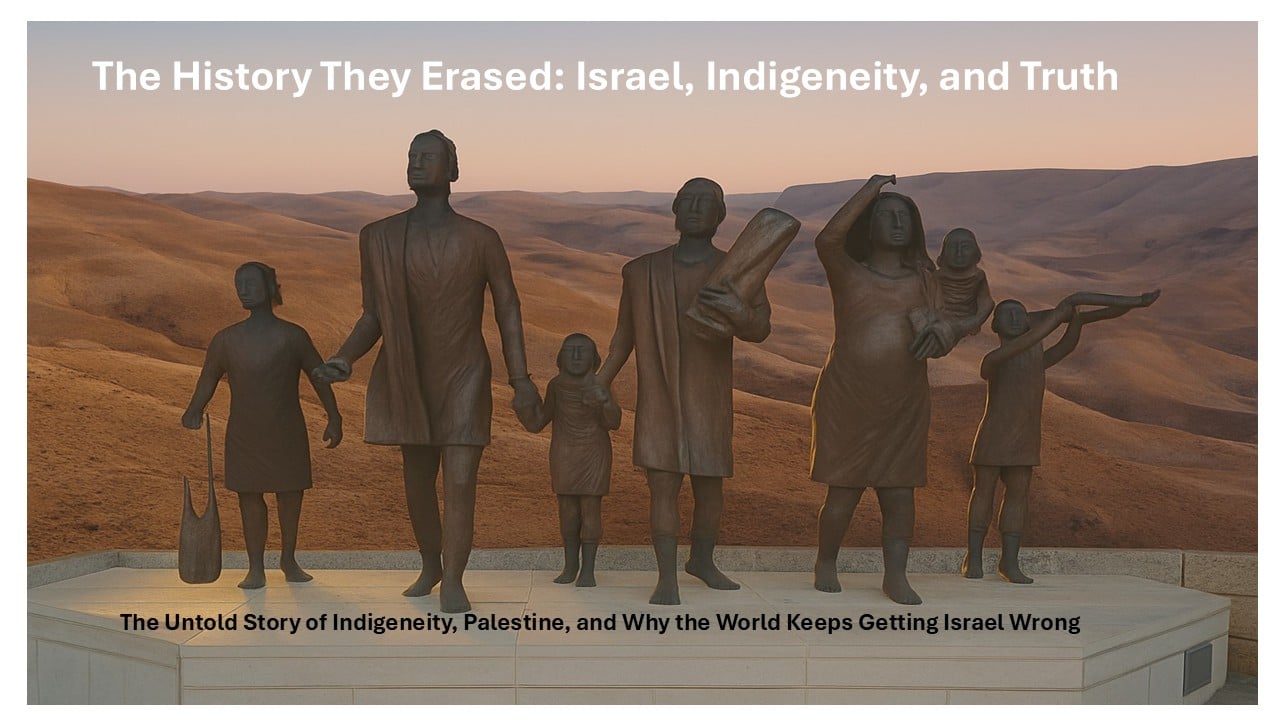
This blog is a reflection on The Untold Story of Indigeneity, Palestine, and Why the World Keeps Getting Israel Wrong
November 29 has become one of the great ironies of modern history.
On this day in 1947, the United Nations voted to partition the land into a Jewish state and an Arab state, recognizing what Jews had always known for three thousand years: the Land of Israel is the ancestral, historical, and indigenous homeland of the Jewish people.
Seventy-eight years later, the world seems more confused than ever.
But perhaps confused is the wrong word.
Perhaps the world has simply grown accustomed to a narrative that is easier to digest than the truth.
In the global debate over Israel and Palestine, we are witnessing a staggering erasure:
the forgetting — and often the deliberate ignoring — of actual history, the meaning of indigeneity, and the origins of Palestinian nationalism.
Recently, as I explored these questions and reflected on the events of this year, one realization became unavoidable: the global conversation has drifted dangerously far from historical reality.
Reflecting on October 8 and the Week of November 30
Reflecting on the world’s reaction — the pro-Hamas protests and marches on October 8, and on the week of November 30, a week that should have been devoted to remembering the Jews expelled from Arab lands — the depth of historical distortion becomes painfully clear. The brutality of October 7 was barely absorbed before global demonstrations redirected blame toward Israel, and the very days meant to acknowledge Jewish suffering were instead overshadowed by narratives that erase Jewish history altogether. This inversion of victim and aggressor, of cause and consequence, reveals not confusion but a deliberate reshaping of truth.
The Forgotten Refugees: 30 November
November 30 marks a largely forgotten tragedy: the forced expulsion of over 850,000 Jews from Arab countries beginning in 1947.
The irony is chilling — the moment the world affirmed Jewish self-determination, a wave of ethnic cleansing swept through the Middle East and North Africa. Jews were stripped of citizenship, their property confiscated, their communities destroyed.
Yet the world focuses exclusively on Palestinian displacement while ignoring the parallel — and often more severe — destruction of centuries-old Jewish communities across the Arab world.
The selective memory is not accidental.
It is part of a broader story of inversion, where truth is bent to fit political convenience.
October 7 and the Global Response
October 7 was the worst massacre of Jews since the Holocaust.
And yet, within a day, the world’s attention shifted.
The pattern was unmistakable:
- The horrors of the day,
- Followed immediately by protests on October 8,
- As though the world had been waiting for an excuse to target Israel.
Even the date meant to honour Jewish refugees — November 30 — became overshadowed by narratives elevating Palestinian victimhood while erasing Jewish suffering.
The United Nations itself reinforced this inversion when, in 1977, it declared 29 November the International Day of Solidarity with the Palestinian People. Instead of remembering Jewish history, persecution, and uprooting, the world chose a symbolic gesture that intentionally eclipses the Jewish story.
Whitewashing October 7: The “Disproportionate Response” Narrative
Today, Israel is condemned for a “disproportionate response.”
But what is truly disproportionate is the world’s moral framing.
The global discourse avoids mentioning:
- massacres,
- rapes,
- torture,
- hostage-taking,
- and brutal atrocities committed against civilians.
If the cause is erased, justice becomes meaningless.
This is the moral perversion we face.
Zionism: A Source of Pride, Not a Crime
Another word twisted beyond recognition is Zionism.
Zionism is not extremism.
It is not colonization.
It is not supremacy.
Zionism is the simple, ancient, and just return of the Jewish people to their homeland — a homeland where:
- our prophets walked,
- our kings reigned,
- our temples stood,
- our language was born,
- and our history unfolded.
After centuries of persecution — from Crusades to Pogroms to the Holocaust and the expulsion from Arab countries — Zionism became a lifeline.
Historically, legally, morally, the Jewish right to statehood is indisputable.
And yet today, Palestinian nationalism is affirmed while Jewish indigeneity is denied.
Are Palestinians Indigenous? Even AI Tells the Truth
Out of curiosity, I once asked ChatGPT:
“Are Palestinians indigenous to this land? Where did they come from?”
The response, based on mainstream academic consensus, was clear:
- The Jews are the only people historically indigenous to this land.
- Arabs arrived in waves across centuries — many during the 19th and early 20th centuries as Jews rebuilt the land.
This does not delegitimize Palestinian identity today.
But history matters.
When we look for an ancient Palestinian national story — a kingdom, a language, a religion, a civilizational center — it simply does not exist.
What does exist are thousands of years of Jewish history tied to:
- Hebron
- Shechem (Nablus)
- Bethlehem
- Efrat
- Be’er Sheva
- Rehovot
- And dozens of towns in this week’s Torah portion
- And of course, Jerusalem — the eternal capital of the Jewish people
These are not colonial constructs.
These are the foundations of Jewish civilization.
Life Today: Reality, Not Apartheid
Arabs in Israel — including Palestinians — enjoy:
- full civil rights,
- world-class healthcare,
- economic opportunity,
- representation in parliament,
- access to education,
- and higher life expectancy than in most Arab countries.
The apartheid accusation collapses on contact with reality.
The only “reverse apartheid” is the argument that Jews should be barred from living in cities like Hebron or visiting holy sites such as Rachel’s Tomb — simply because they are Jews.
Indigeneity: A Forgotten Historical Truth
Indigeneity is not a political slogan.
It has a clear definition:
- The land is the birthplace of your culture
- Your language originated there
- Your religion emerged there
- Your peoplehood formed there
- You maintained continuous presence there
Only one people fits this definition in this land:
The Jewish People.
Israel did not begin in 1948.
It began with Abraham, Isaac, Jacob, Moses, David, Solomon, Isaiah, and Jeremiah.
Even in exile, Jews never left the land completely.
Communities endured in Jerusalem, Hebron, Tiberias, and Safed for thousands of years.
And Jews prayed every day for a return to Zion.
Jordan: The First Palestinian Arab State
In 1922, Britain created Transjordan — today’s Jordan — from 78% of Mandatory Palestine.
Jews were banned from living there.
Today, 70–80% of Jordan’s population is Palestinian.
Yet the world insists that another Palestinian state must be carved out of the remaining 22%.
Even PLO leaders openly admitted the strategy.
Zahir Muhsein famously said in 1977:
“The Palestinian people does not exist…
A Palestinian state is only a means to continue our struggle against Israel.”
This admission should have been a turning point.
Instead, the world ignored it.
Why the Global Obsession With a Palestinian State?
The fixation has little to do with history:
- A tool to pressure Israel
It reframes Jews as “colonial settlers.” - Arab regimes deflect their failures
Keeping Palestinians stateless is politically useful. - Europe projects colonial guilt
Blaming Jews is easier than confronting their own past. - UN voting blocs dominate
Anti-Israel resolutions pass regardless of fact. - Diplomatic convenience
The “two-state solution” offers an illusion of easy peace.
Do Palestinians Have a Right to a State?
In the modern sense, yes — if:
- it is negotiated,
- it does not threaten Jewish sovereignty,
- it rejects terrorism,
- it accepts Jewish indigeneity,
- and it is not used as a weapon against Israel.
Self-determination is a principle — not a tool for erasing another nation’s existence.
A Final Thought for November 30
If peace is ever to come, it will not be built on erasing history.
It will not come from denying Jewish indigeneity or inventing false narratives.
Israel did not arise because of Europe.
It did not replace an ancient Palestinian nation.
It was not a consolation prize for the Holocaust.
Israel exists because the Jewish people are the original, eternal, and indigenous people of the Land of Israel.
Palestinians, too, deserve dignity, opportunity, and a future.
But dignity cannot be built on denial.
And peace cannot be built on historical erasure.
On November 30, let us reaffirm the truth:
The Jewish story here is the oldest.
The Jewish connection is the deepest.
The Jewish presence is the most continuous.
And the Jewish return is the most justified.
Everything else must begin from there.
Related Topics
Related Posts