Bridging Worlds
The Holy Sinners of Israel
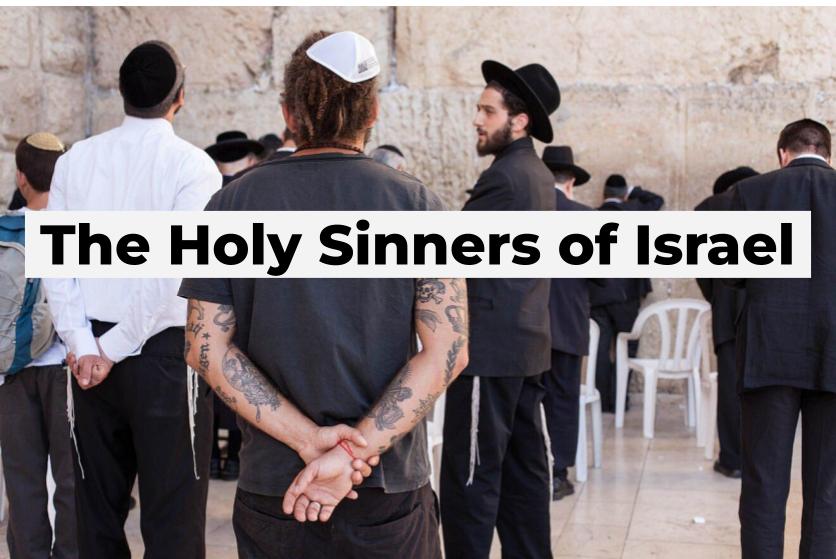
What is the true Jewish perspective on viewing those who are less religious in Israel?
One of the most challenging things to balance is our elevated, exalted view of Eretz Yisrael with the sometimes less than holy actions of the inhabitants who live here.
For our children who recently made Aliyah, they held visions of the Holy Land filled with stories from Tanach and the Gemara, imagining the streets filled with Tzaddikim and Mekubalim.
But sadly, that reality is not always the case. Not everyone in our beautiful land looks so holy from the outside.
What is the Torah perspective on this seeming contradiction? Do we scorn, distance and disdain those who seem less pious and observant than the religious standard? Or perhaps the Torah itself has a very different view of our “secular” brothers and sisters in Eretz Yisrael.
This topic caught my attention from a recent Gemara we saw in Daf Yomi this week:
Avodah Zara 26a
Come and see what the difference is between the thieves of Babylonia and the bandits of Eretz Yisrael. Although thieves are typically less violent than bandits, the thieves in Babylonia reacted to Rav Menashe’s action by denouncing Rav Yehuda, whereas the bandits in Eretz Yisrael praised the wisdom of Rabbi Akiva.
The Gemara in a side comment mentions that even the violent criminals of Eretz Yisrael have respect for our Torah Sages. And Rashi on that Gemara says that this is not just accidental!
And the bandits of the Land of Israel – who encountered the students of Rabbi Akiva and spoke in his praise. And even though bandits are generally promiscuous and thieving, [this is stated] to teach you the praise of the Land of Israel.
Just stop for a moment and consider what’s going on here. The Gemara is not speaking about rabbis and sages. It’s not speaking about nice religious community members. It’s speaking about violent criminals with no regard for the law. But those criminals in Eretz Yisrael still have spiritual merit and the Gemara picks up on the fact of the silver lining of these hardened thugs.
But this is not the only Gemara we see this concept.
There is a famous gemara in Kesubos 111a
Rabbi Elazar said: Anyone who resides in Eretz Yisrael dwells without transgression… Rabbi Yoḥanan said: Anyone who walks four cubits in Eretz Yisrael is assured of a place in the World-to-Come.
What exactly does this mean? Can one sin and do whatever they want and as long as they live in Eretz Yisrael they will be fine and holy?
The Ben Yehoyada shares a deeper perspective:
When it says “dwells without sin”, it means that through the holiness of the Land of Israel, the impure force created by sin is wiped away—and it does not appear on the person’s body, even on the very first day the sin was committed. And this is derived from the verse (Isaiah 33:24):“The people who dwell in it shall be forgiven their sin.” This refers to those who dwell in it—meaning in the “ה” (hei) of Eretz Yisrael, which is associated with the final hei of the Divine Name Havayah (Y-H-V-H), indicating that the Land is bound to holiness and Divine presence.
Yes, people here sin. There make mistakes. And sometimes their lives seem devoid of kedusha altogether. But the Ben Yehoyada explains that the inherent sanctity of just being connected to Eretz Yisrael keeps the individual connected and the sin temporary, no matter what.
Rav Otniel in his Pnei Sheviit Nekabalah spells it out further and says:
The very act of walking in the Land [of Israel] imparts a “spirit”, which merits a person and elevates his life.This is not dependent on the person’s spiritual level.
Just being here gives a Jew an extra spiritual connection and protection.
And perhaps most explicitly Rav Teichtal in Eim Habanim Semeicha lays it out clearly:
Anyone who dwells in Eretz Yisrael is called a tzaddik, even if he appears not to be so outwardly. For if he were not a tzaddik, the Land would vomit him out, as the verse says, ‘And the Land shall vomit out its inhabitants.’ And since the Land does not vomit him out, he is necessarily called a tzaddik—even if he is presumed to be a rasha. Clearly, we cannot judge the inhabitants of Eretz Yisrael based on superficial, physical sight, for ‘Man sees with the eyes, but Hashem sees into the heart.’ Therefore, we cannot judge or degrade any individuals, and certainly not the community, even if we see actions we do not approve of.
Now this does not mean that we should be complacent or accepting of actions and standards that go against the Torah. Our sensitivity demands that when we see another Jew far from his or her spiritual greatness it should pain us and we should feel a responsibility to help the situation from a place of love and respect.
But the overall approach that we need to adopt to every Jew we see, especially in Eretz Yisrael is seeing that Nekuda Tova, the inner point of goodness that is connected to the Eretz Yisrael and by definition Am Yisrael and Elokei Yisrael no matter where they are holding in life.
We should go out of our way to praise them for the good that they do and as Rashi said, ultimately bring full praise to the Land of Israel for all of its inhabitants. And this just might warrant the merit we need to get through these challenging times and see the darkness of destruction turn into the light of Geula!
Related Topics
Related Posts