
The IDF cannot be Britain’s excuse for antisemitism
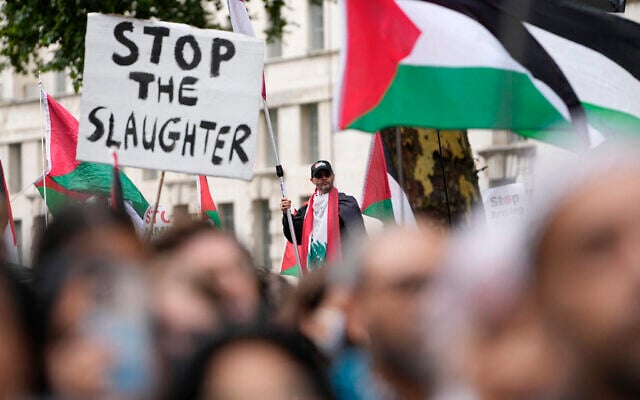
In April of this year, I wrote a piece in Haaretz to underline concerns that ten British citizens who served in the Israeli military may soon face war crimes investigations in the United Kingdom. At that point, there was a quickly blurring line between the actions and operations of the Jewish state, and diaspora Jews elsewhere in the world.
British Jews were once able to watch Israel’s war from afar, granted the luxury of separation from a country at war, to agree and disagree with this and that operation. What happened in Gaza, Egypt, or Lebanon may shape world opinion of Israel, but hardly ever into the streets of London, Manchester or Glasgow.
That line has now been crossed: in the first half of 2025, the Community Security Trust recorded the second-highest half-year figure ever of 1,521 antisemitic incidents across the entire United Kingdom. Unsurprisingly, more than half were explicitly linked to Israel, Gaza, or the IDF. Religious hate crime figures only serve to echo this trend: following Hamas’ massacre on 7 October 2023, police in England and Wales recorded 3,282 offences motivated by antisemitic hatred, double the previous year.
This sort of uptick tends to happen with each war Israel finds itself dragged into, and the facts bear repeating that antisemitism tends to come in waves tied to Middle Eastern violence: after the 1967 Six Day War, antisemitic incidents rose sharply in Europe, though Britain saw less of it than France; the Second Intifada of 2000-2005 brought its own respective spikes, as CST reported record numbers during its midpoint; it occurred when the British rap duo Bob Vylan led a crowd this summer in Glastonbury chanting, ‘death, death to the IDF.’ It is hardly surprising that within twenty-four hours, CST logged 26 separate antisemitic incidents in the highest daily total of the year to that point.
Earlier this year, too, legal scholars debated on whether British courts could prosecute war crimes allegedly committed by Israeli soldiers abroad. Whereas that discussion was more technical – questions of universal jurisdiction, evidentiary standards, political will, et cetera – today’s question is more immediate: there is no luxury of time, and can Britain protect its Jews when foreign wars are fought in their name, regardless of whether they agree with it or not?
One must admit that the British state has certainly been quicker to explore legal avenues against IDF officers than to confront the intimidation facing Jews in its own streets. Politicians, too, have undoubtedly been more comfortable denouncing Israeli military operations than condemning those who graffiti kosher shops and harass the Jewish families that such establishments attract.
European leaders tend to boast of their moral clarity abroad to inflate their standing amongst their populace when all seems more challenging at home. And the leaders who have declared their recognition of a Palestinian state – Keir Starmer in Britain, Pedro Sánchez in Spain, António Costa in Portugal, Justin Trudeau in Canada, Anthony Albanese in Australia – have chosen wilful ignorance, as if doing so could substitute for any negotiation.
There is clearly nothing inevitable about the rise of antisemitism in Britain. It is a conscious choice, made by those who indulge it, by those who excuse it, and by those who fail time and time again to adequately confront it. Foreign wars should not dictate whether a Jewish child in Golders Green deems it safe to walk to school every morning, and yet this is the reality Britain finds itself in. Unless the line between legitimate political debate and outright hatred is redrawn and enforced, the next war in Gaza will test Britain’s moral backbone at home more than it will the Israeli government.