
An American Student
The importance of the upcoming Knesset elections – for Benjamin Netanyahu
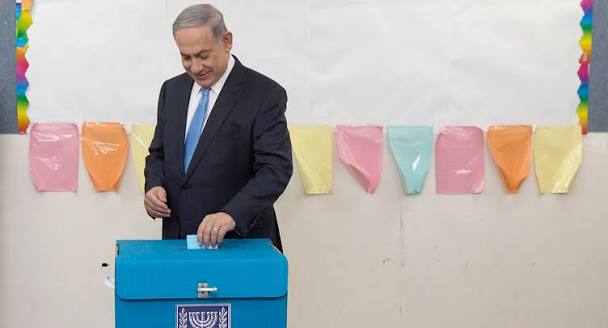
Prime Minister Benjamin Netanyahu votes in Knesset elections in Jerusalem, March 17, 2015.
Much hinges on Israel’s upcoming legislative elections. Come October 27th of this year, Israelis will issue the first national verdict on Prime Minister Benjamin Netanyahu’s wartime leadership since Hamas’s October 7th, 2023, attack. With the entire 120-seat Knesset up for election, Mr. Netanyahu’s Likud party seeks to maintain a coalition by securing the 61-seat majority with party allies, yet faces stark opposition from Arab and centrist parties. And, in fact, it is the first time since 1988 that the Knesset has completed a four-year term.
Leading amongst the opposition is the Yashar party, led by primary opponent Gadi Eisenkot, and the Together alliance, headed by the coalition of Naftali Bennett and Yair Lapid. Mr. Bennett previously ousted Mr. Netanyahu from the premiership for a brief period in 2021 before the latter returned to the premiership 18 months later.
With no national legislative elections following since the October 7th attacks, the election is considered a public judgment of Mr. Netanyahu’s handling of the numerous wars, conflicts and hostage crises that have embroiled the Jewish state since that fateful day in 2023. Moreover, despite Washington-Jerusalem relations fraught with disagreements of continued IDF military operations in southern Lebanon, Mr. Netanyahu can certainly bet on support for Likud from the White House. He has long been the recipient of support from President Trump, but an endorsement by the U.S. Commander-in-Chief does not guarantee victory, as demonstrated by Viktor Orbán’s recent Fidesz party loss despite ardent vocal backing in his favor by the American president and vice president. And so, the prime minister’s name hangs in the balance.
Rival leaders, especially Gadi Eisenkot, have promised on the campaign trail to hold Mr. Netanyahu fully accountable for the alleged failures and reactions pertaining to October 7th. And with The Jerusalem Post reporting Maariv polling on the Likud-led coalition securing only about 49 Knesset seats, short of the desired 61, it is uncertain whether Mr. Netanyahu will remain prime minister. Thus, if the polls are correct, the victorious yet fragmented opposition may soon find a new majority leader in his place.
It will be a tense next three months for the Netanyahu administration. The prime minister and other key cabinet ministers, particularly hard-liners Finance Minister Bezalel Smotrich and National Security Minister Itamar Ben-Gvir, are trying to fast-track measures such as continuing the legalized exemption of ultra-Orthodox Haredi from compulsory military service, further distancing the judiciary from the executive and legislative branches, and increasing Israeli settlements in the West Bank. Mr. Lapid has, contrarily, promised to enforce Haredi draft eligibility, much to the dismay of Israel’s 14-percent ultra-Orthodox population.
For Mr. Netanyahu, this election is more about preventing a political retaliation that could hold him accountable by a state commission of inquiry, as promised by the opposition, for “institutional failures” that resulted in Hamas’s deadly 2023 attack and kidnappings. The reported inaction by the Israeli government to respond, in the months leading up to the invasion, to Shin Bet intelligence that Hamas was becoming highly militarized is just one example put forth by Gadi Eisenkot’s Yashar.
And with the current division of the Israeli political spectrum, there is a good chance that Mr. Netanyahu will face renewed political and legal scrutiny, in particular towards both his long-standing corruption trial and any state inquiry into the Likud-led government’s conduct before and after October 7th.
Right now is a tumultuous time in Israeli politics, with mass demonstrations in Tel Aviv and record-low poll numbers for Mr. Netanyahu’s government. One must realize, however, that this is all commonplace in Israeli politics. And while leaders come and go, Benjamin Netanyahu’s legacy has, regardless of electoral outcome, left an indelible mark on his nation – whether that is a positive or a negative will be left to the people on October 27th.
Related Topics
Related Posts