
The Intimate Jaw
The Intimate Jaw: How Europe and the Arab World Are Being Squeezed into Strategic Poverty
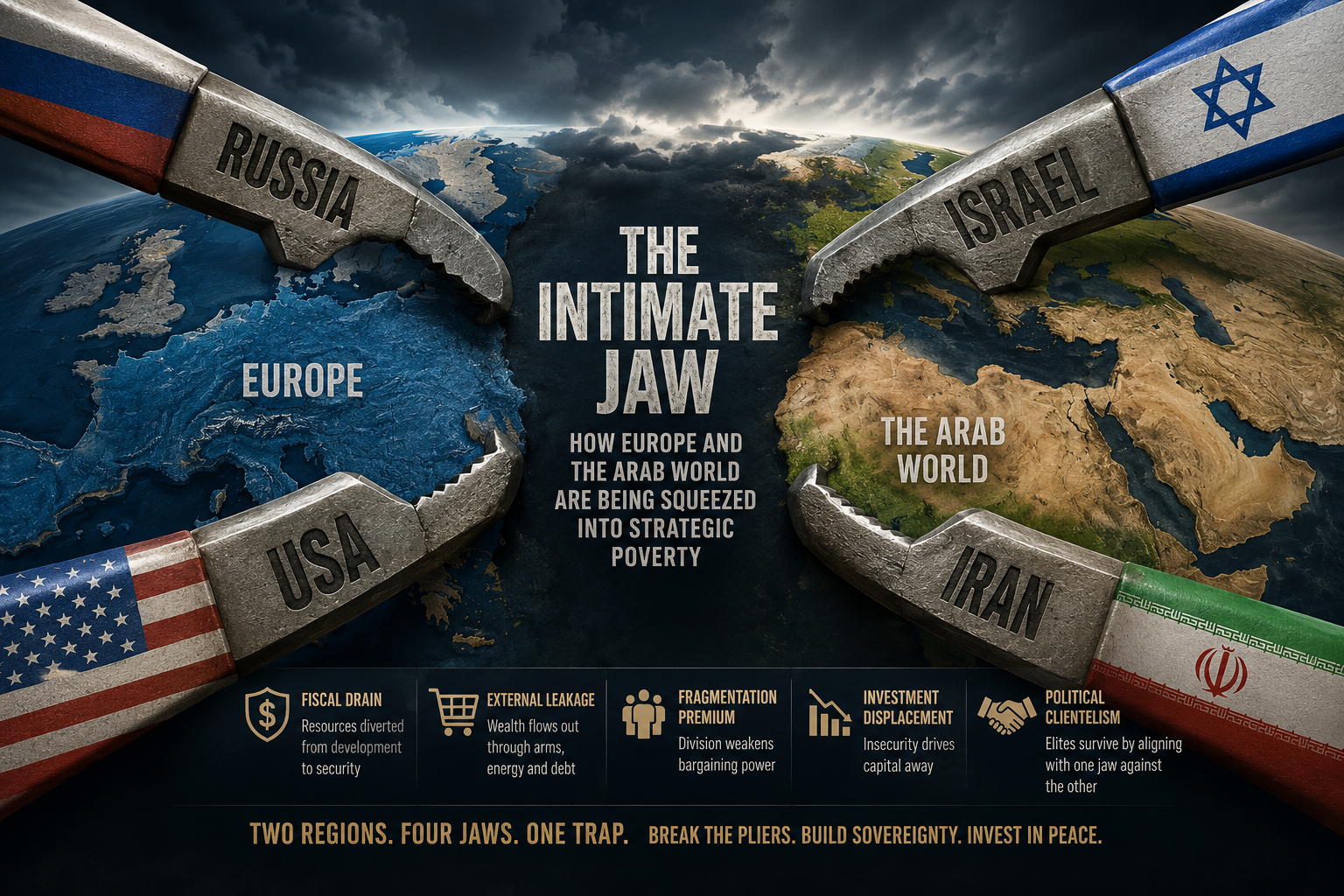
The usual map of geopolitics places enemies outside a region and allies inside its security perimeter. That map no longer explains Europe or the Arab world. I propose a different model: the intimate-jaw pliers.
Each region is squeezed between two powers. One is an overt military challenger. The other claims civilizational or religious kinship and presents itself as protector, yet converts protection into leverage. For EU-centred Europe, the visible jaw is Russia and the intimate jaw is the United States. For the Arab state system, the visible jaw is Israel and the intimate jaw is the Islamic Republic of Iran.
This is a structural comparison, not a claim of moral or legal equivalence. The actors and methods differ profoundly. Nor does the theory require coordination. Pliers work because two pressures converge, not because the jaws share a plan.
The jaw that calls itself family
Washington describes Europe and America as heirs to a shared Western civilization.1 Tehran invokes Islamic unity, resistance and support for oppressed Muslims.4 Both languages contain genuine ties. Both can also conceal hierarchy.
The United States protects Europe through NATO, but benefits from European dependence on American intelligence, weapons, technology, finance and energy. European purchases of US liquefied natural gas surged after Russia’s invasion of Ukraine.3 Defence spending is rising rapidly, while Europe still lacks an integrated defence-industrial and command structure. Donald Trump’s renewed July 2026 demand that the United States control Greenland, despite Danish sovereignty, makes the danger visible: an alliance can be reinterpreted as a right of supervision over the ally.2 MAGA did not create Atlantic asymmetry; it stripped away its diplomatic varnish.
Iran plays a comparable structural role through different instruments. Since the 1979 revolution, and especially after Iraq ceased to function as a regional buffer in 2003, Tehran has built influence through armed movements, political parties, religious networks, missiles and security relationships in Arab states. It speaks in the language of Islamic solidarity and resistance to Israel. The practical result has often been divided sovereignty, parallel armed authority and Arab territories exposed to retaliation.
The intimate jaw says: we belong to the same civilization, and only our power can protect you. The price is reduced strategic autonomy.
How the pliers manufacture poverty
In Europe, the likely outcome is relative impoverishment: slower productivity, pressure on welfare systems, higher energy and security costs, and less freedom to choose an independent course. In much of the Arab world, the result can include absolute poverty.
The mechanism has four parts. Insecurity diverts money from infrastructure, education and productive investment. Dependence causes security and energy expenditure to leak abroad. Fragmentation lets outside powers bargain separately with individual states, extracting a ‘fragmentation premium’ in money, alignment or access. Recurring conflict raises financing costs and pushes skilled people and capital toward safer jurisdictions.
The scale is visible. European allies and Canada increased core defence expenditure by nearly 20 per cent in 2025, while the EU’s Readiness 2030 framework contemplates up to EUR 800 billion in additional expenditure.5 In the Arab states, UNDP estimated that the 2026 escalation could erase 3.7 to 6 per cent of collective GDP and push up to four million additional people into poverty.6
The principal winners may not be whole countries. They are security, energy and political complexes able to monetise fear: American arms, technology and LNG interests; the Russian security state; Iran’s military-political networks; and Israel’s defence industries. Russia and Iran can gain leverage even while their economies stagnate or contract.7 Power for a regime is not prosperity for its population.
Who is the Arab world’s Ukraine?
Ukraine is a frontier state that absorbs the direct assault of an overt challenger, depends heavily on an external patron, and becomes the ground on which a wider regional order is contested.
The United States cannot be the Arab world’s Ukraine. It is the external patron, not the exposed frontier. The GCC is more plausible, but still not an exact equivalent. Gulf states possess vast financial assets, energy leverage and greater capacity to hedge. They resemble NATO’s eastern flank or South Korea more than wartime Ukraine.
Yet the 2026 escalation has given the GCC Ukraine-like features. Gulf territory hosts major American forces, lies beside Iran, contains globally vital infrastructure and, according to the GCC, has been targeted by Iranian missiles and drones.8 If the Gulf becomes the platform for a prolonged US-Iran war, the GCC could become the battlefield that bears the costs of its protector’s confrontation.
The stronger answer is that the Arab world has a distributed Ukraine. Palestine and Gaza bear the most direct destruction generated by the Israeli jaw. Lebanon, Syria, Iraq and Yemen have served as arenas for Iranian networks and Israeli or American counterforce. The GCC is the strategic rear that can rapidly become a front. Together they form a belt of exposed Arab spaces. That fragmentation is itself part of the pliers.
Israel’s paradox
Israel is one jaw, but it is also trapped inside the mechanism. Permanent Arab weakness can produce tactical advantages: divided neighbours, military freedom of action, demand for Israeli security technology and continued American support. Israel is now among the world’s leading arms exporters.9
Yet it cannot fully externalise the costs of disorder. Israel has limited strategic depth, a reserve-dependent military and an open economy sensitive to mobilisation, labour shortages, risk premiums and isolation. The IMF warns that elevated defence spending and prolonged mobilisation are weighing on medium-term growth and crowding out investment.10
Israel may become a successful but permanently mobilised garrison state: technologically advanced, militarily dominant and dependent on Washington. It may overextend itself and suffer capital flight, emigration, fiscal strain and deeper isolation. Or it may convert military strength into a regional settlement, including a credible political future for Palestinians and a broader non-aggression and economic compact.
Only the third path produces a durable peace dividend. Israel can win repeated wars while losing the conditions for ordinary prosperity. A poor, stateless and destabilised neighbourhood is not a normal market; it is a renewable source of insecurity.
Escaping the pliers
Europe needs strategic adulthood rather than anti-Americanism: integrated procurement, European command capacity, diversified energy and technology, and the ability to negotiate collectively with Washington. Supporting Ukraine should build European capacity and be tied to a coherent political end state. Greenlandic and Danish sovereignty must remain a test of whether alliance still means equality.
The GCC should not volunteer to become another Ukraine. It should lead a wider Arab security compact built around integrated air, missile and maritime defence under Arab political control; rules governing foreign bases; hardened civilian infrastructure; and dialogue with Iran conditioned on non-interference and state monopoly over armed force. A Palestinian political settlement is essential because it would remove the central conflict used by both Israel and Iran to justify continuing regional mobilisation.
Europe and the GCC should also cooperate directly in energy transition, ports, digital infrastructure, defence production and investment, reducing both regions’ dependence on a single patron.
The intimate jaw is dangerous because it speaks the language of belonging. But kinship without equality becomes hierarchy, and protection without autonomy becomes dependency. Europe and the Arab world will escape the pliers only when they can defend themselves, bargain collectively and prevent outside powers from turning fear into rent. The real choice is not simply between Russia and America, or Israel and Iran. It is between permanent dependency and regional adulthood.
Selected sources and further reading
- White House, “In Munich, Secretary Rubio Calls on Allies to Embrace Shared Heritage, Meet Challenges of New Era” (14 February 2026).
- Reuters, “Trump reiterates at NATO summit that Greenland should be controlled by US, not Denmark” (7 July 2026).
- US Energy Information Administration, “U.S. natural gas exports to grow nearly 30% by 2027” (16 April 2026).
- President of the Islamic Republic of Iran, “Stronger Islamic unity is most effective response to Israeli regime” (16 September 2025); Constitution of the Islamic Republic of Iran, art 154.
- NATO, “Defence Investment Update: Record Spending in Europe and Canada” (7 July 2026); Council of the EU, “European defence readiness”.
- UNDP, “Escalation in the Middle East reverses more than a year of economic growth in the Arab States region” (31 March 2026).
- IMF country data: Islamic Republic of Iran and Russian Federation (2026 projections).
- GCC Secretariat, Security Council briefing on Iranian attacks against GCC states (2 April 2026); US-GCC Ministerial Joint Statement (25 June 2026).
- SIPRI, “Global arms flows jump nearly 10 per cent as European demand soars” (9 March 2026).
- IMF, “Executive Board Concludes 2026 Article IV Consultation with Israel” (1 July 2026).
Drafting note: The comparison advanced here is structural rather than moral, legal or historical equivalence. Source links were checked on 29 July 2026.