CFO | Empower Society for Good I Author
The Inversion of Genocide
How do we learn to live with difference without turning difference into hate?
That question runs through my reflections on the Good Society. But what happens when that boundary has already been crossed—when demonisation makes another people’s suffering less visible and violence against them easier to explain away?
For me, as a Jew living in Israel after October 7, this is no abstract question.
In The Inversion of October 7, I explored how the massacre’s meaning was reversed. Terror became resistance. Victims became the accused. Israel’s response increasingly displaced the original atrocities as the central moral crime.
https://blogs.timesofisrael.com/the-inversion-of-october-7/
This week, I turn to one particularly charged word: Genocide.
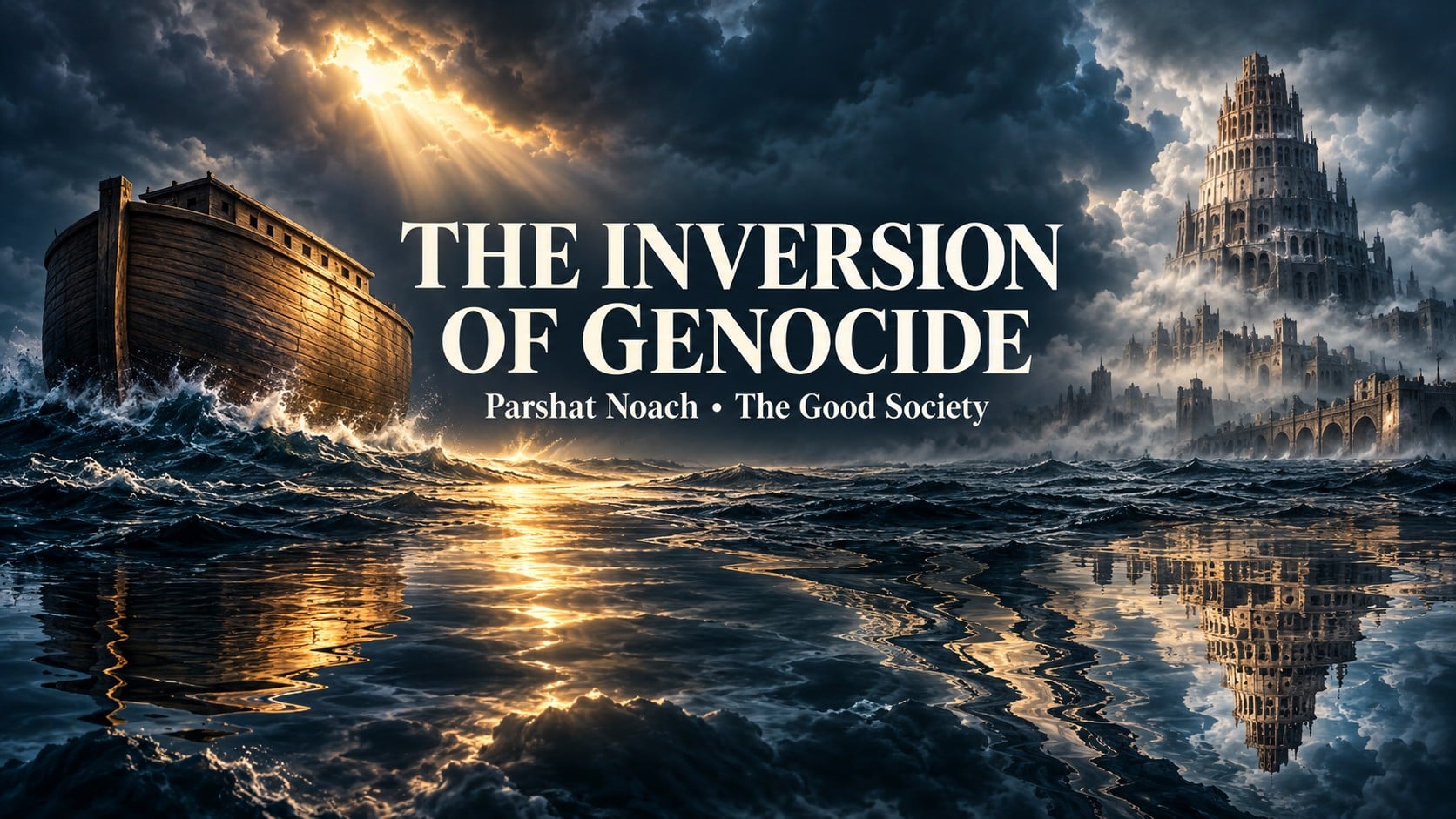
Parshat Noach provides the foundation: violence that corrupts civilisation, the responsibility to protect human life, and collective language that can suppress independent judgment.
A World Filled With Violence
The Torah describes the world before the Flood:
וַתִּשָּׁחֵת הָאָרֶץ לִפְנֵי הָאֱלֹהִים וַתִּמָּלֵא הָאָרֶץ חָמָס
“The earth became corrupt before God, and the earth was filled with violence.”
— Genesis 6:11.
The biblical word chamas translated as violence and the organisation Hamas have different origins. The resemblance strikes an Israeli reader, but the deeper warning concerns violence becoming normal.
The earth was filled with it.
Societies can accommodate cruelty, honour perpetrators and teach that certain people’s lives do not matter.
October 7 exposed that danger. Human beings were deliberately murdered and abducted, their lives expendable in pursuit of an ideological objective.
This did not emerge from an ideological vacuum. Hamas’s 1988 charter contained antisemitic conspiracy theories and religious language envisaging the killing of Jews.
Whatever our disagreements about governments, borders or Palestinian aspirations, those atrocities demand judgment.
A cause does not become righteous because its perpetrators call it righteous.
Where Is Noach?
Within this corrupt world stands Noach, righteous in his generation.
Can we retain our judgment when those around us have lost theirs? And is personal decency enough? What responsibility do we carry beyond the shelter of our homes?
Noach’s ark preserves life through catastrophe. Our responsibility also includes preventing catastrophe—protecting threatened people and challenging ideas that make their destruction acceptable.
A Good Society needs people who remain decent under pressure. It also needs people prepared to act.
Sacred Life Demands Protection
After the Flood, God tells Noach and his sons:
שֹׁפֵךְ דַּם הָאָדָם בָּאָדָם דָּמוֹ יִשָּׁפֵךְ כִּי בְּצֶלֶם אֱלֹהִים עָשָׂה אֶת־הָאָדָם
“Whoever sheds human blood, by human hands shall their blood be shed; for in the image of God He made humanity.”
— Genesis 9:6.
The verse joins human dignity to accountability for bloodshed. As Rabbi Steinsaltz writes in his commentary, this is the first appearance of the death penalty, which is to be imposed on the murderer.
It is not a complete rulebook for modern warfare. But it demands justice from those who murdered and carried out the atrocities of October 7th.
Israel faced a responsibility to defend its citizens and prevent another October 7. An appeal to humanity that ignores that duty leaves its intended beneficiaries exposed. It ignores basic justice.
Palestinian civilians suffering is unfortunately a direct result of Hamas-committed actions and atrocities.
Hamas could have chosen a different path. Surrender, disarm, seek peace. Build a Good Society. It didn’t, and that carries responsibility.
Instead, it chose to exploit the situation and put Israel’s response in the spotlight, leading to questions about Israel’s response
Alleging excessive force is different from alleging an intention to destroy Palestinians as a people.
What Genocide Means
Raphael Lemkin, a Polish-Jewish lawyer, introduced genocide in his 1944 book documenting Nazi policies. His thinking had also been shaped by the Ottoman destruction of the Armenians. He sought language, and ultimately law, to confront the destruction of peoples.
The Holocaust became its defining historical example.
Six million Jews were murdered because they were Jews.
Nazi Germany constructed a bureaucratic and industrial apparatus to identify, isolate, deport and murder them. Men, women, children and babies were targeted because an ideology had determined that the Jewish people should disappear.
Other peoples suffered deliberate destruction.
During the Armenian genocide, the United States Holocaust Memorial Museum estimates 664,000 to 1.2 million deaths through massacres, deportation, starvation and exposure.
In Rwanda in 1994, approximately 800,000 people, overwhelmingly Tutsi but also moderate Hutu and other opponents of the genocide, were murdered in roughly one hundred days.
Under Cambodia’s Khmer Rouge, approximately 1.5 to 2 million people died through execution, starvation, forced labour and disease. Tribunal proceedings identified genocide against Vietnamese and Cham minorities alongside extensive crimes against humanity and war crimes.
Under Joseph Stalin, repression, executions, deportations, imprisonment and catastrophic policies caused millions of deaths. Some estimates reach 20 million, although totals and attribution remain disputed.
Under Mao Zedong, estimates of excess deaths during the Great Leap Forward famine alone range from 16.5 million to 40 million.
These atrocities are a stain on civilisation. Every number represents a life, a family and a future extinguished.
Their scale does not make their intentions, methods or legal classifications identical. Hitler was a Nazi racial totalitarian; Stalin and Mao were communist dictators. Their victims cannot all be placed within one legal category.
Not every massacre is genocide. Not every war crime is genocide. Not every crime against humanity is genocide.
That does not diminish their horror. Words have meanings.
Genocide requires prohibited acts committed with the intention of destroying a national, ethnic, racial or religious group, wholly or partly, as such. The death toll alone cannot establish that intention.
When Accusation Becomes Identity
South Africa brought its genocide case against Israel before the International Court of Justice. The Court’s provisional measures impose binding obligations; they are not a final judgment that genocide occurred.
Beyond the courtroom, however, allegations can become assumptions. Repetition creates something people no longer believe needs proving.
For Jews, that mechanism has a terrible historical resonance.
The blood libel falsely accused Jews of murdering Christian children for ritual purposes. Demonisation made the allegation believable; the allegation then justified further demonisation.
I am not claiming that everyone alleging genocide is antisemitic. Israel must answer evidence concerning its conduct.
But when “genocidal” becomes a description of Israel’s inherent character, extending suspicion to Jews who identify with it, I believe it functions as a modern blood libel.
The comparison concerns collective demonisation.
For me, portraying Israel’s defensive struggle as a project of extermination produces a profound inversion: the Jewish state is cast in the image of those who sought to annihilate the Jews.
Jewish history provides no exemption from accountability. Neither does Palestinian suffering automatically establish an intention to destroy Palestinians as a people.
From Durban to Oslo
This vocabulary predates the present war.
In 1975, the UN General Assembly equated Zionism with racism. It revoked that determination in 1991.
At the NGO Forum accompanying the 2001 Durban conference against racism, Israel was accused through the language of apartheid, ethnic cleansing and genocide. Mary Robinson refused to recommend the NGO declaration, specifically objecting to its genocide language. This document was distinct from the intergovernmental conference’s adopted declaration.
That was twenty-two years before October 7.
This history cannot disprove a later allegation. It does show that the vocabulary was already established.
Navi Pillay subsequently chaired the UN commission that concluded in September 2025 that Israel had committed genocide in Gaza. Israel rejected its findings.
On 9 October 2026, she received the Nobel Peace Prize for promoting peace and international law.
Her wider career deserves acknowledgment. But neither her achievements nor the Nobel Committee’s endorsement makes her commission’s conclusions immune from challenge.
A Nobel Prize is not a judicial verdict. Prestige is not proof.
My objection is that the award risks being treated as an international seal of approval on the genocide accusation—as though honouring its leading author settles the argument.
The commission made a substantive finding. It must be assessed through its evidence and reasoning. The Nobel medal adds no evidence.
Institutions created to defend human dignity must accept rigorous scrutiny themselves. Their moral vocabulary cannot become a shield against questioning their judgments.
Sharansky: Can the Whole World Be Wrong?
Responding to Pillay’s award in his essay Is the Whole World Wrong?, Natan Sharansky wrote:
“Just because the entire world believes something does not make it true.”
He recalled Ahad Ha’am’s reflection on the blood libel: widespread acceptance had never made that accusation true. Sharansky’s argument challenges the authority we surrender to consensus.
It speaks directly to this reflection. International acclaim may increase an accusation’s influence without establishing its accuracy.
We must examine evidence and correct genuine wrongdoing. But intellectual integrity also requires the courage to reject a conclusion when we believe the evidence does not sustain it.
Babel: One Permitted Story
Parshat Noach brings us to Babel:
שָׂפָה אֶחָת וּדְבָרִים אֲחָדִים
“One language and one speech.”
— Genesis 11:1.
The Netziv interprets Babel as a warning about unity hardened into enforced conformity. Difference threatened the collective project.
Our democracies are not twentieth-century totalitarian regimes. Yet intellectual conformity does not always require a dictator. Cultural pressure can make certain conclusions compulsory.
Resistance. Colonialism. Apartheid. Genocide.
These words describe real phenomena. Their power makes precision essential.
If “resistance” excuses deliberate attacks on civilians, the label conceals the act. If every civilian death automatically confirms genocide, the conclusion has displaced the inquiry.
Evidence must determine the label. The label must not determine what evidence we are willing to see.
Babel asks whether we can question the accepted story. Noach asks whether we can remain righteous when others reward something else.
The Good Society
The Flood confronts us with normalised violence. Babel warns against collective certainty. The covenant grounds us to create a good society.
Together, they demand protection, accountability and independent judgment.
We can recognise Palestinian suffering, scrutinise Israeli decisions and confront genuine wrongdoing. We must also reject the romanticising of Hamas and the demonisation of Israel.
Universal principles require consistent application across conflicts, including Russia’s war against Ukraine. Suffering elsewhere excuses nothing here; it challenges selective moral attention.
We must be strong enough to defend life, honest enough to examine our actions, and courageous enough to challenge language that turns our survival into a crime.
A Good Society cannot shelter its conscience inside an ark while violence and falsehood fill the world outside.
Additional reading – A Society Can Be United—and Evil
This week I also reflected on how a crowd can unite around a lie. A nation can unite behind a tyrant. Shared hatred can create a powerful sense of belonging. So why do we so often speak of unity as though it were a virtue in itself?
In this week’s Good Society reflection on Parshat Noach, I explore the Tower of Babel and a troubling question: Why did God scatter a humanity that had learned to work together?
Drawing on Rashi, the Netziv, Rabbi Shai Held and Rabbi Jonathan Sacks, I ask what separates a strong society from a dangerous one—and whether we have learned to recognise the difference.
When everyone speaks with one voice, who still has the courage to say: this is wrong?
https://upgradingesg.substack.com/p/a-society-can-be-unitedand-evil
Related Topics
Related Posts