
The Iran war is not Suez, but America needs to make the right choice
Dear readers,
The article that you will read below has had an interesting gestation, which in itself throws an intriguing light on the intensifying crisis of the present, and is therefore worth briefly recounting here. On 27 June, I read an interesting article by Nick Lichtenberg, who is the Business Editor at Fortune magazine. In that article, Mr. Lichtenberg summarised the views of Ray Dalio, who is a very famous hedge fund founder. I found not one, but several, fundamental flaws in Mr. Dalio’s arguments and posted a note on my Substack, The New World Crisis, summarising these flaws and the objective facts as these can be seen in various sources. I contacted Mr. Lichtenberg to make him aware of this note of mine and propose that I write a response to Mr. Dalio’s arguments, to be published by Fortune. Mr. Lichtenberg expressed definite interest, and agreed to my suggestion that I send him my manuscript that week. This I did, on 2 July. I was not surprised to receive no answer over the weekend of America’s 250th anniversary, but was surprised when no reply came thereafter. It transpired that Mr. Lichtenberg was on vacation, but he did find time to suggest that his non-reply did not constitute a rejection. Only after further prodding, on 15 July, did Fortune‘s unprofessional Business Editor manage to formally reject my proposal. This story is a small window, but a window nonetheless, on the state of modern America. Now, to a more important story, my reply to Mr Dalio’s arguments:
Ray Dalio’s comparison of the Suez Crisis of 1956 to the American-Israeli war against Iran of 2026, as summarized by Nick Lichtenberg, is superficially attractive, but fundamentally wrong on the facts. The two situations are completely different, and America can quickly – yes, quickly – resolve the current difficulties it is having with the criminal and obtuse Iranian regime. What links the two crises is the fact that a resolution in favor of US interests requires sound and active American decision-making. This was absent in 1956, and the consequences were profoundly negative. If the decision-making problem recurs in 2026, the consequences will be as bad or worse than they were 70 years prior.
First, consider what actually happened in 1956. Dalio’s core thesis is that Britain mishandled Egypt’s seizure of the Suez Canal so badly that it precipitated the end of Empire. The first problem with this argument is that Britain’s Empire had in fact been in crisis for decades prior, and had ended publicly and very formally in 1947, nine years before Suez.
On July 1, 1916, slightly more than 40 years before Suez, the Empire had launched a ‘Big Push,’ a massive offensive, against German forces on the Somme during the First World War. On that single day, the worst in British military history, the Empire’s forces lost 19,240 men dead, 2,152 missing and 585 taken prisoner. The war as a whole cost the Empire 956,703 lives. This enormous number is greater than the total number of American deaths in both World Wars, the Korean War and the Vietnam War, combined. Britain was also weighed down by a huge debt to America for purchases of food and munitions made during the war. The Empire won the war, but never recovered from its enormous cost.
The British Empire’s decline accelerated through the Great Depression and the Second World War. First, the Depression led to fiscal austerity, unrest in the Royal Navy and Britain crashing out of the Gold Standard immediately after that unrest, in September 1931. Then, the new war led to Britain running out of money. By December 1940, Prime Minister Winston Churchill was warning President Franklin Roosevelt that Britain would soon be unable to pay for supplies from America, prompting Congressional passage of the Lend-Lease Act of March 11, 1941, critical to British ability to continue to fight.
The Grand Alliance won the war, but the Empire’s strength had run out. The Indian Independence Act of 1947 announced its formal end, including the removal of ‘Emperor of India’ as a Royal title. Soon after, on September 18, 1949, a new devaluation reduced the sterling’s exchange value in dollar terms by 30.5%. Both in political and monetary terms, this was the end of Empire.
The Suez Crisis was not imperial, but rather a limited attempt by both Britain and France to preserve their much-reduced influence in the face of a ruthless dictator, Egypt’s Gamal Abdel Nasser. Nasser first overthrew Egypt’s King Farouk in a coup in 1952, then his former military co-conspirator President Mohammed Naguib in 1954, and then signed a large arms deal with Soviet-controlled Czechoslovakia in autumn 1955. Only after that did he seize the Canal. Britain’s choice was to accept that it had become irrelevant, or to act. It acted, and combined British, French and Israeli action defeated Egypt in a matter of days.
At this point in the crisis, it was America, not Britain, which made the critical error – the second problem with Dalio’s argument. America did not have to betray three democratic countries with which it had good relations in favor of a dictatorship which was purchasing weapons from the Eastern bloc, but it did. Quite simply, President Dwight Eisenhower panicked. He was afraid that the Soviet Union would take military action, even as the Soviet Army was drowning a Hungarian movement for greater independence from Soviet dictates in blood on the streets of Budapest. The USSR did not in fact have good military options in the Middle East, as American intelligence correctly assessed at the time, but mere threats were enough to bounce the administration into extorting its allies into withdrawal through financial pressure.
The consequences of Eisenhower’s foolish decision were awful. Both Britain and France effectively abandoned military power as an instrument of policy. The British defense budget was cut 10% in 1957, the year after Suez, something Americans should remember when they complain about low European defense spending now. Seven decades later, Britain’s situation has not stabilized. The BBC’s Chris Mason describes its current crisis as “an anemic economy, a high tax burden, high national debt, a spiraling benefits bill and huge extra demands for defense spending.” It is reasonable to add to the list of problems the governing Labour party, which refuses to significantly cut benefits and thus increases budgetary pressures. All of this can be traced back to the psychological breaking point of the Suez crisis.
In the Middle East, Eisenhower’s panic led to a rapid unravelling. Egypt became a close Soviet ally and a recipient of enormous quantities of military equipment. Military officers throughout the region sought to follow Nasser’s example. The President effectively reversed course, stating on January 5, 1957, two months after Suez, that “if power-hungry Communists should either falsely or correctly estimate that the Middle East is inadequately defended, they might be tempted to use open measures of armed attack.” It was a little late. The Jordanian monarchy barely survived a coup attempt that year. The following year, the Iraqi royal family literally did not survive a coup. The day after it was executed, Eisenhower sent the Marines to Lebanon, temporarily resolving a crisis there. America spent decades, and hundreds of billions of dollars, cleaning up the mess thoughtless American policy had made.
Right now, America’s position is fundamentally different from Britain’s in 1956. Total Allied, far from only American, deaths from all causes over two decades of military operations in Afghanistan and Iraq amounted to 8,492 personnel, less than half of the Empire’s deaths on that awful first day of the Somme. Every death is a disaster for relatives and friends, but America as a nation is not weighed down by the burden of massive past casualties. As for fiscal pressure, National Defense was assigned 13.7% of federal expenditures in the 2025 fiscal year, significantly less than either Medicare or Social Security. Defense spending stands at less than 3.5% of American GDP and not too far from post-1945 historical lows. Few Americans realize that even at the height of the Afghan and Iraq wars, the fiscal burden of defense barely reached the level of the Cold War minimum.
The burden that America does carry if that of past defeats in unreasonably extended wars. The shame of the helicopter on the embassy roof in Saigon in defeated South Vietnam. The greater shame of a teenager falling to his death from a U.S. cargo plane leaving fallen Kabul. Eleven years in Vietnam, twenty in Afghanistan, all flushed down the drain.
The lesson of the failures of Vietnam, Afghanistan and Iraq is not to quit a war hard and early, as the Trump administration gives the impression of trying now. It is also not to quit on Allies, as Eisenhower did during the Suez crisis. When Vice President JD Vance dismissively tells Israelis “What is your exact proposal? You’re a country of nine million people,” and ignores that Israel conducted 10,800 strikes on Iran compared to America’s 13,500, what remains of Allied, not just Israeli, confidence in American reliability is further undermined. This is the one point on which Ray Dalio is right. If America walks, leaves the situation as it is, its credibility in relation to Taiwan will be crippled. Nobody will believe that if the U.S. deliberately avoids any further fighting with Iran, it will nonetheless be willing to confront China’s far more powerful military. It this becomes a settled opinion, American fiscal credibility and the dollar’s position will also come under threat.
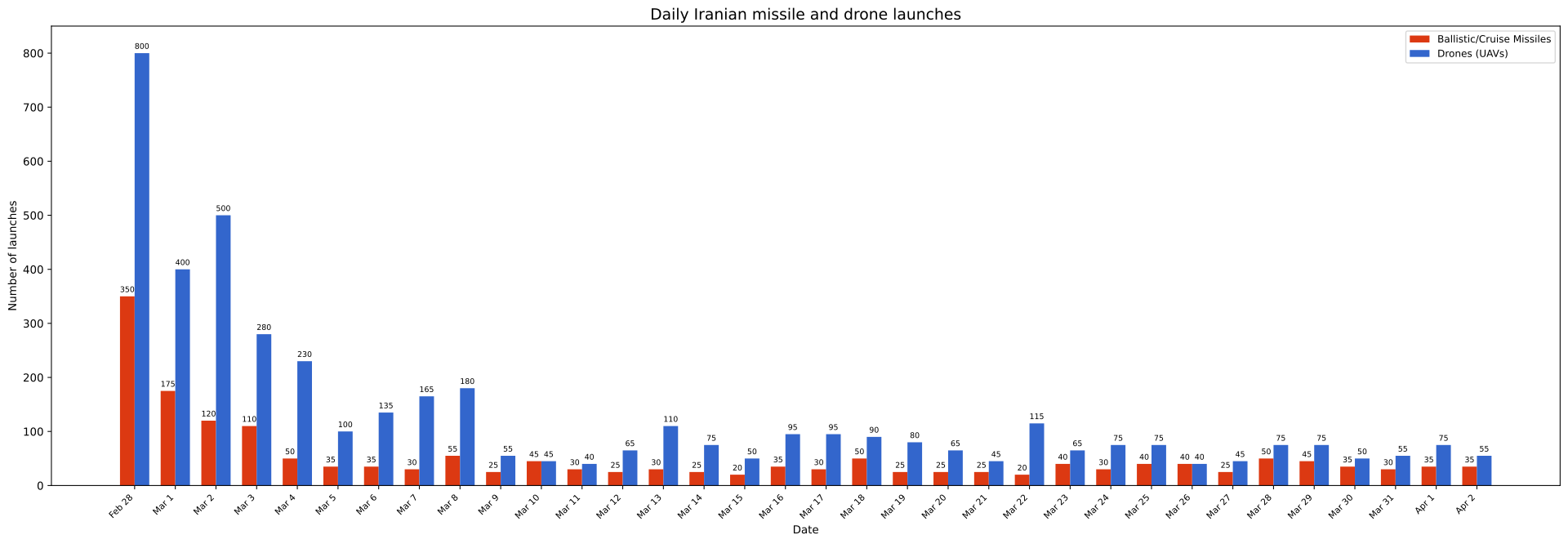
The good thing about America’s problem with Iran is that unlike Britain in 1956, it holds its destiny in its own hands. If America resumes the war, no one can stop it. The Iranian military managed to shoot down only two American planes and an Apache helicopter in the fighting so far. Iran’s oil infrastructure is incredibly exposed to American attack. Its dominant oil export terminal on tiny Kharg Island can be wrecked in a matter of hours. The alternative terminal at Jask is of minor significance, and its single mooring can be destroyed with consummate ease. A minimally active and competent policy will get America out of the crisis with a decisive success. If this minimum is out of reach, America cannot hope for a successful future.
—
If you found what you read above interesting and substantive, do read more and subscribe to my Substack, The New World Crisis.