
How the Iranian regime plans to survive its own collapse
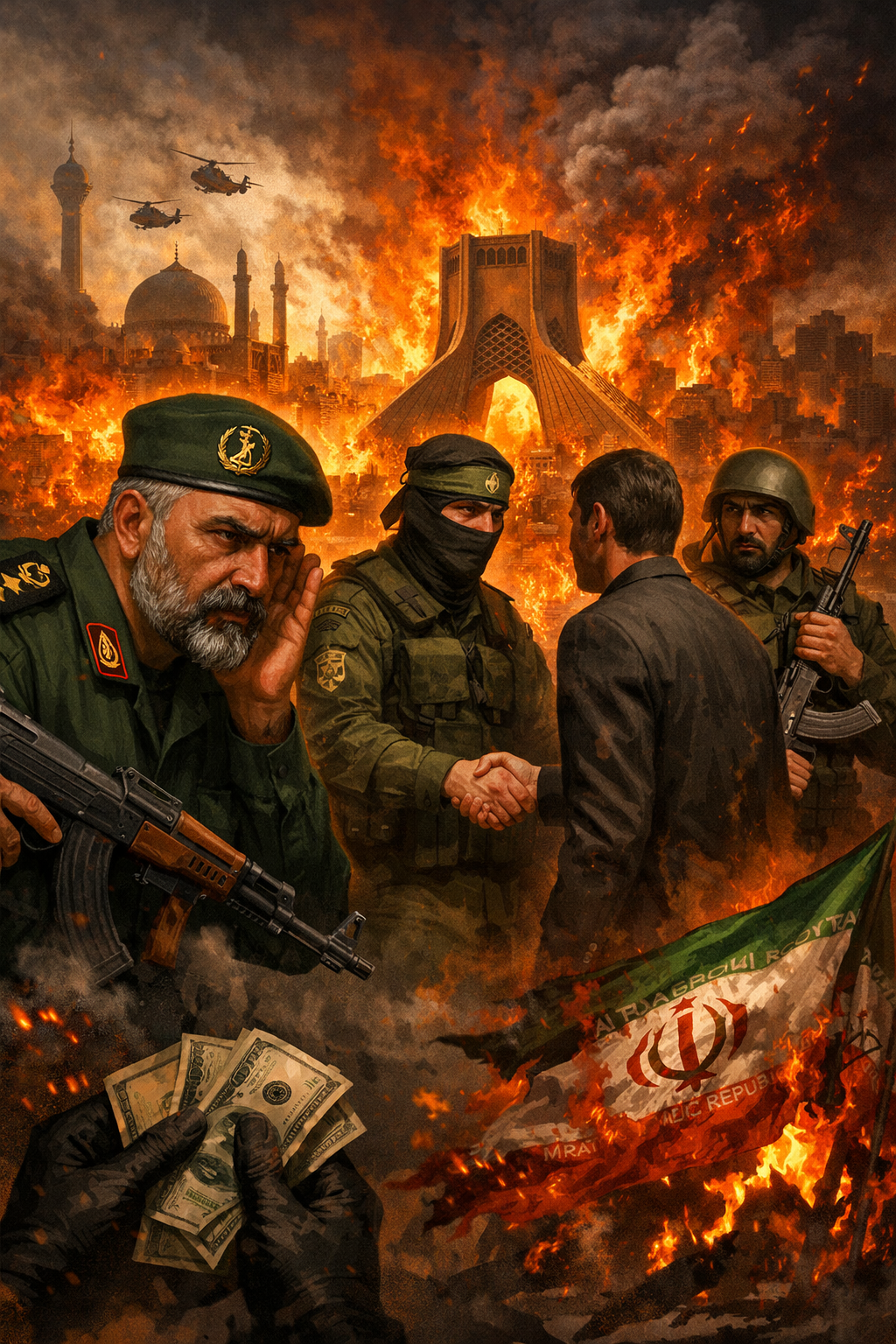
When the Islamic Republic begins to crack, the Islamic Revolutionary Guard Corps will not simply watch the rubble fall. It will move – methodically, opportunistically, and with plans already rehearsed – to ensure that the regime does not truly end, but merely changes costume.
This is not a conjecture born of cynicism. It is the institutional logic of a revolutionary guard that was built to outlast individuals, to protect the architecture of power rather than the face on the posters, and to treat every political rupture as an opening for reinvention.
The IRGC was not created as a conventional military formation. It was designed as the regime’s guarantor: an armed ideology with its own intelligence organs, its own patronage and procurement networks, and its own commercial empire. It has spent decades perfecting a survival doctrine that can be stated plainly: if the center wobbles, tighten the perimeter; if legitimacy collapses, manufacture necessity; if the public turns, make the alternative appear worse. The Guard’s greatest fear is not losing an election. It is losing indispensability.
This is why the most dangerous phase of Iran’s struggle may not be the uprising itself, but the moment when the IRGC begins to enact its contingency plans. As “Rome” burns – when the streets swell, the clerical class panics, and the bureaucracy hesitates – many commanders will seek to approach the opposition and feign a late conversion to patriotism. They will arrive with trembling voices and carefully chosen phrases: fear for the country, concern for stability, horror at violence they previously administered. They will offer cooperation. They will plead for “order.” They will suggest that the future needs them. Some may be sincere; many will not. But the pattern will be structured: controlled defections designed to preserve the institution while shedding the most discredited skin.
The intended outcome is obvious. The IRGC will attempt to seize the transitional moment and present itself as the sole barrier between Iran and chaos. It will claim that without the Guard, the country will become Syria; without the Guard, foreign powers will invade; without the Guard, separatists will tear the nation apart. It will do this because fear has always been its currency, and because it understands that anxious populations can be stampeded into accepting the familiar jailer as the price of avoiding an unknown disorder.
Do not underestimate the strategic imagination at work here. There are several routes by which the IRGC can try to keep its grip while pretending it has let go.
One route is the “regime-from-within” maneuver: a new arrangement in which senior IRGC networks retain control over security, intelligence, ports, customs, and key industries, while a softer political façade is offered to the world as proof of “change.” This is the sleight of hand that authoritarian systems favor when they want sanctions relief and diplomatic rehabilitation: change the rhetoric, shuffle the personnel, preserve the instruments.
Another is the underground strategy: if it cannot openly dominate, it can sabotage. A Guard that has spent decades training proxies and running deniable operations knows how to foment disorder without leaving a clean signature. It can encourage street violence by intermediaries, sow sectarian and ethnic tension, and use targeted disruption – energy infrastructure, transport, communications – to make a new order look incompetent. The purpose is not merely vengeance. It is to create the conditions in which the public begs for “security,” and the Guard – having manufactured insecurity – offers itself as the cure.
A third route is the decapitation of genuine transition leadership. If there are figures who command consistent loyalty – those who have stood with the people from the outset, and those around whom a coherent national restoration might be built – the IRGC will attempt to isolate them, compromise them, or fracture their coalition. It will rely on its oldest techniques: infiltration, blackmail, manufactured scandal, and the weaponization of rumor. And yes, it will revive the regime’s favorite incantation: the spectre of “foreign intervention,” not as analysis but as poison – used to delegitimize authentic opposition as agents and to excuse continued coercion as defence of sovereignty.
This is not paranoia. It is a warning about protocols. The IRGC is a bureaucracy of coercion. Bureaucracies, unlike mobs, plan. They maintain files. They cultivate assets. They map loyalties. They keep options open. They are capable, in the same week, of shooting protesters and then sending “quiet emissaries” to opposition circles to propose a deal. That is not contradiction; it is method.
What should be done, then, if Iran is to avoid the classic fate of revolutions: victory stolen by the men who controlled the guns?
First, Iranians – and those who support them – must reject the seductive lie that stability requires the continued dominance of the very apparatus that destroyed civic life. Stability is not the continuation of fear. Stability is the restoration of law.
Second, any transition worthy of the name must establish disciplined procedures for handling would-be defectors and security officials: vetting, documentation, verified disclosures, conditional leniency for lesser offenses, and prosecution for grave crimes. The IRGC survives on the destruction of evidence and the disappearance of accountability. The transition must survive on the opposite: records preserved, chains of command exposed, financial trails secured.
Third, there must be early, explicit planning for security-sector reform and economic disentanglement. The IRGC is not merely a “force.” It is a political economy. A new Iran cannot breathe while that parallel state retains its commercial empire and intelligence reach. This is not a call for vengeance. It is the minimum requirement for normal statehood.
And finally, Iranians must practice the hardest discipline of liberation: trusting the brave without becoming credulous; accepting help without surrendering the future to late-arriving opportunists. In the decisive hour, many will offer to be forgiven. Some will deserve it. But no nation is obliged to build its new house on the foundations of the old prison.
If the IRGC’s plans succeed, Iran will not collapse into freedom. It will collapse into a managed instability – a permanent crisis from which the Guard extracts power, profit, and supposed indispensability. This is the danger. It is not the fall of the Islamic Republic that should frighten us. It is the prospect that, without vigilance, the same machinery will survive the flames and rule the ashes.