

Geopolitical Analyst: Bridging Somaliland & Israel to the world
The Isaaq Genocide: Remembering the Dead, Rebuilding Peace
From the destruction of Hargeisa and Burao to reconciliation, democratic elections, and the continuing pursuit of international recognition.
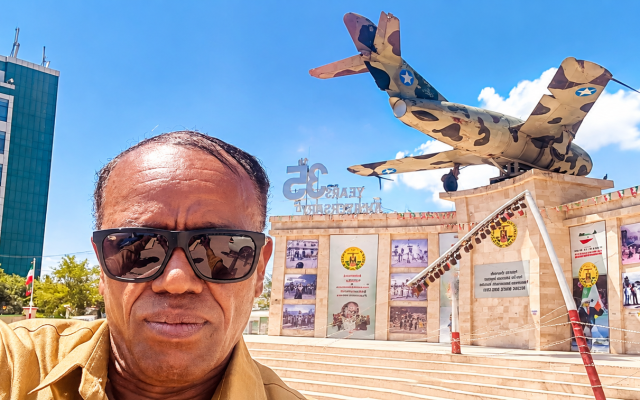
I am standing at the centre of Hargeisa, a fighter aircraft on a stone monument stands above me as I take a selfie (pictured below). The aircraft is not displayed to glorify war. It confronts visitors with the memory of a government that turned its military power against civilians.
Around it, the traffic of a rebuilt capital passes beneath Somaliland flags. In one scene, the past and present meet: destruction remembered, ordinary life restored.
The Isaaq Genocide is central to Somaliland’s historical memory. Yet remembrance need not become a demand for inherited revenge. Its greater purpose is to honour those killed, preserve evidence, defend the dignity of survivors and teach future generations why peace must be protected.
Somaliland’s subsequent record of reconciliation and institution-building deserves to be understood in that light—not as proof of a flawless society, but as an achievement forged under unusually difficult circumstances.
Independence, union and the road to catastrophe
British Somaliland became independent on 26 June 1960. On 1 July, it joined the former Italian-administered territory of Somalia to create the Somali Republic, expressing a wider aspiration for Somali unity. The union’s constitutional arrangements and subsequent political development remained disputed. After the military coup of 1969, Mohamed Siad Barre’s regime concentrated power and suppressed opposition across Somalia.
In the northwest, the formation of the Somali National Movement (SNM) in 1981 was followed by increasingly severe government reprisals against Isaaq civilians, whom state security forces frequently treated as presumptive supporters of the insurgency. Detention, torture, executions, attacks on livelihoods and intimidation preceded the full-scale devastation of 1988.
The atrocities were committed by Barre’s government and its forces; responsibility should not be transferred to ordinary Somali communities or to subsequent generations.
1988: The destruction of cities and civilian lives
When SNM forces launched their offensive in May 1988, the government’s response devastated Hargeisa, Burao and surrounding communities. The Somali Air Force bombed Hargeisa, including from the city’s own airport. Artillery fire struck urban areas and people fleeing the fighting. Other killings and abuses were reported in Berbera, rural districts and settlements across the northwest. The violence shattered families and businesses and drove large numbers of people into displacement, including across the Ethiopian border.
This history does not rest solely on later recollection. Amnesty International’s 1989 report documented widespread extrajudicial executions, deliberate artillery attacks on fleeing civilians and further killings in northern districts. Africa Watch’s major January 1990 investigation assembled survivor and refugee testimony about abuses before and during the war.
Human Rights Watch subsequently cited an estimate of 50,000–60,000 Isaaq civilians killed between May 1988 and January 1990. Other sources estimate the casualties to be closer to 200000 people.
Somaliland commemorates these events as the Isaaq Genocide. The documented pattern of collective targeting and mass atrocity makes preservation and independent examination of the evidence essential. At the same time, the legal characterization of genocide and individual criminal liability are distinct questions requiring appropriate legal standards and adjudication; there has been no final international criminal tribunal judgment covering the campaign as a whole.
Memory must rest on evidence
Survivor testimony is indispensable, but memory also requires archives, records and forensic investigation. A Physicians for Human Rights mission, conducted under United Nations human rights auspices in 1997 and published in a 1998 UN report, assessed alleged mass-grave sites around Hargeisa and recommended further forensic investigations involving international and local specialists. Its findings offer a foundation for careful documentation, not a substitute for the continued work needed to establish identities, preserve remains and support families seeking answers.
Schools, universities, memorial institutions and independent researchers can preserve oral histories, records of displacement, photographs, court materials and evidence from grave sites.
The aim should be a durable historical record accessible to Somalilanders, Somalis elsewhere and international scholars. Rigorous documentation honours victims more faithfully than inflated statistics or claims that cannot be corroborated.
Restoration of sovereignty—and the harder work of peace
Somaliland declared the restoration of its independence at Burao on 18 May 1991, after the collapse of Barre’s regime. The declaration did not rebuild a country overnight. Refugees returned to damaged neighbourhoods, livelihoods had to be restored, and former combatants and divided communities had to find ways to coexist. The peace process involved elders, religious figures, civic leaders, political representatives, traders and diaspora networks; it also experienced setbacks and renewed fighting.
The 1993 Borama conference helped move Somaliland toward civilian administration and a negotiated institutional settlement. Scholarly research on Somaliland’s early peacebuilding describes the importance of mediation, dialogue and consensus—and warns against presenting the process as smooth or inevitable. Communities rebuilt homes and markets while political institutions slowly developed. These achievements are inseparable from the labour of people who lost much but still invested in a shared future.
There is a difficult lesson here. To remember the atrocities without demanding revenge is not to excuse them. It is to insist that accountability and reconciliation serve the living as well as honour the dead. Peacebuilding requires security for every community, room for disagreement, and the refusal to pass collective guilt from one generation to the next.
The ballot box as part of reconstruction
The contrast between 1988 and the 2024 presidential election captures another chapter of this history. In November 2024, opposition candidate Abdirahman Mohamed Abdullahi (Irro) defeated incumbent Muse Bihi Abdi, and the presidency changed hands peacefully. The election used iris-based biometric voter verification. An international observer mission reported significant public participation while also identifying shortcomings and recommendations for future reforms. This was a milestone in electoral politics, not evidence that democracy has no remaining weaknesses.
The value of that transition is better appreciated against the memory of state violence. Where armed conflict once settled political differences, citizens now have an established—if imperfect—electoral means of replacing their president. Protecting that progress demands further work on institutions, political freedoms, accountability and meaningful inclusion across Somaliland.
Why the Hargeisa War Memorial belongs to everyone
At the memorial, contemporary Hargeisa surrounds a reminder of the 1988 aerial bombardment. Photograph supplied by the author.
The Hargeisa War Memorial is one of the city’s most important sites of public memory. Its MiG-17 fighter aircraft recalls the air attacks, while the rebuilt surroundings tell a second story: survival and recovery. A visitor can stand beneath the aircraft and see both the harm that state power can inflict and what ordinary people can rebuild after a catastrophe.
Every Somalilander visiting Hargeisa should have the opportunity to encounter that history. For survivors, the monument recalls loss. For younger generations, it raises questions they may otherwise know only through family stories. For visitors from Somalia and abroad, it can invite a more informed understanding of why the events of the late 1980s remain central to Somaliland’s political identity.
The memorial’s deepest civic value is educational. It should prompt visitors to consider the protection of civilians, the dangers of collective punishment and the responsibility of public institutions. The lessons should extend to all communities: no citizen’s safety may depend on clan identity or political allegiance. Remembrance should strengthen a commitment to preventing future atrocities wherever they occur.
Recognition, patience and the responsibilities of sovereignty
Somaliland’s campaign for recognition rests on its historical claim of independence in June 1960, its experience of union, its 1991 declaration and the institutions it has built since. The African Union fact-finding mission of 2005 acknowledged the distinctive circumstances of the case and recommended special consideration. That recommendation did not itself confer recognition, and Somaliland’s status continues to be disputed internationally.
Israel’s formal recognition on 26 December 2025 marked a new diplomatic development and prompted celebrations in Somaliland. The Israeli Knesset later recorded an official presidential visit in June 2026. Somalia and a number of other governments opposed the recognition on territorial-integrity grounds. Neither the recognition nor the opposition removes the need for peaceful regional diplomacy, respect for civilian protection and careful management of the consequences for communities across the Horn of Africa.
The strongest historical argument Somaliland can make is not that past suffering alone determines present international legal status. It is that its political history, the documented atrocities, its locally negotiated recovery and its contemporary institutions deserve serious examination together. Patience in diplomacy does not require silence about the past; it requires a factual record, sustained engagement and the discipline to keep disagreements political rather than violent.
What remembrance asks of the next generation
On 18 May, Somalilanders celebrate the restoration of sovereignty. The annual occasion invites pride, but it also invites reflection. The flags and public gatherings gain deeper meaning when placed beside photographs of destroyed cities, survivors returning home and the painstaking creation of institutions after 1991. The celebrations following Israel’s recognition belong to that continuing story, while the 2024 election illustrates the domestic responsibilities that accompany a claim to self-government.
Hargeisa’s fighter aircraft will remain suspended over the monument. It cannot return the dead, resolve every disputed historical question or deliver international recognition. What it can do is keep the moral obligations of remembrance visible in daily life: document the truth, protect every civilian, teach history carefully, resolve political differences without violence and make space for a future that does not require anyone to inherit hatred.
A city once attacked from the air has rebuilt streets around the aircraft that recalls its devastation. That is the image worth carrying forward: remembrance without revenge, resilience without forgetting, and the patient work of peace.
Selected sources and further reading
Africa Watch / Human Rights Watch, A Government at War with Its Own People (1990)
Amnesty International, Annual Report 1989 — Somalia
Human Rights Watch, Somalia report (1993)
UN / Physicians for Human Rights, Forensic assessment of Hargeisa mass graves (1998)
African Union, 2005 Somaliland fact-finding mission (historical text reproduced)
Bradbury et al., Emergence of a Somali State, African Affairs (2009)
UCL, 2024 election observer mission final report announcement (2025)
Somaliland Ministry of Foreign Affairs, Israeli recognition (26 Dec 2025)
Israeli Knesset, Somaliland presidential visit (17 June 2026)
Somali Ministry of Foreign Affairs, opposing recognition (Dec 2025)
- Author’s note: The term “Isaaq Genocide” is used as the widely employed historical and commemorative designation. The article distinguishes documented atrocities and attributed casualty estimates from a final international criminal judicial finding.
Related Topics
Related Posts