
The Jew, the Jew, shalt thou pursue?
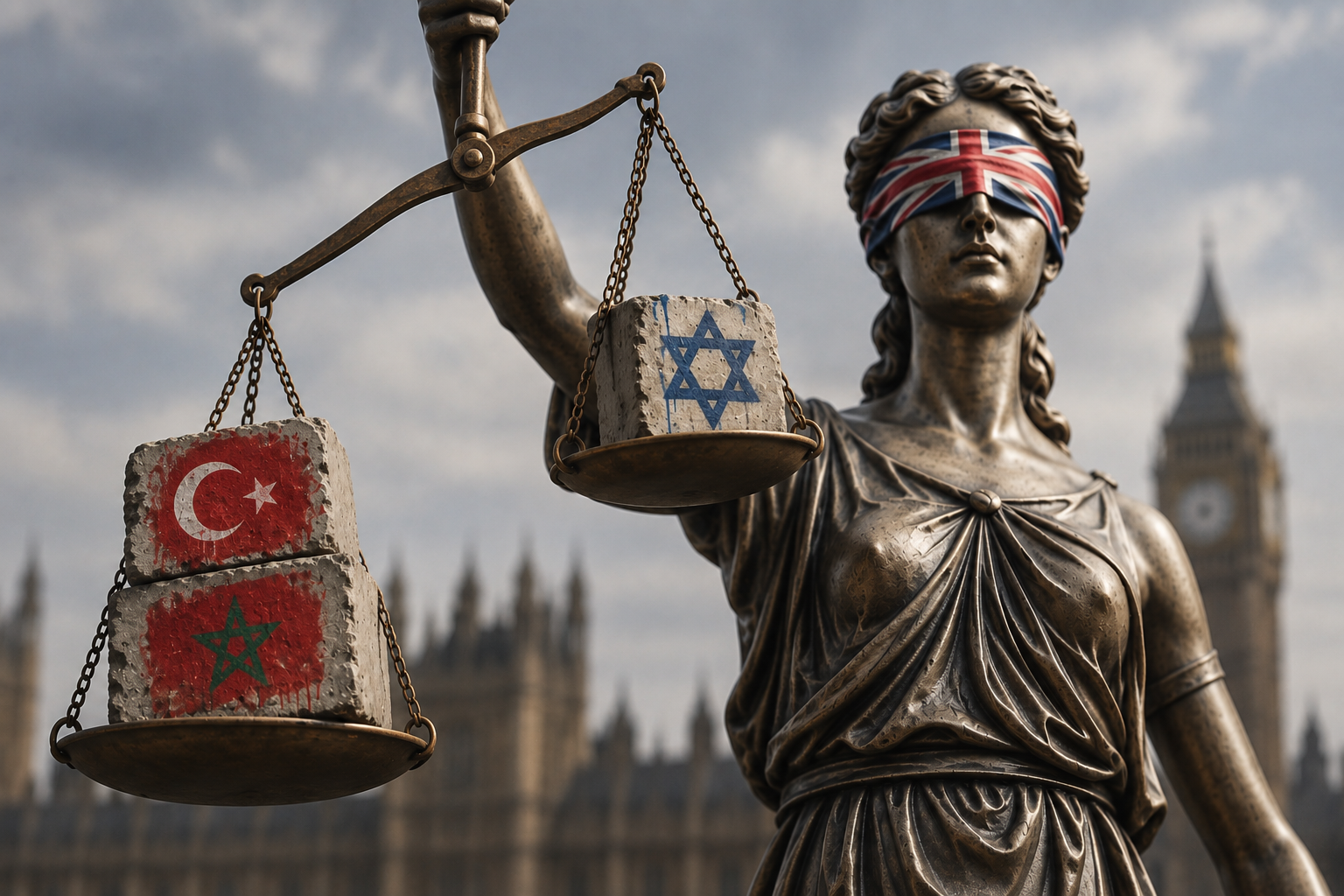
In a statement to the House of Commons on 8 September 2026, UK Foreign Secretary Ed Miliband announced that His Majesty’s Government would introduce a ban on imports into Britain of goods produced in Israeli settlements in the West Bank/Judea and Samaria.
Much has already been said about this new measure. Critics have generally focused on its effectiveness and its potential consequences for the United Kingdom.
Former Shadow Foreign Secretary Priti Patel wrote that the measures were “counter-productive to achieving peace and a two-state solution”.
Current Shadow Foreign Secretary Tom Tugendhat, on the other hand, focused on their potential consequences for Britain’s national security, pointing to the importance of Israeli intelligence cooperation in preventing terrorist attacks in the UK.
Of course, the UK is a sovereign country, and its Government is entitled to propose legislation governing its foreign trade — even legislation that may prove ineffective, unwise or harmful to Britain’s security or economic interests.
But there is a more fundamental problem with the proposed legislation: it is profoundly and blatantly discriminatory.
Consider a simple parable.
The legal speed limit on British motorways is 70 miles per hour. It is widely understood, however, that exceeding it by two or three miles per hour will not normally result in enforcement action.
Imagine that one day the Government announces new regulations requiring the police to fine black drivers whenever they exceed 70 mph — even by a single mile per hour — while leaving enforcement against everybody else unchanged.
The Government could defend the measure by pointing out that, according to its understanding of the law, driving at 71 mph is illegal. It could cite road-safety evidence. It could remind us that black drivers have no legal right to exceed the speed limit.
Those claims may all be true. But they are also beside the point.
The problem would not be that the Government’s measure was ineffective, difficult to enforce or potentially harmful in its consequences. It would be that the Government had selected one category of offender for punishment while declining to apply the same rule to others committing the same offence in similar circumstances.
Now let’s go back to ‘the settlements’.
The UK Government views the West Bank as Palestinian territory ‘occupied’ by Israel; consequently, it regards ‘Jewish settlements’ in that territory, including East Jerusalem, as illegal under international law. It points at international courts, organisations and other states sharing that position.
Whether one agrees or disagrees with those views is immaterial for the purpose of this analysis. The issue is that the West Bank is not the only territory which the UK Government regards as ‘occupied’. And ‘Jewish settlers’ are not the only ‘settlers’.
Take Northern Cyprus.
Britain recognises the Republic of Cyprus as sovereign over the entire island. Including the northern 40%, which it views as occupied by Turkey since 1974. The European Court of Human Rights has likewise expressly referred to Turkey’s ‘occupation’ of Northern Cyprus.
It is a widely acknowledged fact that – encouraged by government incentives – tens of thousands of settlers from mainland Turkey have since moved there.
The European Parliament has explicitly condemned Turkey’s attempts to alter the demographic balance of Cyprus (an EU member state) through what it called a policy of ‘illegal settlement’.
In a resolution supported by the UK, the UN Security Council described attempts to settle an area of Northern Cyprus as ‘inadmissible’.
Yet Britain’s new ‘ban on settlement goods’ does not apply to those settlers. Why not?
Then there’s Western Sahara.
In 1975, the International Court of Justice ruled that the former Spanish colony was not part of sovereign Moroccan territory. Nevertheless – and in defiance of that ruling – Morocco occupied Western Sahara later that year.
Since then, tens of thousands of Moroccans have settled in Western Sahara, drawn by the prospect of higher salaries, tax advantages, subsidies and other government benefits.
Motivated by political interests – rather than truth or morals – the UK refrains from officially calling Western Sahara ‘occupied’, preferring to refer to it as ‘de facto administered’ by Morocco. Still, it does not recognise Morocco’s sovereignty over the territory – and ‘de facto’ is the opposite of ‘de jure’. In other words, Morocco’s ‘administration’ is a reality, but not one based on legal rights.
Political euphemisms notwithstanding, International Law knows no halfway house called ‘de facto administration’. It defines any territory effectively controlled by a state outside its sovereignty and without consent as ‘occupied’. By default, it assigns the sovereign rights over that territory to its inhabitants – in this case the Sahrawis, whose representatives demand independence.
Yet far from trying to punish or deter the Moroccan settlement enterprise in Western Sahara, the UK Government has quietly facilitated it.
Under the UK–Morocco Association Agreement, products originating in Western Sahara and passing through Moroccan customs benefit from the same preferential trade terms as products from Morocco itself. The Government confirmed this explicitly in Parliament in May 2025.
So while Britain is now preparing to ban imports from ‘Jewish settlers’ in one ‘occupied territory’, it expressly gives preferential tariff treatment to goods produced by Moroccan settlers in another occupied territory.
The contrast could hardly be starker.
Israel often complains of bias and double standards. But in this instance, the term ‘double standards’ masks the gravity of the facts: this is not merely a biased policy; it is discrimination inscribed in law.
That such a law can even be contemplated in 2026 by the government of a democratic country is deeply concerning. It is a widely accepted principle of ‘rule of law’ that laws should proscribe offences, not offenders defined by ethnic, religious, national, or even ideological identity. For instance, anti-terrorism legislation rightly refers to ‘terror acts’ in general – not to ‘Islamic’ or even ‘Islamist’ terrorism – even though some of that legislation had been triggered by acts of Islamist terror.
Yet the law proposed by the new Labour Government targets a particular ‘offender’, not a general offence: it is not a law against ‘settlements in occupied territory’, but one targeting only ‘Jewish settlements in the West Bank’. To return to the earlier analogy, it does not punish speeding on the motorway; it punishes black drivers speeding on the motorway. This is the epitome of an unjust, discriminatory law.
Of course, the British Government will claim that the West Bank is different from Northern Cyprus and Western Sahara. And of course it is, just as far-right terrorism is different from Islamist terror. They are all different; no two situations are ever identical.
But that is no excuse for enacting a law against one named offender. A just law defines the offence, so that anyone who commits it – now or in the future – can be judged by the same rule.
A law that defines who should be punished, rather than what is unlawful, crosses a dangerous line. The Nuremberg Laws – the infamous epitome of ‘legal’ discrimination – did not appear out of nowhere; they emerged from a process in which discrimination based on identity had been progressively normalised in law.
So why make a law against ‘Jewish settlements’ rather than just ‘settlements’?
Firstly, while no two cases of ‘settlement’ are exactly the same, it would be very difficult to claim that West Bank ‘settlements’ are materially different from those in Northern Cyprus or Western Sahara. Unless the Government can demonstrate such a fundamental difference, why should the former be punished, while the latter are ignored – or even (as in the case of Morocco) rewarded?
Enacting a just law – one defining the offence, not the offender – might get the UK into trouble with Turkey and Morocco – and potentially with other countries, as well – because judicial review could determine that the same law applies also to their ‘settlements’.
Secondly, for the new Labour Government, Israel is a politically convenient punching bag.
Starmer was virulently attacked by Labour’s hard Left for being ‘too soft’ on Israel. Gaza turned that grievance into raging anger and an electoral threat: Labour lost votes and seats to the ‘Gaza Independents’, while the Greens are increasingly crowding Labour from the Left. In 2024, five independents campaigning prominently on Gaza took seats in which Labour finished second, and subsequent polling shows Gaza has been an important factor among former Labour voters defecting to further-left alternatives.
The current Labour government is neither extreme nor naïve: it understands that the effect of the new ban in the Middle East will be minor at best and harmful most likely. But it is interested in Middle England, not the Middle East. So let us be clear: this is not about virtue, but about votes.
But why should a ‘tough stance on Israel’ buy British votes? In fact, why would any foreign policy issue, especially one that is geographically remote and economically inconsequential?
It’s not like the UK Government does not (or should not) have more burning concerns: economic growth is sluggish, competitiveness degrading, public debt bulging, national security weakening – and the list could go on and on.
So why Israel?
To some, the answer is obvious. Britain has nearly three million Muslim voters, many concentrated in Labour constituencies; Gaza matters intensely to a substantial proportion of them. Then there is Labour’s hard Left, for which hostility towards Israel has become an article of faith.
Yes, all that matters. But it cannot be the whole answer. Muslim voters are still only around six per cent of the electorate, and to most of them Gaza is not even the overriding concern. Nor does the hard Left remotely represent British public opinion as a whole.
The real question is why hostility towards Israel is so widespread beyond those constituencies. Why does the Jewish state excite passions that Saudi Arabia, Turkey, Iran or Morocco simply do not? Why can events in a tiny country thousands of miles away dominate British politics for years, while wars and occupations elsewhere barely disturb the national conversation?
My answer is uncomfortable: anti-Jewish prejudice is far more deeply embedded in British society than most Britons care to admit.
I deliberately say prejudice, rather than ‘antisemitism’. The two are not synonymous. A person need not hate Jews, vandalise a synagogue or subscribe to some lunatic conspiracy theory to harbour prejudicial ideas about Jews. A major 2017 study found that roughly one Briton in three held at least one recognisably anti-Jewish belief. That does not make one Briton in three an antisemite. But it does mean that anti-Jewish stereotypes find remarkably fertile soil.
And prejudice matters precisely because it often operates below the level of conscious hatred. It affects what seems plausible, whose motives we instinctively distrust, whose wrongdoing excites us most – and, crucially, what discrimination we notice and what discrimination we fail to see.
That, I believe, is what makes Israel such a politically convenient punching bag. Electoral convenience is the effect. The deeper prejudice is the cause.
That’s what explains the fascination with Gazan children killed by Israeli bombs or starved by Israeli blockade. There is always the suggestion – and often even the accusation – that the Jewish state kills, maims and tortures children deliberately. There’s very rarely a similar suggestion when Iranian schoolchildren are killed by American missiles; or when Yemeni children are killed by Saudi bombs or by Saudi blockades; or when Sudanese children are butchered or simply waste away.
Jews killing children… hmmm… isn’t there something rather ‘classical’ about that accusation?
There is, of course, an often-heard objection to the charge of anti-Jewish prejudice: how can a policy promoted by Ed Miliband possibly be anti-Jewish when Miliband is himself Jewish?
An exchange on BBC Radio 4’s Today programme was revealing. US Ambassador to Israel Mike Huckabee had accused the British Government of ‘Jew-hatred’. Presenter Anna Foster challenged him: did he realise that Ed Miliband was himself Jewish?
Huckabee confirmed that he did. He pointed out, by analogy, that there are Americans who despise America, burn the American flag and campaign against their own country. Foster appeared not to hear the point. Incredulously, she asked him again whether he knew that Miliband was Jewish. Again, Huckabee said yes. It was a dialogue of the deaf.
Foster’s question rested on a remarkably weak assumption: that because Ed Miliband is Jewish, a measure promoted by him cannot possibly be motivated by anti-Jewish prejudice.
Of course it can. A woman can support a law discriminatory towards women; a member of an ethnic minority can harbour prejudices about that minority. There were Africans who collaborated in the transatlantic slave trade; there were black slave masters who owned black slaves. Identity is no inoculation against prejudice – or against its poisonous fruits.
But Foster’s question also smuggles in another assumption: that Ed Miliband is ‘Jewish’ simply because his ancestry is Jewish.
Well, is he?
Unless one is a Nazi, Jewishness cannot be reduced to a blood test. As I have argued elsewhere, it is a rather peculiar mixture of ethnicity, religion, culture and national identity. One need not believe in God to be Jewish; plenty of Jews don’t. But Jewishness does imply some palpable manifestation of that identity – whether religious, cultural, national, or (very often) some untidy mixture of all three.
Miliband’s ‘bloodline’ is unquestionably Jewish. So was Karl Marx’s – and Marx managed to write things about Jews that most Jews today would regard as blatantly antisemitic.
Both Miliband’s parents were Jews by birth. But they were also committed, ardent Marxists. He grew up in a household steeped in socialist politics and, by his own admission, outside Jewish communal life.
Miliband now calls himself a “proud British Jew”. That’s great. But politicians call themselves many things, particularly when those things are politically useful. So, since he brought it up himself in support of his policies, it is hardly outrageous to ask: what, exactly, makes Ed Miliband a ‘proud Jew’ in practice?
What has he done as a Jew – other than harshly criticising the Jewish state? What part has Jewish religion, culture, peoplehood or attachment to Israel played in his public identity? And how does that identity sit alongside another one he has proclaimed rather more consistently – socialism?
I don’t pretend to know the answer. Perhaps Miliband feels profoundly Jewish. Or perhaps socialism is his main identity. Perhaps both are. I do not know. But Anna Foster does not know either.
And that is the point. Saying ‘But Ed Miliband is Jewish!’ does not answer charges of anti-Jewish discrimination. It merely replaces a substantive argument with a Nazi-style ancestry test.
Political bigotry is ugly enough. Bias and double standards are worse. But once discrimination is written into law, something much more dangerous occurs: prejudice becomes state policy. The law itself is turned into an instrument of persecution.
Prime Minister Andy Burnham rather pompously declared that “Britain must stand for something”. Well, perhaps. But must it stand for on the neck of the Jewish state – and only of the Jewish state?
Because no amount of sanctimonious talk about ‘international law’ can disguise the fundamental issue: like the laws of the Russian tsars, this new ban does not target ‘settlements’ – just ‘Jewish settlements’.
It does not pursue justice – it pursues the Jew.