From Yemenite tradition to the coming Beith HaMikdash
What “A House of Prayer for All Nations” Does Not Mean
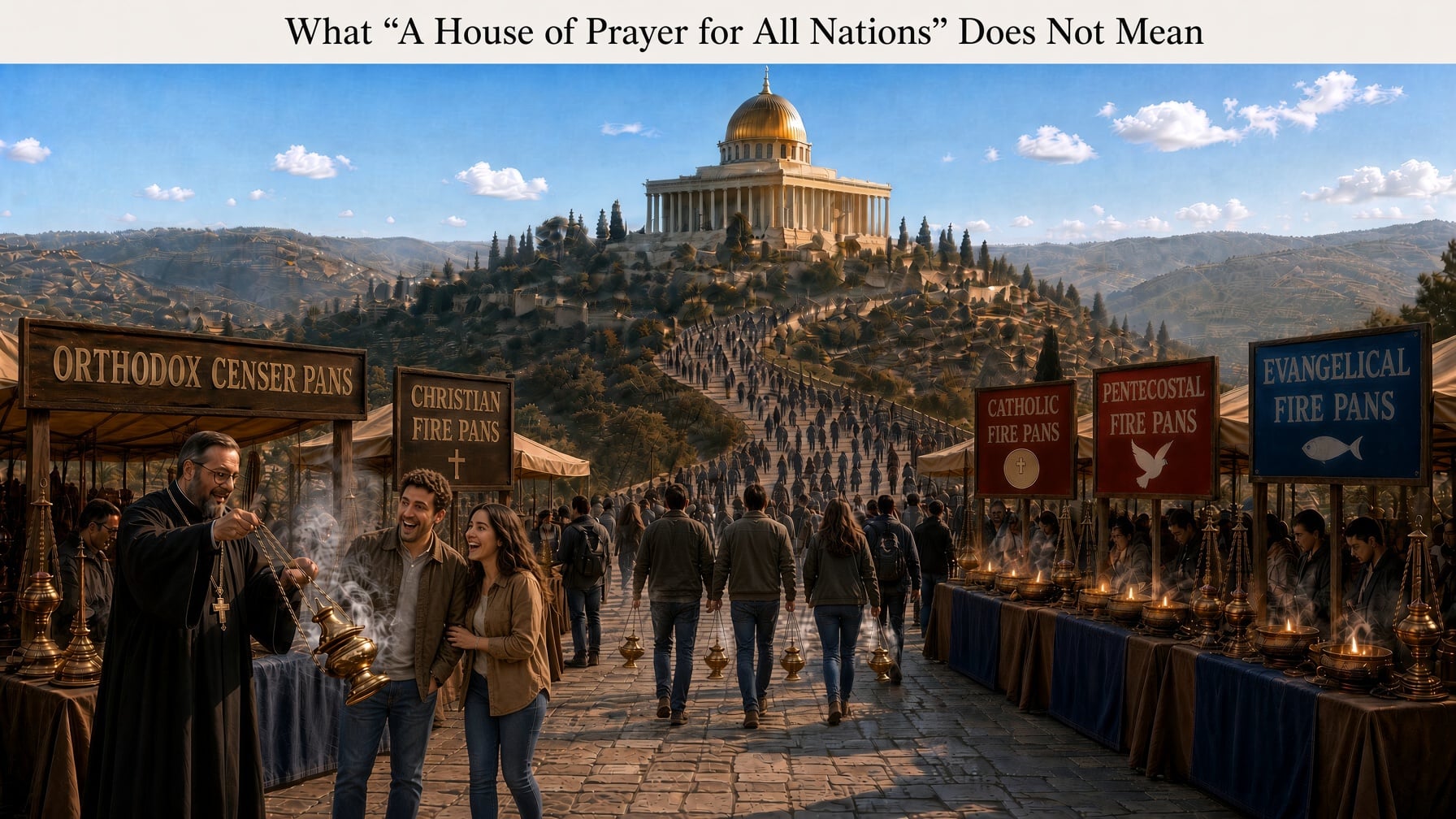
Foreign worshippers looking forward to praying at the 3rd temple (Image generated using AI)
Isaiah 56:7 invites people to serve Hashem. It does not invite anyone, Jew or gentile, to bring a service of their own up the mountain.
The sentence you were handed
You may have heard that the day has a simple shape. The House Hashem chose for His Name will be “a house of prayer for all nations.” So the nations will come as they are, pray as they already pray, and a photograph of that will count as the prophecy fulfilled. Some go further. They say prayer that stopped at the Western Wall, the Mount of Olives or Shiloh fell short because it did not climb.
The verse is real. That reading of it is not. If you love Israel and came because someone told you the mountain was waiting for your prayer as you already pray it, your love is not the mistake. The mistake is in the sentence you were given. Many people were handed it, and many Jews hand it on.
Read the verse in its place
Isaiah 56 opens with justice, righteousness and Shabbat. Then it names a fear. The foreigner worries that Hashem will separate him from His people. The eunuch worries he is a dry tree.
The answer does not set up a second group beside Israel. It speaks of the foreigner who joins himself to Hashem, ministers to Him, loves His Name, keeps Shabbat and holds fast the covenant. Hashem brings that person to His holy mountain. Their offerings are accepted on His altar. “For My house shall be called a house of prayer for all peoples.” The next verse adds still more people to the gathering of Israel’s dispersed.
“All nations” describes how far the House reaches. It does not describe how the House worships. Avodah means the service Hashem commanded, done the way He directed. Avodah zarah means foreign worship: service directed to another, or directed to Him in a way He did not command. The term means strange service, not strange people. That definition applies to everyone.
The Shabbat in this chapter is not a command laid on the nations. The nations do not keep Shabbat. The one who keeps it in the verse is the foreigner who has already joined himself to Hashem and held fast the covenant. He is not still standing outside as a nation. He is the ger tzedek, the foreigner who has become Israel. That is set out below. Reading the verse as “the nations keep Shabbat, and so does every church that climbs” puts a commandment of Israel onto people who were never given it.
Strange fire started at home
Before this is about anyone else, it is about us.
On the day the Mishkan was dedicated, Aaron’s own sons, Nadav and Avihu, brought “strange fire which He had not commanded them,” and fire came out from before Hashem (Leviticus 10:1-2). They were not foreigners. They were priests of Israel, on the holiest day of their lives, and they meant well.
Korach’s company were Israelites too. They took fire pans, filled them with fire and laid incense before Hashem (Numbers 16). It was not theirs to offer. Their censers were hammered into plating for the altar, a reminder placed where every priest would see it.
The machta, the fire pan, appears among the altar vessels in Exodus 27:3. It is a kli sharet, a vessel made for His service. Carrying fire toward the sanctuary does not make it avodah. The Torah taught that lesson to Israel first, using Israel’s own sons.
The road of stalls
Picture a road leading up to the House, lined with stalls.
One stall sells fire pans marked with a cross, with a wafer on the table. The next sells censers under a dove, and the one after that sells pans under a fish. Further along there are pans stamped with a crescent, then with the syllable Om, then pans packaged with crystals and a “universal” blessing. The busiest stall is run by Jews. They sell a pan of their own design, polished and modern, with a sign that says Hashem will love whatever you bring.
At every stall a teacher shows a couple how to swing the censer. The couples are happy. People walk on toward the House with smoke already rising from what they bought.
This picture is not an insult to the couples. Each of them was told the mountain wanted what they already had. The question the picture asks is not which stall is worst. It is who wrote the instructions? Isaiah’s foreigner does not shop along that road. He comes up by joining the service Hashem already named.
The prophets already answered the foreigner
At the dedication, Solomon prayed for the nokhri, the foreigner from a far country who comes “for the sake of Your Name” and prays toward this House. He asked Hashem to hear him, “so that all the peoples of the earth may know Your Name and fear You, as Your people Israel do” (1 Kings 8:41-43). That foreigner is heard without keeping Shabbat. His prayer is toward the House, for the sake of the Name.
Isaiah 2 describes the same thing from the mountain’s side. The nations stream to the House, Torah goes out from Zion, and they learn His ways. They do not set up their own.
Zechariah 14 has the nations come up year after year to bow to the King, Hashem of hosts, and to keep Sukkot. The bow is to Hashem, and the feast is the one He commanded. Sukkot is named. Shabbat is not. The nations come. They are not told to keep Israel’s day.
Who the foreigner is
The foreigner of Isaiah 56 is the ger tzedek, someone who joins Israel fully. The Shabbat in the verse is his, because he is no longer outside. The Talmud (Yevamot 47a-b) lays out how. He is told the weight of the commandments and accepts them. He is circumcised, he immerses, and from then on he is an Israelite in every respect. Exodus 12:49 gave the principle long before: “One Torah for the native-born and for the stranger.” One Torah includes Shabbat. That is why Isaiah can say this foreigner keeps it.
A gentile who has not joined does not keep Shabbat by climbing the mountain, and he is not failing Isaiah if he does not. Shabbat was given to Israel. The Talmud treats a gentile who rests on Shabbat as one who has taken a commandment that is not his (Sanhedrin 58b). The choice the verse leaves him is not a lighter Shabbat of his own. He joins, and then the day is his because he is Israel. Or he remains a nokhri, and Solomon’s prayer still covers him: toward the House, for the sake of the Name, heard, and not a Sabbath-keeper.
That does not mean everyone else is shut out. Hashem is not waiting for the nations to become someone else before they may come. He is waiting for every person, Israel included, to bring Him what He asked for. The nations come up. The one who keeps Shabbat in Isaiah 56 has already crossed, and the crossing has a name. Ger tzedek.
How the nations serve Him
You are not standing at a locked door. The prophets already said what the nations do, and it is concrete.
Solomon asked that the foreigner from a far country be heard when he comes for the sake of the Name and prays toward this House (1 Kings 8:41-43). That prayer is worship. It does not ask for a pan, a church rite, or Shabbat. It asks for His Name, and for the House as the direction. A person who has never joined Israel can pray that way today and be inside the verse Solomon prayed.
Isaiah 2:3 puts the words in their mouths. “Come, let us go up to the mountain of Hashem, to the House of the God of Jacob, and He will teach us of His ways, and we will walk in His paths.” Torah goes out from Zion. They come to learn, and they walk in what they are taught. Zechariah 8:23 brings it closer. Ten men from the nations take hold of the corner of a Jew’s garment and say, “Let us go with you, for we have heard that God is with you.” They come with Israel, not past Israel.
Zechariah 14:9 says that Hashem will be King over all the earth, and on that day Hashem will be one and His Name one. Verses 16-19 say the survivors of the nations go up year by year to bow to the King, Hashem of hosts, and to keep Sukkot. The worship named there is a bow, and a feast He already commanded. Israel has been offering for those nations all along. On Sukkot the altar receives seventy bulls over the seven days, and the Talmud says they correspond to the seventy nations (Sukkah 55b). The House has been praying for the nations before the nations arrive to pray.
Isaiah 60:7 brings the flocks of Kedar and the rams of Nebaioth up, and they are accepted on His altar. Their gift comes onto His altar. They do not build a second one, and they do not stamp the gift with another name. Isaiah 66:23 says all flesh will come to bow before Him, from one Shabbat to another and from one new moon to the next. They come to bow when Israel appears before Him. The verse does not hand them Israel’s Shabbat to keep at home. It gives them a place in the procession.
Two doors, both open. The nokhri prays toward the House and is heard. The ger tzedek joins and is Israel, and then Shabbat and the offering are his. Neither door is a service invented on the road. Both are His. If you came because you love the Name, you are already in Solomon’s prayer. The mountain was not waiting for your old service. It was waiting for you.
Where the sting belongs
If this reading stings, the sting is not meant for the believer who came to pray. By all means come to Hashem’s Temple. It is meant for teachers, some of them Jewish, who strip “a house of prayer for all nations” of its conditions and then hand the churches a Shabbat they were never given. The conditions are join, love the Name, and hold the covenant. Shabbat sits inside that join, because the one who joins is now Israel and brings the offering He named. In place of that, these teachers offer a staged ascent and call it Isaiah.
The old replacement theology put the Church in Israel’s place. The quieter version puts our own idea of a beautiful scene in the place of Hashem’s instructions. Anyone can fall into that, and Jews were the first to do it.
They will come
None of this closes the mountain to the nations. The prophets open it, and they open it to you. They will come, and the service will be set out so they can serve Hashem as He directed: prayer toward His House for the sake of His Name, the walk up to learn His ways, the bow to the King, Sukkot kept with Israel, and gifts accepted on His altar. Not a fire pan bought on the road. Not a name the Shema does not know. Not Israel’s Shabbat, unless the one who wants that day has joined Israel. The nations who come to bow are still the nations, and the service in front of them is His.
So here are the questions worth asking, whoever you are:
- Who taught me what the mountain wants?
- Is it in the verse, or was it in the sentence I was handed?
- If Aaron’s sons could bring strange fire with good intentions, could I?
Until those questions are answered, a picture of the nations on the Mount is only a picture. Isaiah 56:7 is not fulfilled by staging it. The door in that chapter is open to everyone, and it opens toward Him.
Related Topics
Related Posts