
The Jewish American Summit: The Jewish Energy Boost.
In America, between six and seven million people identify as Jews. It is a relatively large group, representing nearly half of the global Jewish population. Yet, unless one practices Orthodox Judaism, meeting fellow Jews is becoming an increasingly difficult task. One does not attend a synagogue on a regular basis—once a year at most. Gone are the days of banquets and public, community-organized celebrations of Israeli independence. There is a genuine dearth of places where one can meet fellow Jews. One gets the impression, based on events organized by JCCs, that singles are the only Jewish subgroup interested in meeting other Jews—as if communal leadership believes that once a person meets another Jew, there is no reason to meet more. And the deficit of these meeting places is worsening. For many years, AIPAC’s Annual Policy Conference was one such event, providing unforgettable opportunities for lifelong commitment, a year-long energy boost to America-Israel relations, and the chance to meet thousands of Jews of various backgrounds from all over the country. AIPAC shifted its strategy, and the conference has not returned since 2020. But the field of Jewish engagement is not dead, and green sprouts are starting to pop up all across the country. The Jewish American Summit is one of those.
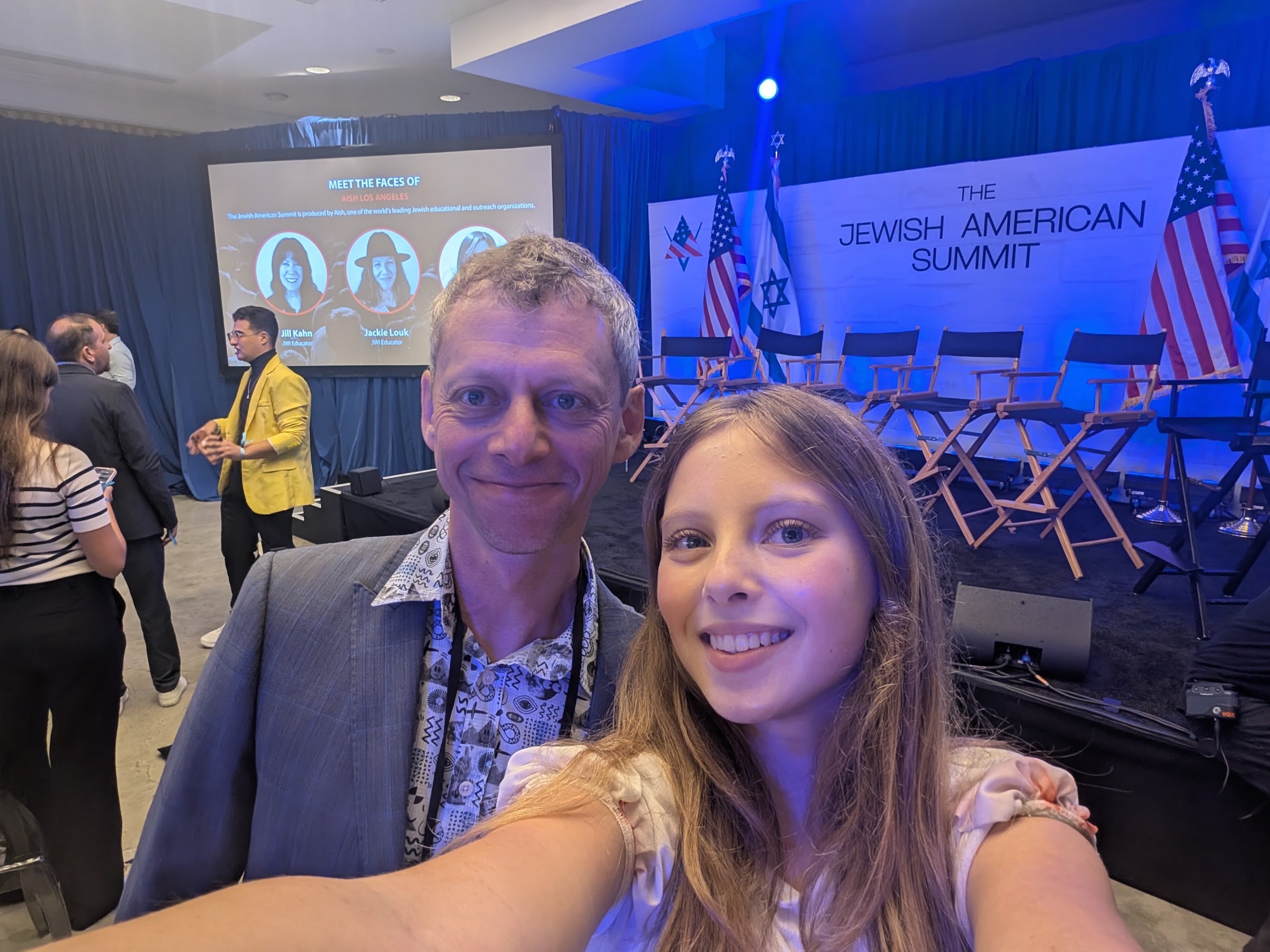
On August 30th, I had the pleasure of attending The Jewish American Summit. This was the third time the summit was held, but the first time I attended. The event took place in Los Angeles. The summit is put together by Aish LA, a branch of Aish Global, and many dedicated volunteers from Los Angeles and all over the country. A little short of a thousand people attended, and according to the organizers, the event was sold out. It was heartwarming to see many different facets of the community in attendance. There were the secular, the religious, the Orthodox, the Modern Orthodox, former Soviet Jews, Israelis, gay and lesbian individuals, and allies. The audience very much resembled the one at past AIPAC Conferences. The entire spectrum of the American Jewish community was present. The summit itself—its nature, its leitmotif—was not a carbon copy of the AIPAC Conference. Much of the summit’s content, the presentations, and the discussions did center around Israel, the United States, the relationship between the two countries, and growing antisemitism. But there was also a local component focusing on issues specifically of interest to Jews in California in general and Los Angeles in particular. “Politics is local,” goes the old adage, and so the speakers touched upon subjects of concern to Jewish Angelenos and Californians.
Steve Hilton, a GOP candidate running for California governor, spoke about antisemitism, his support for Israel, the ways he plans to combat antisemitism if elected in November, and his vision for California’s future—noting that economic stability and prosperity are great antidotes to antisemitism and social strife. Mr. Hilton’s family history—his parents escaping Hungary after the Soviet invasion—connected him with much of the audience on a personal level that no Facebook post can match. Jay Sures, vice chairman of United Talent Agency, discussed Hollywood in the post-October 7 world and addressed some heated questions from the audience. Israeli Ambassador Yechiel Leiter provided listeners with a tour de force primer on the current political landscape of the Middle East. His personal story of losing his son in Gaza gave the audience an eye-watering glimpse of Israeli resilience. United States Ambassador to Israel Mike Huckabee addressed the participants via a Zoom link. His generous friendship and relentless humor offered a hopeful message for the future relationship between the US and Israel. Tanya Tsikanovsky, a West Hollywood City Council candidate born into a family of former Soviet Jews, discussed her political journey—from organizing for the Hillary Clinton campaign to becoming a Republican candidate—and shared how her Zionist positions as an openly lesbian candidate led a venue in West Hollywood to cancel her appearance. Her powerful words resonated deeply with the audience. Zach Sage Fox, one of the most successful pro-Israel influencers, addressed one of the most critical issues today: the information war. Unlike the kinetic conflicts in Gaza, Lebanon, Syria, and Iran, it is a war Israel and Jews are currently losing. Zach, unlike many commentators who simply lament the problem, provided a sharp analysis of root causes and suggested concrete solutions. And then there was Luai Ahmed, a journalist and writer with a unique life story. Born in Sana’a, Yemen, Ahmed escaped to Sweden, where he came out as gay and, after October 7, “came out” as a Muslim Zionist. If one was looking for hope that hatred can be defeated, Luai gave reason to believe. There were many other great presenters and speakers; these are just a few.
I doubt anyone left The Jewish American Summit without enriching their knowledge, expanding their intellectual horizons, or learning more about politicians and activists. More importantly, the summit provided an energy boost to every Jew in attendance—a reminder that one is not alone. As we all know, it can feel lonely on this side of the “barricades.” Everyone I asked felt energized and ready to do their part for Israel and the Jewish community. I hope other communities follow a similar approach and that events like the summit become as common as Chabad Houses. As for myself, I look forward to returning for the next one in Los Angeles.