
Rabbi of Tamid Palm Beach
The Jewish Art of Remembering Forward
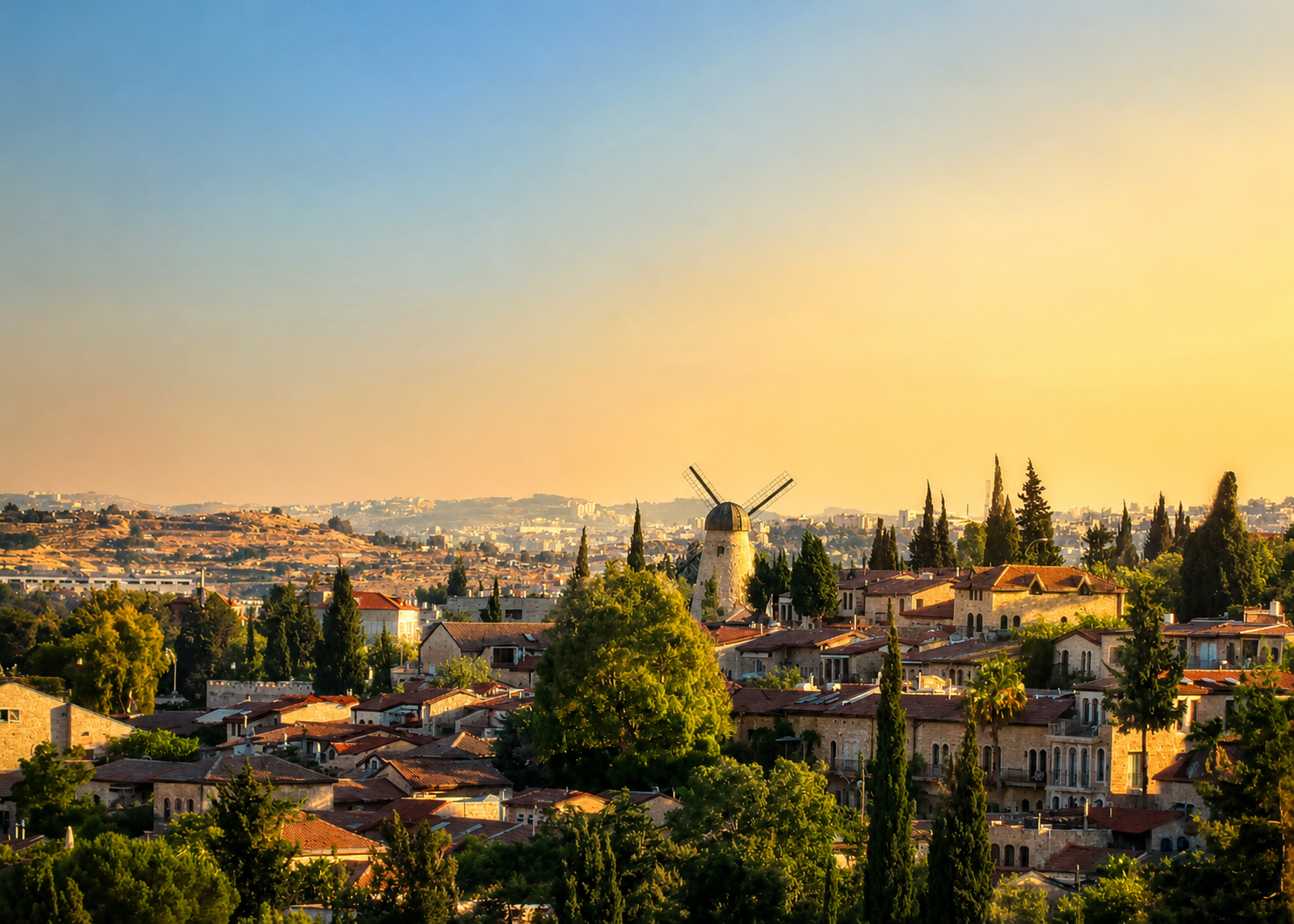
Built in the 19th century by Sir Moses Montefiore, the windmill stood just outside the walls of the Old City, part of an early effort to help Jews rebuild and expand Jerusalem beyond its ancient boundaries. Long before Jerusalem was reunited, the windmill quietly embodied a Jewish instinct that has endured for centuries: remembering the past while building toward the future. Photo by Abbie Strauss
From “Next Year in Jerusalem” to “Jerusalem of Gold,” Jewish memory has often functioned less as nostalgia than as preparation for the future.
There is something slightly unusual about the Jewish relationship with memory. Most people remember the past in order to preserve it. Jews often remember the past in order to move toward the future.
This is not the sort of thing one notices immediately. Judaism contains many ordinary-looking activities that, upon closer inspection, are quietly peculiar.
Take the phrase “Next year in Jerusalem.”
For nearly two thousand years, Jews concluded the Passover seder with those words. Not “Remember Jerusalem.” Not “We once had Jerusalem.” But “Next year.” That is an astonishing thing for a scattered people to say repeatedly across centuries.
It is not nostalgia. Nostalgia looks backward wistfully. “Next year in Jerusalem” leans forward. It assumes that history is still open. That return, repair, redemption, or renewal remain possible even when circumstances suggest otherwise. Judaism, in this sense, has always practiced a kind of directional memory.
Shabbat offers another example. The commandment is to “remember” the Sabbath day, but Jews begin preparing before it arrives. Shopping is done early. Tables are set. Food is cooked. Candles are prepared. In Jewish life, remembering often changes present behavior because of something that has not happened yet. That is a very different understanding of memory.
Modern culture tends to divide people into two unhappy camps: those trapped in the past and those anxiously obsessed with the future. Judaism traditionally tried to create something else entirely: people anchored by memory but leaning toward possibility.
Nowhere is this more beautifully expressed than in the song “Jerusalem of Gold.” Naomi Shemer wrote the song in the spring of 1967, just weeks before the Six-Day War. At the time, the Old City of Jerusalem and the Western Wall were inaccessible to Jews. The song emerged out of longing and incompleteness. “The marketplace is empty,” she wrote. “No one visits the Temple Mount in the Old City.”
And yet the song immediately captured the imagination of the Jewish world because it sounded less like mourning than yearning. It carried an emotional posture Jews already knew instinctively: the habit of singing toward a future not yet visible. Then history shifted with astonishing speed. Within weeks, Israeli paratroopers reached the Western Wall. Suddenly, “Jerusalem of Gold” no longer sounded merely wistful. It sounded almost prophetic.
Not because Naomi Shemer was predicting the future like a biblical meteorologist. The song resonated because Jewish culture had spent centuries training itself to emotionally orient toward restoration before restoration arrived. Long before Jerusalem was reunited, Jews were already psychologically facing it.
This may help explain one of the great mysteries of Jewish survival. Empires usually preserve themselves through power, geography, or political continuity. The Jewish people spent much of history without those advantages. What they possessed instead was an extraordinary ability to remember forward.
Every Passover seder rehearsed freedom before freedom felt complete.
Every Shabbat anticipated a more peaceful world before such a world existed.
Even Jewish mourning rituals contain movement. At weddings, Jews break a glass to remember Jerusalem at the height of joy. But even this is not purely backward-looking grief. At weddings, Jews break a glass to remember the destruction of Jerusalem at the height of joy. The Jewish story remembers catastrophe, because it keeps orienting itself toward renewal.
This does not mean Judaism ignores reality or indulges in naïve optimism. Jews are, if anything, historically overqualified in realism. A people does not survive expulsions, inquisitions, pogroms, terrorism, and family WhatsApp arguments without developing a sober view of the world.
But Judaism consistently resists one particular temptation: the temptation to believe that present conditions are final conditions. That may be one of the deepest meanings hidden inside Jewish ritual life. We do not simply preserve memory to honor what was. We preserve memory to shape what could still be. The Jewish future, more often than not, was built by people who learned how to lean toward it before they could fully see it.
And perhaps that is why “Jerusalem of Gold” still moves people so deeply today. Beneath the melody lies an ancient Jewish instinct: long before redemption arrives, you begin preparing your heart for its possibility.
Related Topics