
Welcome to the Ongoing Situation
Featured Post
The Jewish state would like to buy a vowel
Israel cannot agree on its borders, its future or what happened yesterday. But for NIS 250,000, we may finally learn how to spell Petah Tikva
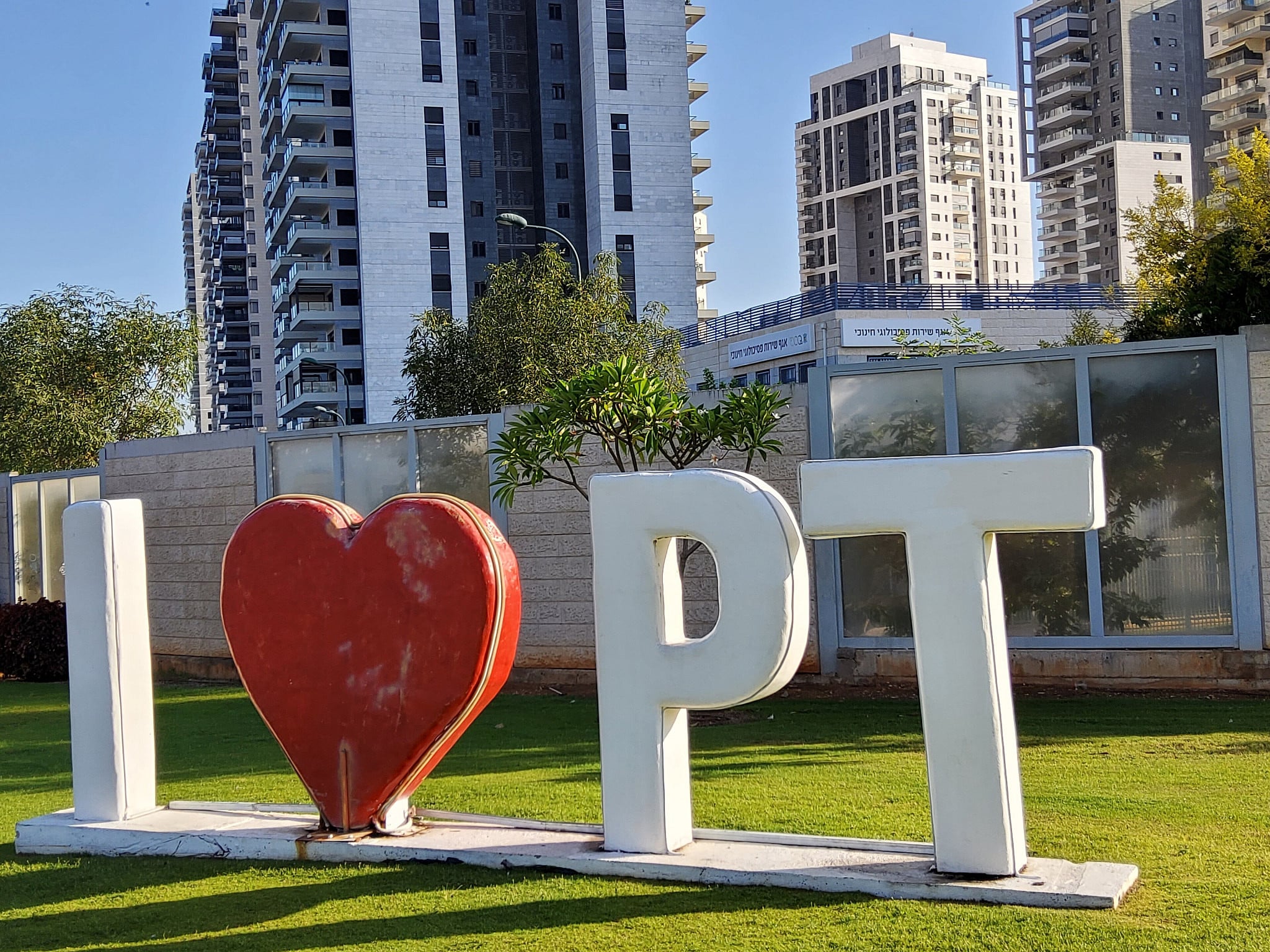
I love Petah Tikva sign on October 6, 2022 (Dr. Avishai Teicher/ WikiCommons)
The road to Petah Tikva is well marked. Getting there is easy. Knowing what to call it once you arrive is another matter entirely.
Is it Petah Tikva? Petah Tikvah? Petah Tiqwa? Or, for travelers who enjoy arriving at their destination with a diacritical mark lodged in their throat, Petaḥ Tiqva?
After nearly eight decades of national uncertainty, the Israeli government has decided the time for ambiguity is over. Not regarding Gaza, the West Bank, military service, civil marriage, public transportation on Shabbat, the constitutional limits of the Supreme Court, or where exactly “the center of the country” ends and “the periphery” begins, forever, apparently.
Those remain open questions. This one, we are solving.
According to The Times of Israel, the government is preparing to spend NIS 250,000 to standardize the English and Arabic spellings of Israeli place names. The Prime Minister’s Office will work with the Academy of the Hebrew Language to create uniform transliteration rules for ministries and municipalities — which means that somewhere in Jerusalem, in a room with four fluorescent lights and six strongly held opinions, a committee will finally decide whether ק is a “k,” a “q,” or a personal failing.
Finally, leadership!
For decades, visitors have followed signs to Caesarea, Keisarya, and Qesarya without realizing all three lead to the same Roman ruins and, eventually, the same overpriced iced coffee. Safed is also Tzfat, also Tsfat, also Zefat, depending on which relative is giving directions. Acre answers to Akko. Jaffa becomes Yafo whenever the neighborhood wants to raise rent. The Sea of Galilee has three names, which is still fewer than Jerusalem has definitions.
Ben Gurion Airport alone introduces every arriving tourist to the founding principle of Israeli public life: every sign is authoritative, and no two of them agree.
This is not really a spelling problem. It is the national character, rendered in Roman letters and refusing to sit still.
Hebrew has spent three thousand years resisting instruction from other alphabets. It survived exile, conquest, and centuries confined to prayer books and still arrived intact. It did not do all that just to take orders now from the language that gave the world “queue” — four silent letters standing in line behind one that’s doing all the work.
English wants a name to have one spelling, forever, like a contract. Hebrew finds this needy. Hebrew is a language that often omits vowels altogether and trusts you to reconstruct them from context, instinct, and how disappointed the person speaking to you sounds. It has letters that swap sounds with each other, letters that share a sound out of pure solidarity, and at least one letter that is technically present on the page but has quietly opted out of pronunciation.
Transliterating Hebrew, then, isn’t really translation. It’s closer to describing an Israeli hand gesture over the phone: you can gesture toward the meaning, but the thing itself doesn’t survive the trip.
Take Petah Tikva. “Tikva” is friendly enough. It’s roughly how an English speaker would guess at תקווה unprompted. “Tiqwa” announces that someone recently finished a dissertation. “Tikvah” adds a silent final “h” for no audible reason.
Then there’s “Petah” itself. The ח is not really an “h.” It’s closer to the sound of clearing a sunflower-seed shell from the back of your throat mid-sentence — a phoneme English can’t produce, mostly because English speakers were raised to use something called “indoor voices.”
The academically rigorous solution is “Petaḥ,” dot beneath the h and everything. It is precise. It is elegant. It is completely unusable by anyone trying to type the name into Google Maps from a rental car at Ben Gurion, sleep-deprived, at 1 a.m.
So the government must choose: linguistic accuracy, or the continued existence of Petah Tikva as a place people can actually find. (Assuming, generously, that Petah Tikva is real to begin with.)
Still, NIS 250,000 feels like a bargain for national unity. Israel has spent considerably more money achieving considerably less agreement — see: everything.
The real question is process. Will there be public hearings? A panel of experts? A six-month pilot in which half the country uses “k,” the other half uses “q,” and the Ayalon Highway becomes the front line? Can the coalition survive a floor fight over “Tiberias” versus “Tverya”? Will the religious parties insist the English spelling honor the sanctity of the Hebrew original? Will secular Israelis demand a civil transliteration, separate and unequal? Will someone eventually discover that the attorney general lacks the constitutional authority to recognize “Zefat,” and that this, too, must go to the Supreme Court?
And when the Academy finally issues its ruling, what happens? Everyone keeps spelling it however they always have. This is, after all, a country where your pronunciation of the letter ר can broadcast your age, your ancestry, your immigration history, and whether your parents were listening to the radio before 1975.
Israelis do not treat language as a neutral delivery system for information. Words are evidence. Accent is autobiography. Grammar is a background check. One syllable can identify you as Russian, American, French, Yemenite, kibbutznik, Jerusalemite, recent immigrant, or someone who learned Hebrew entirely from an ex and now speaks exclusively in the masculine imperative.
Maybe that’s why transliteration generates such heat. The fight was never really about letters. It’s about which version of the country gets handed to outsiders.
“Tzfat” belongs to one Israel. “Safed” belongs to another. “Yafo” sounds local, ancient, and gentrifying in real time. “Jaffa” sounds like oranges, tour buses, and a restaurant where the cauliflower costs more than your first car did. “Yerushalayim” is the city we sing about at weddings. “Jerusalem” is the city foreign ministries issue statements about. Even “Israel” isn’t quite what Israelis call Israel.
A standardized system might produce cleaner road signs. It cannot produce a more consistent country. Israel holds too many histories, immigrations, and unfinished arguments in one alphabet for that. Every place name here has passed through conquerors, olim, cartographers, and mouths that never quite agreed on how to shape it — and kept the disagreement as a kind of souvenir.
I genuinely hope the project succeeds. I look forward to the day every government office, road sign, and municipal website agrees on one spelling of Petah Tikva. It will stand as a stirring demonstration of what this country can accomplish once it sets aside politics, religion, and ideology to focus on what truly unites us: correcting each other.
Of course, the official spelling will be rejected on arrival by residents, academics, taxi drivers, and one man named Avi who has a photograph of a sign from 1987 and will show it to you.
But that’s democracy. Or at least the transliteration of it.
Israel may never agree on where the country is headed. For NIS 250,000, though, we might finally agree on how to spell the place where we missed our exit.
Related Topics
Related Posts