The Jews American Screens Never Show
A few nights before my wedding, my mom painted my palms with henna. I wore the keswa el kbira, the “great dress,” a deep burgundy skirt and bodice made of velvet, heavy with gold embroidery.
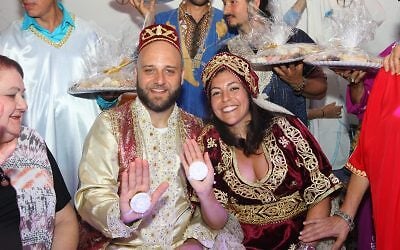
Jews expelled from Spain carried its design to Morocco more than five centuries ago, and for generations fathers gave it to their daughters to wear for the first time at the henna. I put it on after changing garments several times that evening. My husband joked that in some of his traditional Moroccan Jewish wedding attire, he looked like Aladdin.
The air smelled of orange blossom and sugar. When the henna touched my skin, the room erupted in kululu, the high, trilling cry our women have raised at celebrations for centuries.
It was the most Jewish night of my life.
I have yet to see anything like it on an American screen. That absence matters. When the screen shows only one kind of Jew, the world learns there is only one kind.
And yet in Israel, brides of every background now hold henna nights of their own, Ashkenazim among them.
Years ago, I watched Keeping the Faith, the story of a rabbi and a priest who have been best friends since childhood. I loved it. It is tender and funny, and it takes faith seriously without losing its humor. But every Jewish person in the film came from the same world: the same Upper West Side, the same Eastern European grandparents, the same shorthand of guilt and gefilte fish. A quarter century later, little has changed. The rabbi of Nobody Wants This and the comedian of The Marvelous Mrs. Maisel are beautifully drawn, and both come from that same corner of the Jewish story.
This is not a complaint about good art. It is a question about the whole picture. Where are the Jews who wear kaftans? Where is the Mimouna table on the night Passover ends, the doors thrown open to neighbors, the mufleta stacked high and dripping with honey and butter? Where is the Passover stew my mother makes, la soupe aux fèves, thick with meat and fava beans, fragrant with saffron and cilantro?
When Americans are invited to “try Jewish food,” they are handed brisket, matzo ball soup, and gefilte fish. These are cherished dishes, and I would never begrudge anyone their grandmother’s kitchen. But they are one kitchen among many, and the others have been left off the menu.
The same is true of Jewish humor, which America has embraced as its own. The humor it knows was born in the shtetl and carried to the Catskills. But the Jews of the Arab world and the Mediterranean had their own laughter, their tales of Jeha the wise fool told in Judeo-Arabic and Ladino for generations. Most American Jews have never heard them.
Language tells the same story. Americans who have never met a Jew still schlep groceries, kvetch about traffic, and schmooze at a party. How remarkable that Yiddish has woven itself so deeply into English that people reach for its words without ever knowing where they came from. Judeo-Arabic is every bit as rich, and it never found that place here. I grew up with it, and to this day, its words come to me frequently, and not only at the holiday table. When I miss someone, I reach for blabesh, meaning I wish they were here. To tell someone I love them, I say kapara, that I would atone for them, take their suffering as my own. There is a fierceness in how we love, a warmth that holds nothing back.
Consider Jerry Seinfeld, perhaps the most recognizable Jewish comedian of his generation. His maternal grandparents were Syrian Jews from Aleppo. Almost no one knows this. On television, Jerry’s parents became Ashkenazi retirees in Florida. Aleppo never made it onto the screen.
Some will say the screen simply reflects the population. There is truth in that. According to the Pew Research Center, about two-thirds of American Jews identify as Ashkenazi, and only a few percent as Sephardi or Mizrahi. But our films and television travel the world and shape what “Jewish” looks like far beyond our shores, and the Jewish world is larger than America.
In Israel, roughly half of Jewish citizens trace their roots to North Africa and the Middle East. To speak only of Ashkenazi life is to leave out the Persian Jews of Isfahan and Shiraz, the Iraqi Jews of Baghdad, the Turkish Jews of Istanbul and Izmir, the Yemenite Jews, the Ethiopian Jews who gather each year at Sigd to renew their covenant and their longing for Jerusalem, and the Jews of North Africa, my own mother’s Morocco and my father’s Tunisia among them.
These are not footnotes to Jewish history. They are its main body. And at a moment when misinformation about who we are travels faster than the truth, this is exactly the story to tell in full. When we let one story speak for all of us, the rest of us vanish.
We speak often and proudly of the big tent. We say there is room for every Jew, every family, every path into the covenant. Yet, when we tell our story to the world, we light only one corner of that tent and leave the rest in shadow. I think of my own wedding, the mark of the henna on my palms and my family’s kululu rising. This too is the Jewish story.
Let us light every corner.