
The Kanaani Diplomacy™ Doctrine
 Diplomatia Kanaaniensis
America at the Center of a New Soft-Diplomacy Model for Preserving Israel’s Jerusalem-Born Living Heritage
A Brooklyn-Born Model for America’s Next Century of International Cooperation
By Animal Chaplain and Rabbi Mikhail Salita
Founder of the Brooklyn-based Kanaani Revival Program and The World Kanaani Organization; Master of International and European Law; PhD Student in International Law at the National University ‘Odesa Law Academy,’ Ukraine
In the year the United States marked 250 years since the Declaration of Independence, a small Brooklyn initiative demonstrated an American truth: consequential ideas do not always begin inside government. Sometimes they begin with a citizen who sees a neglected possibility and decides to act before any institution offers permission, funding, or a roadmap.
That is how KANAANI DIPLOMACY™ – rendered in Neo-Latin as Diplomatia Kanaaniensis – began. I developed the concept to describe an American-led, non-state-initiated form of international cooperation built around the Kanaani cat, an exceptionally rare documented domestic breed with roots in Jerusalem. Its purpose is larger than preserving a breed. It is to create durable cultural, scientific, civic, and economic relationships among countries through a shared act of stewardship.
The idea is no longer hypothetical. The revival has already connected the United States, Israel, Ukraine, Finland, and Germany. It has entered American and international feline systems, made its world show debut, and produced world-record recognition. All of this was achieved without municipal, state, or federal funding and without formal diplomatic sponsorship.
The question is no longer whether the idea can travel. It already has. The question is whether American institutions will recognize a diplomatic asset created in their own backyard and help it reach its potential.
For America, the Kanaani represents a golden opportunity: a chance to transform a citizen-built preservation effort into a visible model of American public diplomacy, to honor a living heritage born in Jerusalem, and to bring partner nations together through practical responsibility for life.
A diplomatic instrument born in civil society
Traditional diplomacy remains indispensable, but it no longer belongs exclusively to foreign ministries. Universities, cities, foundations, religious communities, corporations, cultural organizations, and individual citizens increasingly create relationships that governments later formalize or support. KANAANI DIPLOMACY™ belongs to this wider field of multilevel diplomacy.
The breed was developed in Jerusalem in the 1990s by the German-Israeli artist and Holocaust survivor Doris Pollatschek. Its later survival depended on private custodians and specialists working across borders. Liudmila Vlasova played a foundational role by entrusting important Kanaani cats to me. Ukrainian specialists assisted with pedigree documentation and access to World Cat Federation procedures. In the United States, The International Cat Association accepted the Kanaani as a New Experimental Breed on December 5, 2025. Brooklyn then became the operating center of the revival.
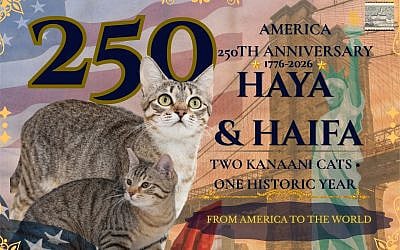
Finland gave the breed its first appearance at an official international cat show during the World Cat Federation Jubilee Show in Vantaa on August 8-9, 2026. Haifa and the Brooklyn-born kitten Haya earned recognized results there. Following that event, the two cats simultaneously reached No. 1 positions within the adult and kitten-junior Kanaani categories of WCF Best Cat. Their achievement received world-record recognition from Record Holders Republic and additional recognition in Ukraine. Three international record organizations – Official World Records, Record Holders Republic, and Noble World Records – have recognized the Kanaani in formulations identifying it as the world’s rarest officially registered or documented domestic cat breed.
These recognitions are not wildlife-conservation classifications, and the Kanaani is a domestic breed rather than a separate endangered species. Their significance is public and diplomatic: they transformed a technically difficult preservation effort into an international story that ordinary people can understand.
What America can learn from panda diplomacy
China demonstrated that an animal can become an enduring instrument of statecraft. Earlier panda diplomacy included state gifts; the contemporary model relies primarily on structured loans under continuing Chinese ownership. Host institutions invest in specialized habitats, veterinary care, research, and public education. The pandas attract audiences while the relationships surrounding them serve broader national interests.
The United States should learn from the diplomatic effectiveness of that model without copying its centralized structure. KANAANI DIPLOMACY™ did not originate with a government ministry. It began through American private initiative. Nor should its goal be to maintain a monopoly over scarcity. The objective is to establish healthy, responsibly managed, and coordinated Kanaani populations in multiple countries.
Cats may eventually be transferred to qualified partners through donation, grant-funded or privately sponsored placement, or responsible sale accompanied by consultation. The mechanism can differ according to the partnership. The principle does not: each transfer should create local capacity, continuing cooperation, and a responsibly managed population.
Panda diplomacy derives influence from controlled scarcity. Kanaani diplomacy derives value from shared recovery. Its ultimate success will come when the breed is no longer exceptionally rare, while the international relationships created through its recovery continue to grow.
American leadership without government takeover
The American character of this project lies not in claiming ownership of an Israeli-origin heritage, nor in asking the federal government to absorb a private program. It lies in the way the United States can elevate civic initiative into public purpose.
America has repeatedly benefited from citizens, nonprofit organizations, universities, faith communities, and entrepreneurs acting before bureaucracy catches up. Government can support such leadership without appropriating it. It can provide recognition, lawful pathways, scientific capacity, grants, diplomatic introductions, and institutional credibility while allowing the originator to preserve the program’s identity and continuity.
That distinction matters. KANAANI DIPLOMACY™ is non-state in origin, multilevel in implementation, and international in ambition. It needs government support, but it does not need government ownership.
The absence of public support is no longer merely a private inconvenience. It is a missed American opportunity. A rare living heritage has arrived in the United States, an international network has begun to form, and a citizen-led program has already generated recognition abroad. The responsible response is not to ask why the founder has not mastered every layer of bureaucracy alone. It is to build an accessible pathway through which public institutions can evaluate and support a promising initiative.
What support should look like
No single government office needs to control the project. Different levels of American government can contribute according to their lawful roles.
Brooklyn can begin with formal recognition from the Borough President and connections to civic, educational, cultural, and philanthropic institutions. New York City can help evaluate a public-facing pilot center, identify appropriate nonprofit and university partners, and connect the program with animal-welfare and cultural initiatives. New York State can support research, veterinary partnerships, tourism, education, and economic development. At the federal level, relevant agencies can provide regulatory guidance, competitive funding opportunities, scientific connections, and diplomatic introductions. The Department of State and American missions abroad can convene conversations with potential partners without converting the initiative into a government-owned program.
The practical centerpiece should be a New York Kanaani Conservation and Diplomacy Pilot. A public identity such as Kanaani Park New York could attract visitors and educators, but the facility itself should be a secure research, breeding, education, and cultural center rather than an uncontrolled outdoor park. It should include enclosed catios, quarantine capacity, veterinary supervision, careful recordkeeping, and structured public programming.
Universities and genetic laboratories could study population structure, health, and genetic diversity. Veterinary institutions could establish welfare protocols. Foundations could support research and public education. Companies in pet nutrition, veterinary medicine, insurance, transportation, and technology could provide transparent sponsorship without controlling scientific conclusions or animal-placement decisions.
What is needed first is modest but consequential: recognition, a government liaison, a feasibility partnership, and a coordinated route to appropriate grants and institutions. Those initial steps would allow the program to replace improvisation with accountable growth.
An expanding circle of partner nations
The five countries already involved are the foundation, not the geographical limit, of the concept. Israel provides historical and cultural origin. Ukraine contributed documentation expertise. The United States became the center of revival and organizational development. Finland hosted the world debut. Germany provides an international institutional pathway through the World Cat Federation.
Future participation could extend to the United Kingdom, Turkey, Cyprus, Lithuania, Slovakia, Hungary, and other qualified countries. Each may contribute something different: scientific research, municipal animal-care experience, cultural institutions, exhibitions, veterinary capacity, or financial support.
A participating country should not receive a living trophy. It should become a steward and a diplomatic partner. Shared standards should govern identification, pedigree documentation, veterinary screening, quarantine, genetic planning, animal welfare, transfers, public reporting, and scientific data. Welfare must remain the sine qua non of every partnership.
Partner nations and cities could be recognized as founding participants in the international recovery. That distinction has cultural and reputational value. Not every country can be the birthplace of the Kanaani, and not every city can be the birthplace of its American revival. But every responsible founding partner can become part of the history that secured its future.
A fitting American project at 250
The national anniversary asks Americans to remember what the country has built. It should also invite the country to notice what its citizens are building now. America at 250 should celebrate not only inherited institutions, but the continuing capacity of free people to create new institutions, new forms of cooperation, and new reasons for nations to work together.
KANAANI DIPLOMACY™ offers a small but unusually visible demonstration of that capacity. It joins private initiative with public responsibility, an Israeli living legacy with American leadership, Ukrainian expertise with Finnish openness, and German institutional access with the possibility of a much wider international network.
The breed’s meaning reaches beyond rarity. The Kanaani was born in Jerusalem on the Holy Land, giving its preservation a biblical and civilizational resonance that few animal-conservation projects possess. The Babylonian Talmud teaches that, had the Torah not been given, humanity could have learned modesty from the cat (Eruvin 100b). The Kanaani gives that ancient teaching an unusually fitting contemporary expression. Its dignity does not depend on an extravagant coat or ornamental display. It lies in natural form, restraint, survival, and quiet presence. In this symbolic sense, the Kanaani may be called the most modest of cats – and therein lies its royalty. Its value rests not only in being rare, but in the living heritage it carries and the cooperation it can inspire.
Compassion is sometimes treated as separate from serious foreign policy. That is a mistake. Shared care creates relationships, and relationships create diplomatic capacity. Veterinarians can work with veterinarians, universities with universities, cities with cities, and citizens with citizens even when governments disagree on harder questions. Such cooperation does not replace traditional diplomacy. It enlarges the human and institutional space in which diplomacy can succeed.
The project has already shown what one non-state actor can begin without public funding. It is now time to learn what America can build when civic initiative and public institutions finally meet.
At 250, the United States should not merely celebrate the courage of those who founded the nation. It should recognize the same civic principle when it appears in a new form: a citizen sees a possibility, accepts responsibility, and invites the country to help turn it into a contribution to the world.
Author note on conceptual priority
KANAANI DIPLOMACY™ (Diplomatia Kanaaniensis) is an original international-relations concept conceived, developed, and first implemented by Animal Chaplain and Rabbi Mikhail Salita in Brooklyn, New York. The term was publicly documented in connection with Salita no later than August 15, 2026. The trademark symbol denotes a claim of rights in the name and does not represent federal registration.
Diplomatia Kanaaniensis: conceptus originalis a Mikhail Salita excogitatus, elaboratus atque primum ad effectum deductus.
Copyright 2026 Mikhail Salita. All rights reserved.
Editorial verification sources
America250. Official national commemoration of the 250th anniversary of the United States. https://america250.org
Hartig, Falk. Panda Diplomacy: The Cutest Part of China’s Public Diplomacy. The Hague Journal of Diplomacy 8, no. 1 (2013): 49-78. https://doi.org/10.1163/1871191X-12341245
Buckingham, Kathleen C., Jonathan N. W. David, and Paul Jepson. Diplomats and Refugees: Panda Diplomacy, Soft Cuddly Power, and the New Trajectory in Panda Conservation. Environmental Practice 15, no. 3 (2013): 262-270. https://doi.org/10.1017/S1466046613000185
Babylonian Talmud, Eruvin 100b. https://www.sefaria.org/Eruvin.100b
Official World Records. The World’s Rarest Officially Registered Cat Breed. March 7, 2026. https://officialworldrecord.com/the-worlds-rarest-officially-registered-cat-breed/
Noble World Records. The Rarest Documented Domestic Cat Breed in the World. https://nonolympictimes.org/the-rarest-documented-domestic-cat-breed-in-the-world/
IssueWire. Kanaani Kitten Haya Makes History at WCF Debut in Finland. August 15, 2026. https://www.issuewire.com/kanaani-kitten-haya-makes-history-at-wcf-debut-in-finland-1873579356781656