A Moroccan Journalist
Featured Post
The land that refuses to be shared
One side cries defense and deterrence. The other, occupation and dispossession. They speak past each other, each believing its story the only worthy one
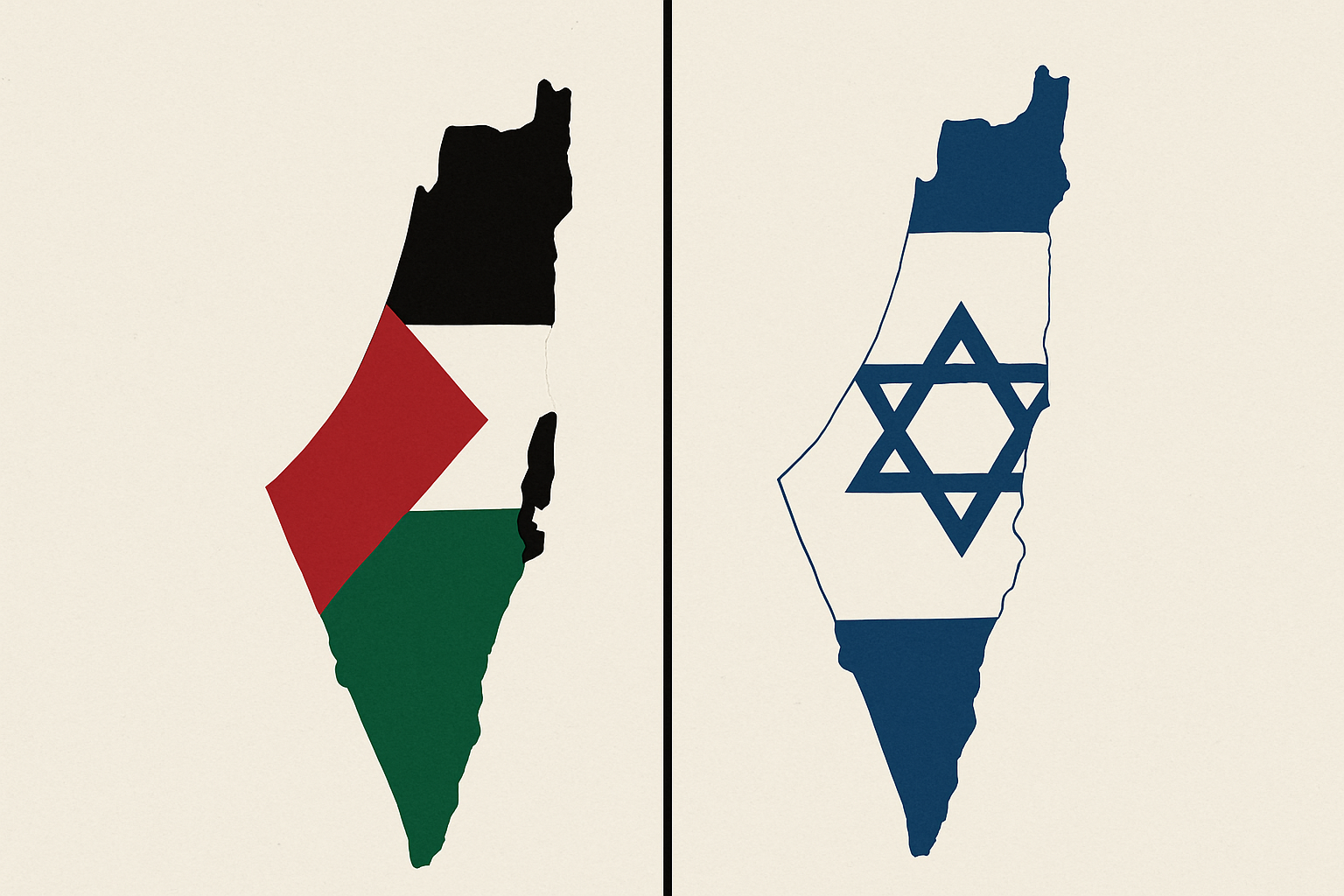
Eretz Yisrael to some, Filastin to others – Yerushalayim to some, Al-Quds to others. (AI-generated)
I have watched this war longer than I have been alive. It does not come in chapters anymore; it comes in a rhythm, the kind you know by heart and hate for it. The sound of the first air raid after a fragile ceasefire is like the opening line of a song you swore you would never listen to again. Both peoples speak of home, of survival, of truth – yet the same sun lights two entirely different landscapes in their minds.
If I speak as an Israeli, the land is not a recent possession; it is Eretz Yisrael, the land of Israel: a covenant carved not in ink, but in stone and fire, promised to Avraham, Yitzhak, and Yaakov, sanctified by the blood of prophets and the prayers of exiles scattered from Vilna to Fez, from Baghdad to Kiev. The rebirth of the state in 1948 was not an act of colonization – it was tekumah, resurrection after 2,000 years of dispersion and, above all, after the Shoah, the Holocaust, when six million reminders were etched into the Jewish genome that weakness invites annihilation. Security, bitachon, is not a luxury – it is oxygen. The Hamas rockets from Gaza are not grievances; they are proof of the eternal truth that without strength, ain lanu kiyum – we have no existence. Every hill in Yehuda and Shomron is not merely real estate; it is Judea and Samaria, the heartland where David reigned, where Shilo once held the Mishkan, the Tabernacle. To retreat from it is to retreat from our own bones. The checkpoints are not cruelty; they are fences around the camp, gader le-paratz, to protect children who ride buses knowing that one suicide bomber is enough to rewrite every parent’s life. The world lectures about occupation, but it did not stand at Sderot’s playground when the siren blared and the Iron Dome intercepted a warhead above a sandbox. The IDF is not a symbol of oppression – it is the Tzva HaHagana LeYisrael, the army of defense, not of conquest, sworn to ensure that Jewish history will never again be written by others’ hands. The question is never whether we want peace; the question is whether we can survive trusting the promises of those who dream of our disappearance.
If I speak as a Palestinian, the land is not a partitioned territory – it is Filastin, a trust from God and a patrimony of ancestors who tilled its olive groves before the word “Israel” returned to politics. Al-Nakba in 1948 was not an abstract tragedy – it was the uprooting of a people, the tearing of villages from the map, the scattering of families into refugee camps in Lebanon, Syria, Jordan, Gaza, and the West Bank. The house keys we carry are not symbols; they are testimonies to the homes stolen, to the waqf lands endowed for generations and seized without consent. Gaza is not merely a strip; it is a prison whose walls are patrolled by drones, where the sea is a locked door, where fishermen cannot cross the invisible lines set by foreign gunboats. Sumud – steadfastness – is not romantic endurance; it is survival under the crushing weight of occupation. The IDF raids are not neutral security operations; they are the midnight storms that rip fathers from beds in front of their children, the bulldozers that level homes under the pretext of “security needs.” Checkpoints are not protective – they are daily humiliations, barriers that turn a 10-minute walk to school into a two-hour ordeal. The West Bank is not “disputed” – it is land seized by force in 1967, carved by settlements and bypass roads for others, while our towns are hemmed in and strangled. International law is our scripture in the absence of divine rescue, yet the ummah watches and the world speaks of balance, as if a colonizer and the colonized stand equal on a scale. Resistance, whether stone or rifle, is not madness – it is the echo of al-Quds under occupation, the cry that God is with the oppressed, and that Insha’Allah, the land will return to its people.
Each narrative is complete unto itself, a closed fortress of memory and righteousness. From within, each makes perfect sense; from without, each looks like an unmovable wall. Each story is self-sealing. Each grievance arrives with a date stamp and a photograph, an exhibit, and a funeral. Every accusation is answered with a ledger. The ledgers never close. The Israeli mind measures risk in centuries of exile and persecution, in Yom Kippur War mobilizations and the funerals of teenagers who never saw their 20th birthdays. The Palestinian mind measures time in decades of displacement, in massacres named after camps – Sabra, Shatila – in curfews that last longer than a childhood, in dreams where you walk in your grandfather’s village and wake to find it paved over.
One side calls it defense and deterrence. The other calls it occupation and dispossession. One side says never again and means the particular. The other says never again and means the universal. Two languages that use the same phrase and speak past each other, like twin radios tuned half a notch apart – both believing their broadcast is the only one worth hearing.
Every negotiation becomes a rehearsal for the next collapse. The “peace process” is an exhausted phrase, a diplomatic talisman passed from one envoy to another, each pretending that this time, trust will grow in soil salted by betrayal. Two states exist more in conference halls than on maps; one state is a fantasy drowned in the fear of demographic erasure or political domination. The sacred city – Yerushalayim to one, Al-Quds to the other – cannot be split without both sides feeling amputated. Refugees cannot be returned without Israel feeling undone; settlements cannot be erased without Palestinians feeling mocked. Diplomacy offers its careful toolkit – “confidence-building measures,” final status issues, borders to be drawn with rulers across hills that do not submit to rulers. Jerusalem with its stones that outvote elections. Refugees with keys that unlock nothing. Security guarantees that are guaranteed until the next siren. Deconfliction lines that bend into smoke. Prisoner exchanges that carry thousands of birthdays. Ceasefires that are not peace and are not meant to be. Normalization that tries to skip the middle chapter. Quiet that means quiet for the loudest actors, never for the civilians. Every communique reads like a well-made umbrella in a sandstorm – the wind does not read communiques, and the rain does not pause for signatures.
And so the conflict becomes a perpetual motion machine, powered by grief and suspicion, immune to exhaustion. Each side produces martyrs, each side raises children to remember the dead, each side educates in vigilance. The outside world manages, never resolves; it funds reconstruction only for it to be shattered again. Hope is the opiate offered by press conferences, by carefully staged handshakes, by “confidence-building measures” that build nothing but time until the next eruption. Hope says if children meet, the future changes. Children did meet. They exchanged drawings and then they inherited alarms. Hope says if we mourn together, the cycle breaks. People did mourn together. The morgue still ran out of ice. Hope says if we say the right words in the right order, the door opens. The door is not locked by grammar – it is locked by history, and the key is kept in two separate pockets, each convinced the other’s pocket is a theft.
The honest reading is brutal. Both narratives are coherent from the inside and ruinous from the outside. Both have martyrs, calendars, maps, and poems. Both have lawyers and quartermasters. Both can quote law and scripture. Both can show you a small body or a shattered street and ask you to choose. The moral instinct is to refuse the choice. The political reality is that the choice arrives anyway – in uniforms and sirens and flight alerts and trenches and rubble and the long wait for a phone that will not ring.
Perhaps the most honest thing to say is that there is no honest solution visible from here. Not one that preserves what each side believes is sacred, just, and existential. The Israeli will not trade security for words; the Palestinian will not trade justice for quiet. And so they remain, two peoples with one wound, each convinced it was inflicted by the other, each tending it as proof of why they must never relent. The world may grow bored, headlines may fade, but on that narrow strip between river and sea, boredom is a luxury no one can afford. Here, the cycle is the life. And life, as it is lived here, is the cycle.
So I come to a bleak thesis. There is no solution that looks like a solution. There is only exhaustion, and exhaustion is not a policy. There is only management, and management is not a life. There is only the slow grinding of narratives that will not concede because concession tastes like erasure. The world will posture, donors will fund, negotiators will return to their hotels with tidy notes, and the ground will remain what it is – a space where two stories insist on totality.
If there is a path through, it begins with a sentence that no one wants to say – not the sentence of recognition that diplomats print on heavy paper, but a smaller one. I am not safe, and neither are you. I am not whole, and neither are you. I am not going anywhere, and neither are you. It is not a solution. It is not even a plan. It is an unpleasant mirror, and perhaps one day it becomes a door. For now it is only glass – and even that can cut.
Related Topics
Related Posts