An Aging Jewish Feminist
The Land, the Children, and the Choice Before Us: Parashat Lech Lecha
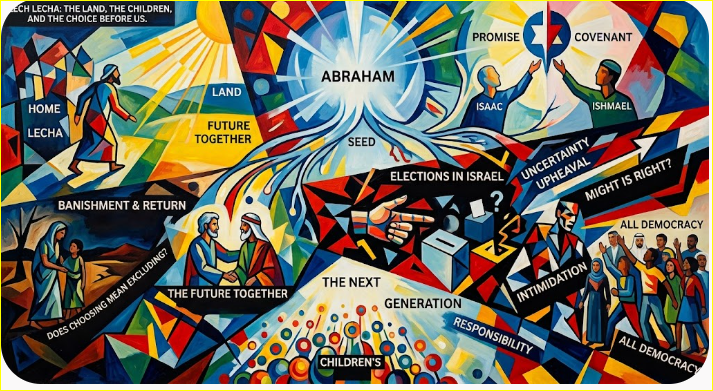 Gemini image for Lech Lecha and Elections in style of Wassily Kandinsky (1866-1944)
Israel’s defining moment now is one of uncertainty. We are all on standby, waiting for the worst. For the past few weeks, we have been dreading the elections that are now less than a week away. It is clear to anyone even vaguely aware of what is happening in the world how consequential these elections are. Are we going back into the Middle Ages, to a world where the rule of might is right? The threat is there.
This morning, my cleaning person, who lives in a nearby Arab village, expressed her fear that extreme right-wing supporters will come into her community and try to intimidate people so that they will not vote. Her fears echo mine. They also remind me of something that we sometimes forget: we are all children of Abraham.
That thought brings me directly to this week’s parashat Lech Lecha, and to a question that runs through the story of Abraham: Who belongs? Who inherits? And what happens when choosing one person seems to mean excluding another?
ABRAM AND HIS UPHEAVALS
Abram begins Lech Lecha already in the midst of enormous upheaval. In the previous parasha, we learn that his brother Haran has died. His other brother, Nahor, has remained behind. Abram’s wife Sarai is barren, and his father Terach has uprooted the family from Ur Kasdim, intending to reach Canaan, but stops in Haran and dies there.
In other words, before God ever calls him, Abram has already experienced several major losses: the death of a brother, the loss of his homeland and extended family, the death of his father is imminent, and the apparent loss of any hope of having children.
Then God speaks:
וַיֹּ֤אמֶר יְהֹוָה֙ אֶל־אַבְרָ֔ם לֶךְ־לְךָ֛ מֵאַרְצְךָ֥ וּמִמּֽוֹלַדְתְּךָ֖ וּמִבֵּ֣ית אָבִ֑יךָ אֶל־הָאָ֖רֶץ אֲשֶׁ֥ר אַרְאֶֽךָּ׃
“Go forth from your land, your birthplace, and your father’s house, to the land that I will show you” (Genesis 12:1).
The command is followed by extraordinary promises: Abram will become a great nation; he will be blessed; his name will become great; and he himself will become a blessing. God even promises to bless those who bless him and curse those who curse him.
We tend to read this as a simple story of faith: God calls, and Abram obeys. But there is something more complicated here. The Torah says that Abram went “as God had spoken to him”—using the verb diber, “spoke,” rather than tzivah, “commanded.” Abram is persuaded rather than simply ordered. And what God asks of him is enormous. Abram leaves behind everything familiar and sets off for a land that God has not yet identified. At seventy-five, after a lifetime of upheaval, he begins another one.
Perhaps this is the first connection to our own moment. We too are living through upheaval. We do not know what lies ahead. We are a country in waiting. We are glued to the media, trying to make sense of events. We sigh a lot. We keep busy, each in our own way. We move between hope and despair. Rumors abound. We are fearful of the future. Our armies remain on alert, and people are coming from all over the world to vote. We wonder whether people will be intimidated from voting, or influenced at the last moment by propaganda and fake news.
We are not refugees in our own country, but we are experiencing something of the same psychological disorientation that comes with displacement. We do not know what the next morning will bring. And that brings me back to the land that God promises Abram.
A PROMISE—AND TO WHOM?
When Abram arrives in Canaan, God tells him:
“I will assign this land to your offspring” (l’zar’acha) (Genesis 12:7).
That wording caught my attention. We usually remember that God promises Abraham the land. But here the promise is specifically to his offspring, literally seed (זרע) !
The distinction becomes even more striking in Genesis 15, when God makes the covenant with Abram and says:
“To your offspring I assign this land, from the river of Egypt to the great river, the Euphrates.”
Why does this matter? Because Abraham has more than one son.
The Torah itself contains a complicated story about who constitutes Abraham’s zera, his “seed” or offspring. Isaac is Sarah’s son and the one through whom God says the covenant will continue. But Ishmael is also unmistakably Abraham’s son. The Torah repeats this fact again and again.
When God announces that Sarah will have a son, Abraham’s immediate response is not simply joy. He says:
“O that Ishmael might live by Your favor!” (Genesis 17:18)
Abraham is worried about his firstborn.
God answers that Sarah will indeed bear Isaac and that the covenant will continue through him. But God immediately adds something important about Ishmael:
“As for Ishmael, I have heeded you. I hereby bless him.”
Ishmael will be fertile, become exceedingly numerous, and father twelve chieftains. He too will become a great nation. God therefore chooses Isaac without annihilating Ishmael. That distinction is crucial. Abraham seems to understand something that later generations often forget: being chosen does not necessarily mean that someone else has to disappear.
ABRAHAM’S ANXIETY ABOUT ISHMAEL
Abraham’s concern becomes even clearer in the interpretation of Nachmanides. Commenting on Abraham’s words, lu yishmael yichyeh lefanecha—“Would that Ishmael might live by Your favor”—Ramban argues that Abraham feared that once he learned Isaac would be the covenantal heir, Ishmael might die or disappear. Abraham was asking God, in effect, to let Ishmael live and let his descendants continue to exist.
This is a very different reading from the one that reduces Ishmael to a rejected son. Abraham is not eager to get rid of his firstborn. He is troubled by the prospect that choosing Isaac will endanger Ishmael.
And the Torah confirms that this anxiety is not misplaced. In next week’s portion, Sarah tells Abraham to banish Hagar and her son because Ishmael must not share the inheritance with Isaac. Abraham is deeply distressed. God tells him to listen to Sarah, while simultaneously promising that Ishmael too will become a nation.
The irony is painful. Abraham gets up early in the morning to send Hagar and Ishmael into the wilderness with only bread and water. And later, in the same narrative cycle, he gets up early again to take Isaac to Mount Moriah.
The same Abraham who is willing to send one son away is terrified of losing the other. There is something profoundly human about this wavering.
WE MUST REMEMBER ISHMAEL
The rabbinic tradition itself preserves more than one way of remembering Ishmael.
One particularly fascinating midrash identifies Keturah, the woman Abraham marries after Sarah’s death, with Hagar. In Genesis Rabbah, Rav says that Keturah is Hagar, while Rabbi Nechemiah initially objects. Rav then explains that Abraham took her back in accordance with the divine word. Her name, Keturah, is connected with ketoret, fragrance, because she had become “fragrant” through her commandments and good deeds.
I have always found this midrash intriguing. Abraham does not simply replace Hagar with another woman after Sarah dies. According to this tradition, he returns to the woman he had once banished—the mother of his first son. And Ishmael himself remains connected to his father. When Abraham dies, the Torah tells us:
“His sons Isaac and Ishmael buried him” (Genesis 25:9).
The two brothers come together to bury their father. Even more strikingly, Isaac later settles near Be’er-lahai-roi, the place associated with Hagar and Ishmael.
The Torah therefore preserves two competing traditions. One emphasizes Ishmael as the son of Sarah’s slave; the other repeatedly calls him Abraham’s son. Those traditions do not easily fit together. But perhaps the tension is precisely the point.
THE DANGER OF CHOOSING
This is where the biblical story meets our own moment.
The last election gave us a government in which racist and violent elements became powerful enough to shape national policy. We have watched a government that has failed to provide adequately for its citizens, while some of its leaders appear more concerned with preserving their political power than with the welfare of the country. The damage—to Israel’s institutions, reputation, security and future generations—will take a long time to repair. The danger is not simply that we may choose the “wrong” political party. The deeper danger is that we may embrace a worldview in which choosing one group means demonizing and excluding another.
Sarah’s words about Hagar—ha-amah hazot, “that slave woman”—are disturbingly familiar. Once we reduce human beings to categories, once we turn “them” into a threat and “us” into the only legitimate owners of the future, it becomes much easier to justify exclusion.
The Ishmael story warns us about precisely this temptation. The Torah does not tell us that Isaac is not chosen. He is. But neither does it tell us that Ishmael must disappear.
God’s message is more complicated: Isaac has the covenant, and Ishmael has a future.
That is a message worth remembering as we approach an election that could determine what kind of country we will be.
WHO WILL INHERIT THE LAND?
The rabbinic tradition noticed the ambiguity in the biblical promises about the land. Nechama Leibowitz points out that the Torah contains several promises of the land to Abraham and his descendants, but there are also passages where the promise is specifically to his zera, his offspring.
One remarkable midrash in Megillat Ta’anit imagines Ishmael’s descendants making precisely this argument. They quote Genesis: “To your seed I have given the land,” and say, in effect, We too are Abraham’s seed. Why should the land belong exclusively to you?
The rabbinic response is that Abraham eventually gave Isaac everything he possessed and sent the sons of his concubines away.
The argument is hardly neutral. It reflects the rabbinic need to establish Israel’s particular claim. But the fact that the rabbis preserve Ishmael’s argument is itself significant. They allow him to speak. They allow him to say: I too am Abraham’s seed.
And that brings us back to our own election. A country is not only a piece of land. It is a legacy. The question is not simply who gets to live here today, but what kind of country are we leaving to our children and grandchildren? Abraham’s story teaches us that the choices we make about who belongs have consequences that extend far beyond our own generation.
OUR DEFINING MOMENT
This is why the election next week feels so consequential. My fear is not simply that a particular politician or party will win. It is that we may choose to continue down a path in which power is more important than responsibility, where might becomes right, where minorities are intimidated, where dissent is treated as treason, and where those who are different from us are pushed outside the boundaries of legitimate belonging.
My cleaning person’s fear that people will try to prevent Arab citizens from voting is therefore not a peripheral concern. It goes to the heart of democracy. If people are afraid to exercise their right to vote, then the election has already been corrupted.
And it reminds me again that we are all children of Abraham.
Abraham himself stood at a crossroads between his sons. He did not always know what the right thing was. He worried about Ishmael even when God told him that Isaac was the chosen heir. He remained connected to Ishmael. And in the end, Isaac and Ishmael stood together at their father’s grave.
Perhaps Abraham’s uncertainty is something we need right now. We should be wary of those who are absolutely certain that they alone possess the truth, that they alone belong, that everyone else is an enemy.
Next week, we will have to choose. We have a responsibility not only to ourselves, but to our zera—our offspring, the generations who will inherit whatever we create. The land may be promised to our descendants, but the kind of society they inherit is up to us.
A week before the election, I am reminded of a prayer my niece, a member of a congregation in Riverdale, sent me before the last election in the States. Her rabbi, Barry Dov Katz, distributed it to his congregation before the election. He asked that as people voted they would see their ancestors before their eyes, remembering those who worked toward a nation in which “all” could include everyone. And he asked that they see the next generations before their eyes, because those generations trust us to leave the world better than we found it.
That is what is at stake.
Not simply Isaac or Ishmael.
Not simply left or right.
Not simply one government or another.
But what kind of people we will be—and what kind of country we will leave to those who come after us.
Shabbat shalom.