Russian-American-Israeli Palestinian. Palestine is Israel.
The Land Without a People for the People Without a Land
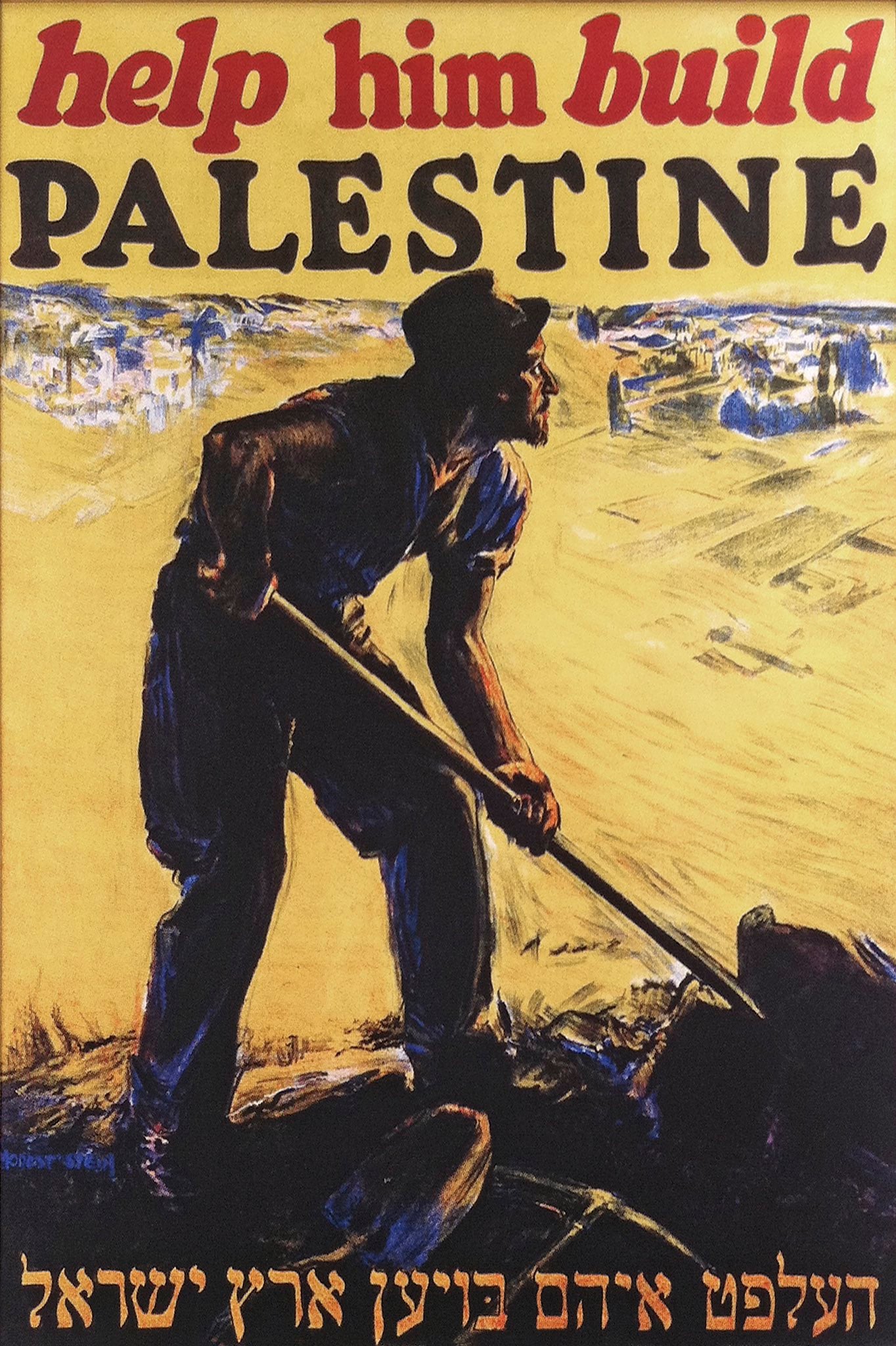
"Help Him Build Palestine" — Zionist poster by Modest Stein for Keren Hayesod (Palestine Foundation Fund), 1930
Why a Simple Capital Letter and Articles Change the Entire Story
There’s a phrase that Ziophobes love to hate:
A land without people for people without a land.
They brandish it like a rhetorical weapon, shouting that Zionists denied the existence of Arabs in Palestine, used the phrase to justify colonialism, and launched a campaign of ethnic cleansing. According to their version, early Zionists saw Palestine as a barren, empty desert—just waiting for Jewish “settlers” to come fill the void.
There’s just one problem: that’s not what the phrase was or meant. At all.
Welcome to the great semantic sleight-of-hand—the phrase that was mistranslated, misused, and manipulated, mostly in English, to fit an anti-Zionist narrative. And like many mistranslations, the damage lies in what got lost—or perhaps deliberately buried—in transit.
“people” or “People”? A Capital Idea
Let’s take a closer look at the phrase. In Hebrew, it reads:
Ha’Aretz L’lo Am La’Am L’lo Eretz
הארץ ללא עם לעם ללא ארץ
Now notice something: the word Am (עם) doesn’t mean “people” as in individuals. It means People, as in a Nation.
In English, however, we’re stuck with a confusing word: “people.” Whether it’s written with a lowercase p or an uppercase P, it sounds identical when spoken—but the meanings are worlds apart. So when English speakers read “a land without people,” it sounds like “nobody lived there.” That’s not what the original said—or meant.
The phrase should be rendered more accurately as—and note the importance of the articles as well:
The land without a Nation for the Nation without a land.
Or:
The land without a People for the People without a land.
Big difference — these are very different from the misleading phrase “A land without people.”
Twisting the Words, Warping the Intent
Over generations, the original phrase has been mangled into misleading variations—each one diluting, distorting, or outright inverting its meaning. These aren’t harmless paraphrases; they’re rhetorical booby traps, engineered to paint Zionism as erasure and colonization.
Let’s look at a few of the most common corruptions:
- “A land without people for people without a land.”
The most widespread distortion. It erases both the articles (a, the) and the capitalization that distinguish individuals from a Nation. It sounds like a claim that no one lived there. - “A land without people for a people without a land.”
Slightly closer—but still erases the national character of the first group. The Jews are “a people,” but the land is portrayed as empty of any people at all. - “Palestine was a land without people.”
This isn’t even a phrase—it’s a myth, pulled out of context and repeated endlessly to accuse Zionists of fabrication and erasure.
These versions work like propaganda: they swap nations for nobodies, erase context, and feed the illusion that Jews imagined a vacant lot and painted it as an empty canvas with imperial brushes.
So Who Was Really There?
Yes, Arabs lived in Palestine in the 19th century—nobody denies that. But the land had no sovereign nation, no unified identity, and certainly no “Palestinian Nation” or “Palestinian People” in any modern political sense. The population was a loose patchwork of communities—Jews, Christians, Armenians, Assyrians, Circassians, Samaritans, Druze, Arabs, Muslims, and others—some native, many migratory: Egyptians, Syrians, Bedouin tribes, and other Ottoman subjects. Even the Arab population itself was a mosaic of distinct groups, with varying dialects, loyalties, and origins—far from a cohesive national entity.
There was no Palestinian flag, no Palestinian dialect, no government, no cultural movement, no aspiration to statehood. In fact, it wasn’t until the Jewish national revival gained momentum that Arab leaders began speaking of “Palestine” as a distinct political idea—a reactive identity, not an organic one.
Meanwhile, the Jews—both in exile and in the land—were already a People (a Nation) in every sense of the word: history, language, law, memory, purpose. The only thing they lacked was territory.
So the phrase wasn’t erasure. It was diagnosis. The land had no People (Nation), and the Jews were the People (Nation) without land. Hence the match.
But Wait—Wasn’t the Land Crowded?
Not really. For most of its post-Biblical history, Palestine was sparsely populated. Under Ottoman rule, the total population hovered between 200,000 and 300,000. That’s smaller than today’s Haifa. When the British took a census in 1922, the number was still modest: around 750,000, including Jews.
More importantly, much of the Arab population grew after Zionists arrived, drawn by the jobs, infrastructure, improved public services, and prosperity Jews brought. Arab migration from neighboring lands surged—Egypt, Syria, Transjordan—people came not to reclaim lost roots, but to join an economic boom sparked by Zionist development.
In other words, Zionism didn’t displace Arabs—it attracted them.
So even the distorted version—“a land without people”—isn’t entirely off base. Not literally, of course, but figuratively: it was a land without a distinct national population, without a unified People, and with plenty of room to grow.
A Convenient Misread
So why does this phrase get dragged out so often in anti-Zionist rhetoric?
Because it’s easy to distort, especially in English. Because it’s in English, the language of the global debate. Because it sounds colonial if you ignore its original language and historical context.
But most of all, because it’s a shortcut—a lazy way to smear Zionism as inherently racist, without doing the hard work of understanding what Zionism actually is: a national liberation movement, not a colonial enterprise.
Conclusion: Time to Retire the Myth
“The land without a People for the People without a land” was never about denying anyone’s existence. It was about recognizing nationhood where there was none, and restoring nationhood where it had been severed.
So the next time someone quotes that distorted phrase like it’s some kind of Zionist confession—stop them. Ask what it says in Hebrew. Ask what Am means. Ask if they’ve confused a person with a People—or if they know anything about the actual demographics of Palestine. Or better yet, just send them this article.
And then tell them the truth: the only thing empty here is their understanding.
Related Topics
Related Posts