NAnews - Nikk.Agency Israel News
The Last Homework of 14-Year-Old Daniel Umansky, Killed by a Russian Drone
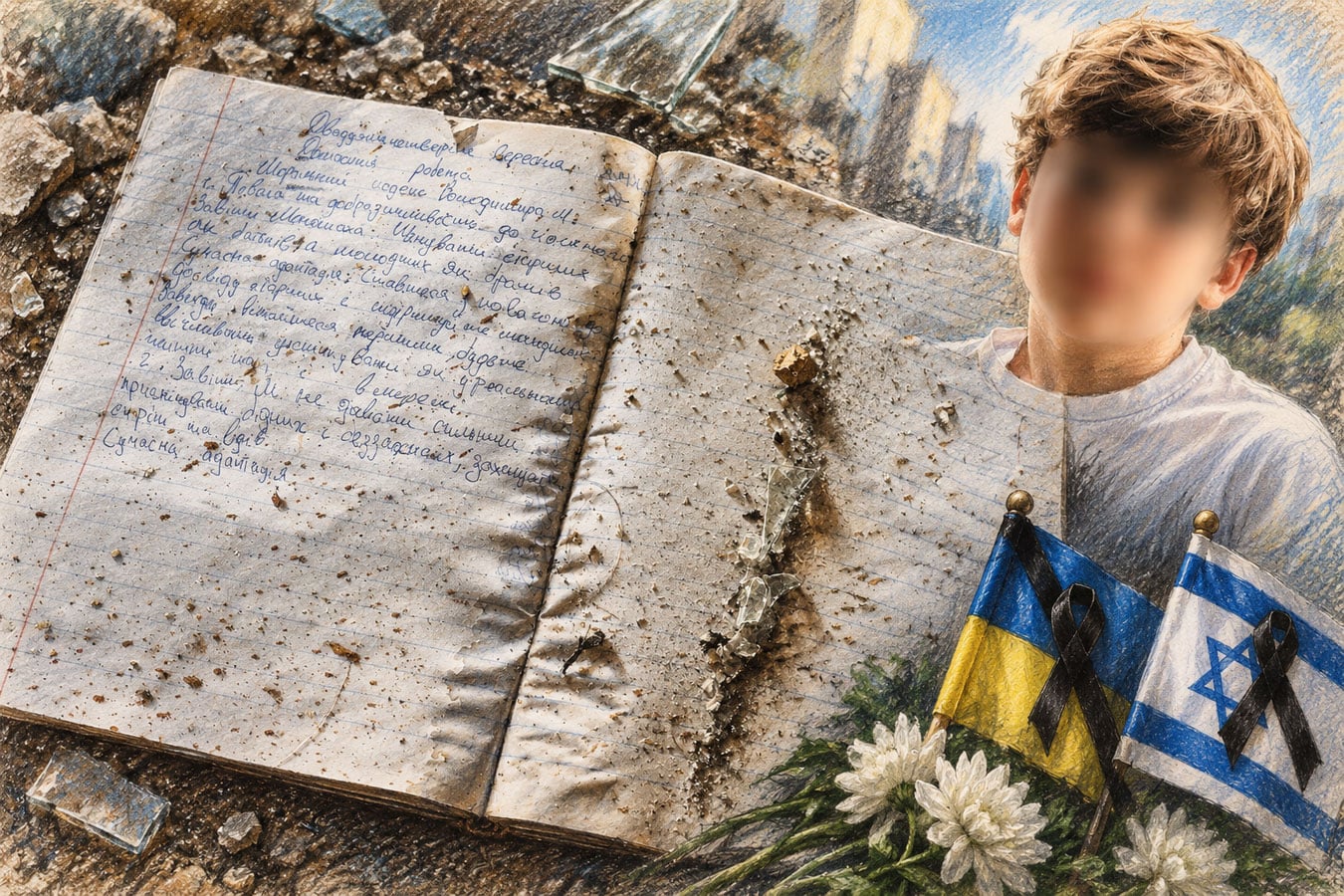
The Last Homework of 14-Year-Old Daniel Umansky, Killed by a Russian Drone – Image created using AI.
A 14-year-old Israeli-Ukrainian boy was writing about responsibility, protecting the weak and respecting other people. Then a Russian drone struck his home in Kyiv.
There are details in war that refuse to remain statistics.
I have been following Russia’s war against Ukraine for years, often from the point where it intersects with Israel. There are missiles, diplomatic statements, casualty figures, arguments over foreign policy and endless debates about what Israel should or should not do.
And then there is an unfinished school notebook.
On September 25, 14-year-old Daniel Umansky was at home in Kyiv working on his homework. The assignment concerned Volodymyr Monomakh, the 12th-century ruler of Kyiv, and in particular the moral principles traditionally associated with his “Instruction” to his children.
Daniel was trying to translate those old ideas into modern language: responsibility, respect for other people, helping orphans, protecting those who are weaker.
He never finished.
A Russian drone struck the residential building where his family lived in Kyiv’s Pechersk district. Daniel was killed. His mother was wounded. His younger brother survived.
Ukrainian human rights lawyer and Nobel Peace Prize laureate Oleksandra Matviichuk later published a photograph of Daniel’s unfinished schoolwork. A child had been answering a question about how a person with power should behave toward someone weaker.
Then the war entered his room.
That coincidence is almost unbearable, but it is also why I have kept thinking about this story.
For many Israelis, the name Volodymyr Monomakh will mean little. In Ukraine, however, he belongs to the history children encounter at school. His “Instruction” is not studied merely as the biography of a medieval prince. It is also a text about conduct: do not be lazy, care for the vulnerable, help those in need, respect others and take responsibility for your own actions.
A nine-century-old text had become a homework assignment for a teenager in modern Kyiv.
There is another historical layer that may be less obvious to an Israeli reader. The Kyiv of that era was already connected to Jewish history. Jewish life in the city predates Monomakh’s rule by generations. One of the best-known pieces of evidence is the Kyiv Letter from the Cairo Geniza, generally dated to around the 10th century and connected with Kyiv’s Jewish community.
Daniel’s school assignment therefore belonged to a city whose Ukrainian and Jewish histories have overlapped for more than a thousand years.
But Daniel himself embodied a much more recent connection between Ukraine and Israel.
He was a citizen of both countries.
Before moving to Kyiv, he had lived in Israel and studied at the Ahavat Zion school in Tel Aviv. His family later relocated to Kyiv because of his father’s work, while his grandparents and other relatives remained in Israel.
In Kyiv, Daniel was not simply “an Israeli child living abroad.” He was an eighth-grade student at Lyceum No. 5 in the Pechersk district. His teachers later recalled that he particularly loved the Ukrainian language and dreamed of becoming a Ukrainian-language teacher.
That detail matters.
We often try to fit people into a single national box because it makes a story easier to explain. Israeli. Ukrainian. Immigrant. Expatriate.
Daniel’s life did not fit into one.
Israel was home. Kyiv was also home.
After his death, his parents decided to bring him back to Israel for burial.
At the funeral, Knesset member Gilad Kariv, chairman of the Committee for Aliyah, Absorption and Diaspora Affairs, heard Daniel’s parents say goodbye to their son in two languages. Kariv later wrote: “Israel must stand with the citizens of Ukraine.”
That was the statement of an opposition lawmaker, not a new declaration of Israeli government policy. The distinction matters. But so does the place from which those words came.
They came after the funeral of an Israeli child killed by a Russian strike on Kyiv.
I wrote separately about Daniel’s funeral and Kariv’s call for Israel to stand with the citizens of Ukraine, because this case exposes something that is too easily lost in abstract discussions of Israeli foreign policy.
Ukraine is not necessarily “somewhere else” for Israel.
There are Israelis living in Ukraine. There are Ukrainian families in Israel. There are new immigrants, refugees, mixed families, grandparents in one country and grandchildren in another. There are Israelis whose childhood language is Russian but whose relatives are being attacked by Russia. There are Ukrainians whose family history leads directly to Jerusalem, Haifa or Tel Aviv.
For these people, the distance between Kyiv and Israel is not measured in kilometers.
A few days after Daniel’s funeral, Israel’s ambassador to Ukraine, Roi Rosenblit, visited Lyceum No. 5. He met the school administration, teachers and Daniel’s classmates. They discussed possible cooperation between the embassy and the school, including a way to commemorate Daniel.
His classmates remembered a kind, sincere boy.
His teachers remembered a student who loved Ukrainian.
And somewhere behind all of that remained the unfinished homework.
Israelis understand better than most people what it means to continue ordinary life under sirens.
Children still go to school. Parents still go to work. People argue about exams, dinner and who forgot to charge a phone. A city cannot spend every hour behaving as if the next missile will arrive in five minutes, even when everybody knows that it might.
Kyiv has been living inside that contradiction for years.
So has Israel.
Perhaps that is another reason Daniel’s story should be understood here without the usual psychological distance we sometimes place between ourselves and wars beyond our borders.
On September 25, Daniel was doing something completely ordinary. He was sitting at home and trying to finish an assignment.
The question before him was, essentially, what responsibility means when one person is stronger than another. What do we owe the weak? How should power be used? Why does respect for another human being matter?
Adults have spent centuries producing complicated answers to those questions.
A 14-year-old boy was trying to write his own.
A Russian drone did not let him finish.
But the questions remain.
And now they are ours as well.
–
This post is based on my original reporting for NAnews. The full source article, including the chronology, school records, historical context and Israeli response, can be read here: “The last homework assignment of 14-year-old Daniel Umansky”.
Related Topics