CFO | Empower Society for Good I Author
The Leadership Our Children Will One Day Judge
Every generation inherits its challenges.
It also inherits its leaders.
But Parshat Pinchas asks a deeper question:
What does responsible leadership look like?
The parsha begins with one of the Torah’s most challenging episodes. Pinchas acts decisively to halt a moral and national collapse. God rewards him with a Brit Shalom—a Covenant of Peace. Yet Jewish tradition notes something extraordinary: in the Torah scroll, the letter vav in the word shalom is written broken.
Perhaps this teaches us that even necessary violence leaves something broken. Peace achieved through conflict is never complete.
Israel understands this reality better than most nations.
Since October 7, Israelis have fought not because they desire war, but because they were forced to defend their citizens against Hamas, Hezbollah, the Houthis and Iran’s wider campaign of destruction. Every military success carries a human cost. Every victory leaves families grieving. The goal has never been war. The goal has always been peace.
The broken shalom reminds us that genuine peace remains our aspiration.
Yet the parsha quickly changes direction.
Five courageous women—the daughters of Zelophehad—step forward to seek justice. Moses does not dismiss them. He listens. God responds, “The daughters of Zelophehad speak rightly.”
Then Moses, knowing he will never enter the Promised Land, asks God for one thing: appoint a leader so that Israel will not become “like sheep without a shepherd.”
He is not thinking about himself.
He is thinking about the future.
These are not disconnected stories.
Together they define responsible leadership.
Responsible leadership protects its people.
Responsible leadership pursues justice.
Responsible leadership prepares the next generation.
Today, the world debates different models of leadership. Some admire reconciliation. Others celebrate strength. History continues to assess leaders such as Nelson Mandela, Winston Churchill, David Ben-Gurion and, more recently, Donald Trump. Each is judged through different political and moral lenses.
The Torah begins with a different question.
What is the leader trying to preserve?
Leadership cannot be separated from purpose.
That raises another difficult question.
What does it mean today to be “pro-Palestinian”?
If it means compassion for Palestinian civilians, concern for their dignity, and a desire for two peoples to live in peace and security, those aspirations are entirely consistent with Jewish values.
But if it means supporting movements that reject Israel’s legitimacy and seek to replace rather than live alongside the Jewish state, then we are no longer speaking simply about peace. We are confronting an ideology that denies the Jewish people’s right to national self-determination.
Responsible leadership must distinguish between compassion for people and support for political ideologies.
Another challenge confronts us.
In many parts of the world, anti-Israelism has become one of the quickest paths to attention. On university campuses, across social media, and within sections of politics and culture, increasingly hostile positions toward Israel often attract approval, influence and followers. Complex realities are reduced to slogans. Nuance disappears. Moral certainty replaces honest debate.
Responsible leaders do not ask, “What will make me popular?”
They ask, “What is true? What serves justice? What protects the future?”
One question therefore lingers over Parshat Pinchas.
Are we too late?
Has the perception of Israel become so entrenched that it can no longer be changed?
Perhaps.
But Moses did not measure success by what people thought of him in the moment. He measured success by what Israel would become after he was gone.
That is responsible leadership.
If Israel, and those who support her, become consumed only with winning today’s headlines, we may lose the longer battle for truth. Yet if we continue to invest in education, moral clarity, dialogue and the next generation, perceptions can change.
History is full of ideas that once seemed permanent until they weren’t.
Our responsibility is not to guarantee the outcome. It is to ensure that truth is not abandoned because the task is difficult.
Perhaps we are asking the wrong question.
Instead of asking whether Israel is winning today’s media battle, perhaps we should ask what kind of nation we are building for tomorrow.
Moses never crossed the Jordan.
He never saw the society he had spent forty years preparing.
Yet his final act was not one of regret, but of responsibility. He ensured that Joshua was ready, that Israel had direction, and that the covenant would continue.
Perhaps that is the greatest definition of leadership.
Not winning today’s applause.
But ensuring that our children and grandchildren inherit something stronger than we received.
That was Moses’ legacy.
May it become ours.
Questions to Ponder
- What is the purpose of leadership: popularity or responsibility?
- Can there be lasting peace without first protecting life?
- How do we distinguish compassion for people from support for destructive ideologies?
- Are we investing enough in the next generation to shape Israel’s future—and its story?
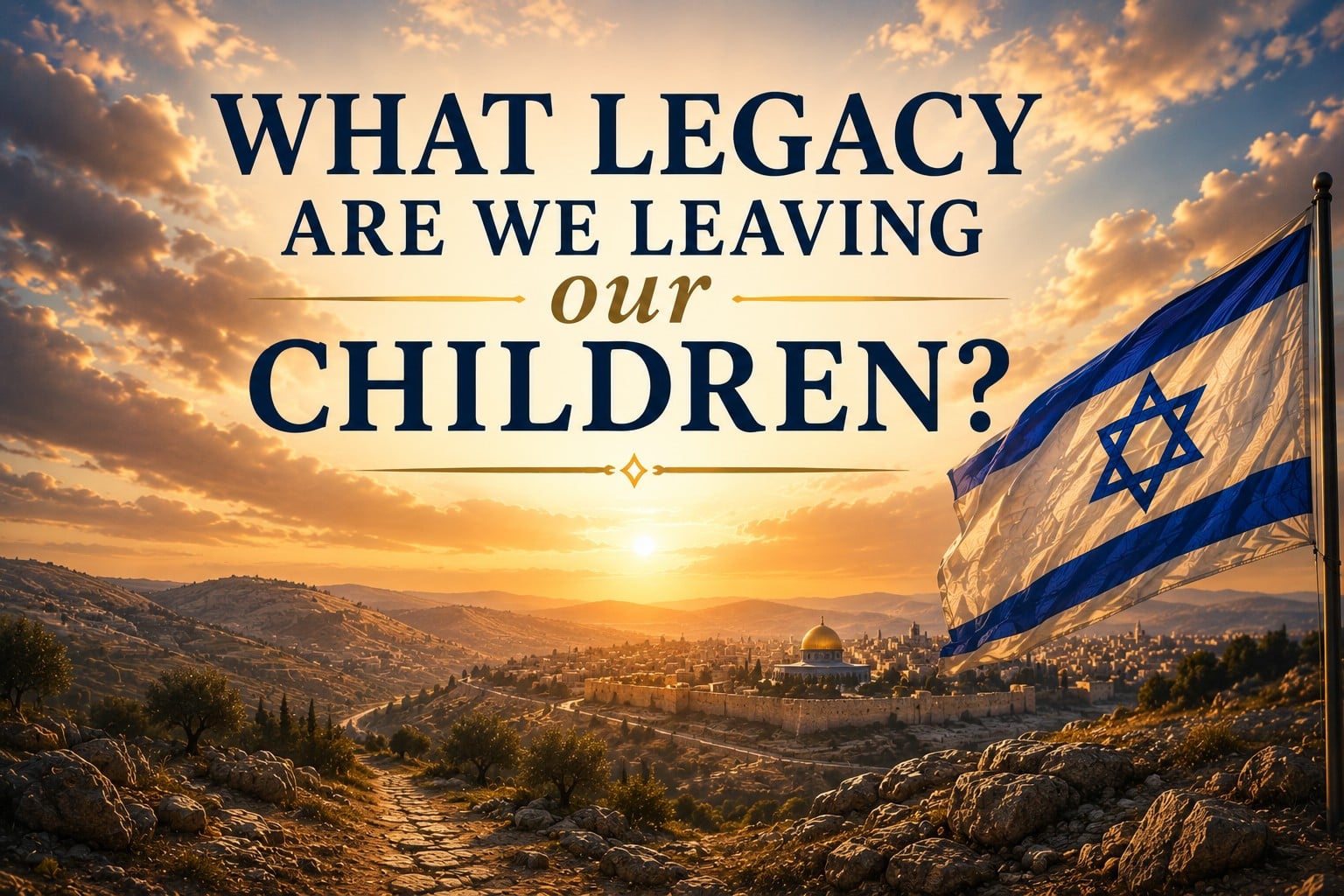
- What legacy are we leaving our children and grandchildren?
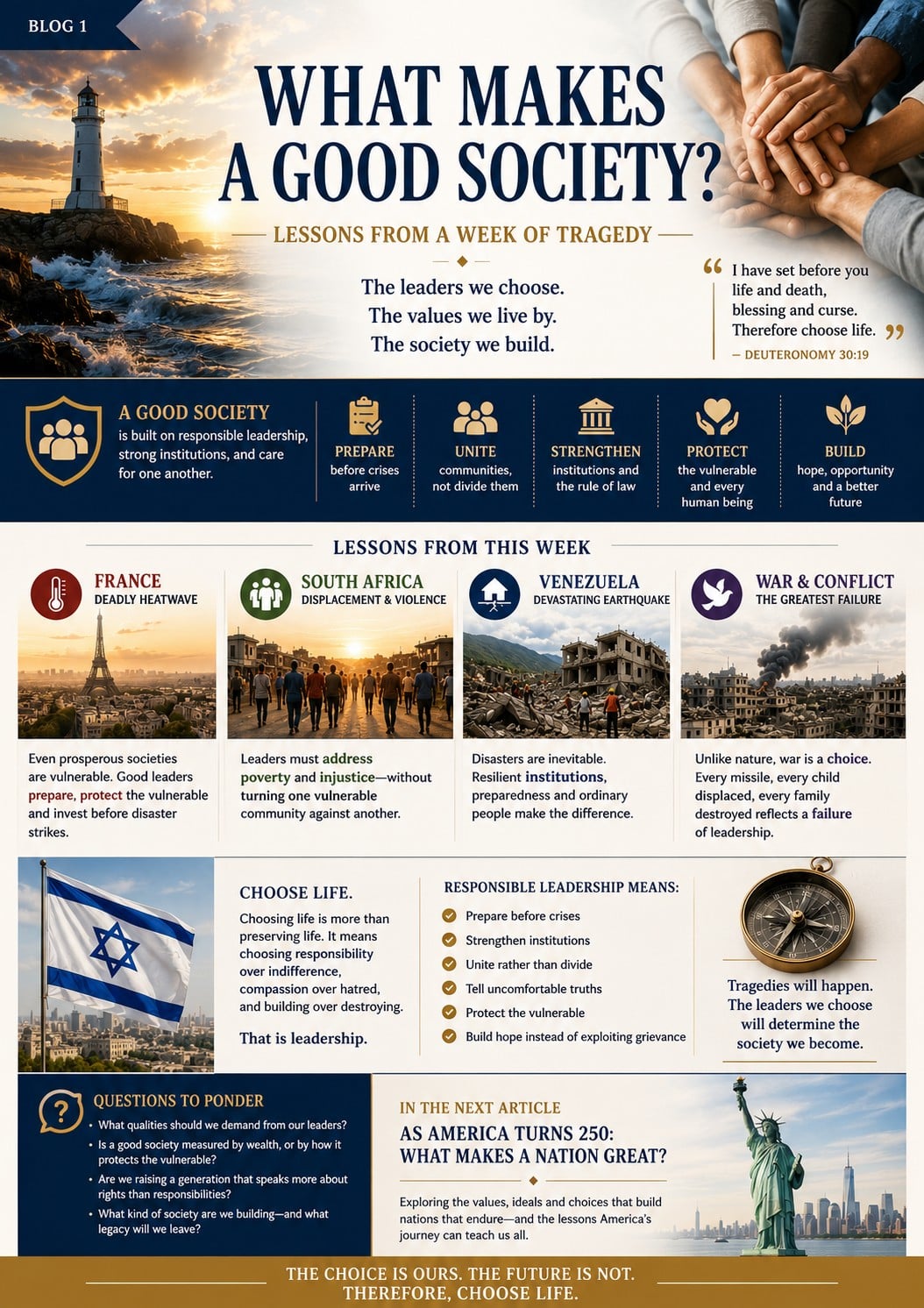
I invite you to read my series, “What Makes a Good Society?”
Over the coming weeks, I’d like to explore a question that I believe sits at the heart of many of today’s global challenges:
What makes a good society?
Through a four-part series, I’ll reflect on:
- Responsible Leadership – How this week’s global tragedies reveal that societies are ultimately shaped by the leaders they choose and the values they uphold.
- Great Nations – As America marks its 250th anniversary, what truly makes a nation great? Is it power and prosperity, or its ability to renew itself and learn from its past?
- Rights and Responsibilities – Have we become so focused on our rights that we’ve forgotten our responsibilities to one another?
- Rabbi Lord Jonathan Sacks – On his 6th Yahrzeit, I will be sharing why his teachings on responsibility, covenant and choosing life may be more relevant today than ever before.
The series is not about politics alone. It is about leadership, resilience, responsibility and the values that bind societies together.
I’m pleased to share the first article:
“What Makes a Good Society? – Lessons From a Week of Tragedy.”
I hope it provokes reflection and conversation.
https://blogs.timesofisrael.com/what-makes-a-good-society/
Related Topics
Related Posts