
The Left and Political Islam in Kurdistan
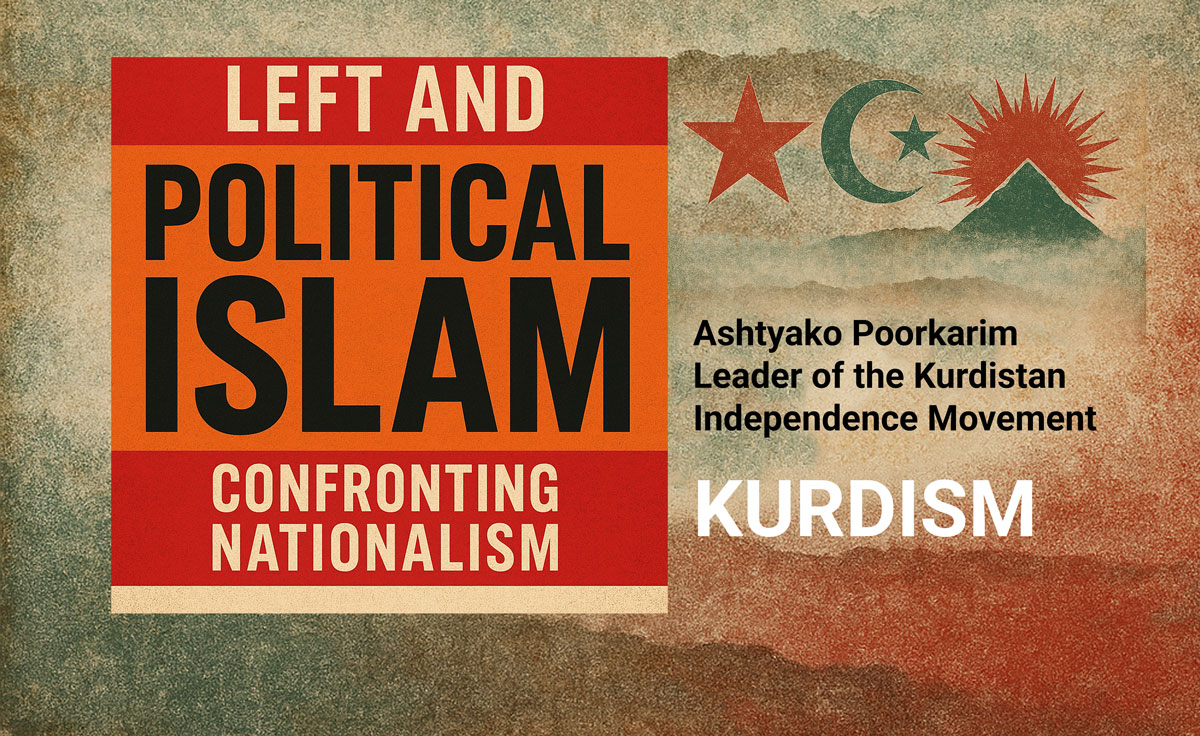
The Left and Political Islam: Confronting Nationalism in Kurdistan
Ashtyako Poorkarim. Leader of the Kurdistan Independence Movement
Research on the intellectual and political transformations of Kurdistan is incomplete without considering the role of three major discourses: nationalism, political Islam, and leftist thought. Over the past century, these three have traversed different paths within a Middle Eastern context marked by national, ethnic, religious, and class conflicts, yet they have remained ever-present in the social and political life of the Kurds. Kurdish nationalism, as a response to the enduring experience of “statelessness,” has been a project of survival and the reclamation of collective sovereignty. By contrast, political Islam and leftist movements, although emerging with claims of justice and liberation, have often adopted an ambivalent attitude toward the national question in Kurdistan. Examining this triangular confrontation provides a deeper understanding of the logic of power, identity, and emancipation in the Middle East, particularly in a land divided among four states and subjected to repressive and controlling policies.
This study is even more urgent today, as in recent decades Kurdistan has witnessed diverse experiments in self-rule, democratic confederalism, Islamic movements, and leftist organizations, while regional and international politics continue to delay this nation’s right to self-determination. A critical analysis of leftist and Islamist discourses, and their comparison with Kurdish nationalism (“Kurdism”), makes it possible to rethink pathways toward emancipation and democracy, offering policymakers, civil society actors, and researchers a clearer map for the future.
Kurdish nationalism, or “Kurdism,” unlike narratives that portray it merely as a construct of modernity, is rooted in a historical memory of resistance and in the enduring culture of a people. Over the centuries, the Kurds, through their connection with the Zagros and Alborz mountains, their related dialects, folklore, rituals, and collective memories, have forged a distinct identity, repeatedly resisting homogenizing projects of central governments.
The partition of Kurdistan following the Sykes–Picot Agreement and the Treaty of Lausanne denied their sovereignty, turning the Kurds into one of the world’s largest stateless nations. Since then, Kurdish nationalism has become not just a cultural movement but a project for survival, security, and the reconstruction of sovereignty.
In modern history, the uprisings of Sheikh Ubaydullah Nahri, Seyid Riza of Dersim, Simko Shikak, Bibi Maryam Bakhtiari, Sardar Ayoz Khan Khorasani, Maryam Qalavand, Sheikh Mahmud Hafid, and the Republic of Kurdistan in Mahabad each sought to establish political power and preserve Kurdish identity. In Northern Kurdistan, under Turkish occupation, the revolt of Sheikh Said and the Ararat Republic exemplified resistance against the Turkification policies of the new republic. In Syria and Iraq, systematic repression of Kurdish identity—from denial of citizenship to the Anfal genocide and the chemical attack on Halabja—turned nationalism into a refuge for the protection of existence.
These bitter and often bloody experiences created a shared memory that remains the driving force of national movements. Kurdish nationalism, intellectually, has moved through three layers: a mythical-symbolic memory that enshrines mountains, heroes, and collective rituals as pillars of identity; a modern layer shaped by print media, poetry, new literature, parties, and civil organizations; and a legal-political layer gaining legitimacy through interaction with international law and theories of self-determination. Together, these make Kurdism a complex yet dynamic discourse capable of resisting occupation while seeking new forms of governance.
Political Islam in Kurdistan, as elsewhere in the Middle East, arose from a fusion of religion with concerns for justice, morality, and political order; yet its emergence in Kurdish regions has taken specific forms. It has been shaped by three main factors: the pressures of dominant regimes, internal fissures within Kurdish communities, and transnational waves of Islamism. In the Kurdistan Region under Iraqi rule, Islamic parties entered parliamentary competition in the 1990s, sharing governance with nationalist forces. In Iranian-ruled Kurdistan, Sunni groups have sought a fragile balance between cultural activism, sermons, and resistance to security policies. In Turkey, Islamist movements have at times aligned with the state and at times opposed it, but their main priority has often been consolidating power rather than defending the right to self-determination. In Syria, religious networks have mostly worked to sustain social life in Kurdish communities rather than organizing as independent political projects.
Political Islam in Kurdistan can be analyzed on three levels. Structurally, the lack of public services, economic discrimination, and the absence of neutral institutions have opened space for religious networks to distribute welfare and legitimacy. Institutionally, the quality of competition and state tolerance has determined its trajectory: where electoral mechanisms and freer media existed, Islamists leaned toward participation and moderation; under repression, extremist and violent interpretations grew. Discursively, political Islam oscillates between solidarity and justice on one hand and prioritizing the “ummah” over the nation on the other. Whenever the latter prevails, Kurdish national identity is marginalized and becomes a tool for state containment strategies.
The left in Kurdistan, while initially arriving as a bearer of social justice and class equality, failed to establish a stable, authentic connection with the Kurdish national question. Many leftist forces in the Kurdish regions of Iran, Iraq, Syria, and Turkey emerged from communist parties tied to the Eastern bloc or to ruling, occupying states. Their priority was the consolidation of class hegemony and alignment with central power, not defending Kurdish self-determination. In Iran, the Tudeh Party adopted a cautious stance toward the Republic of Kurdistan in Mahabad and remained silent during its suppression. In Iraq and Syria, communist parties justified cultural erasure and Arabization under Ba’athist regimes in the name of “Arab socialism.” In Turkey, segments of the secular left reduced the Kurdish issue to gradual reform within the Turkish Republic, avoiding recognition of an independent national existence. This ideological and organizational dependency prevented the left from producing an indigenous, coherent vision for Kurdish liberation.
Many Kurdish leftist parties, especially in the 1960s and 1970s, sought to replicate imported versions of Marxism, viewing class struggle as the sole axis of analysis. They sometimes dismissed the national cause as a “petty-bourgeois deviation” or postponed it until after the global proletarian revolution—a promise that, in practice, meant passivity in the face of repression. Even groups calling themselves “national left” often oscillated between loyalty to orthodox Marxism and the imperative of defending Kurdish independence, failing to craft a clear strategy.
Both political Islam and the left share foundational similarities. They are transnational in essence, privileging allegiance to the ummah or the class over loyalty to the nation. In political Islam, especially in authoritarian versions, devotion to the ummah and to sharia takes precedence, relegating Kurdish concerns. On the left, the global proletariat or internationalism is presented as the primary agent of liberation, while the rights of subjugated nations are treated as secondary. Consequently, despite promises of justice and emancipation, both currents have historically evaded recognizing Kurdish self-determination or deferred it indefinitely. Political Islam in Kurdistan, though at times couched in the language of social justice or charity, has often—particularly in strands tied to state patronage or Salafist currents—served to legitimize systems of domination. Groups supported by Iran and Turkey, invoking the primacy of the ummah and feigned neutrality toward nationalism, have in practice strengthened containment policies. Similarly, the left has occasionally, in the name of “class solidarity,” sided with state forces against independence movements, with clear examples in Ba’athist Iraq and Pahlavi and post-revolutionary Iran.
Their chief difference lies in language and modes of mobilization: political Islam draws on religious symbols, mosques, sermons, and charitable networks, while the left relies on unions, student associations, and intellectual circles. Yet their shared outcome—once detached from democratic norms and respect for diversity—has been the weakening of national cohesion and failure to address the Kurds’ historic demands. Both defined justice and liberation in abstract, universal terms without sufficient regard for the specific plight of the Kurdish people. Political Islam, in its authoritarian readings, restricted free articulation of national claims under the pretext of sharia and obedience. The left, trapped in rigid orthodox Marxism and inattentive to both external and internal colonialism, neglected to devise a practical, locally grounded strategy. As a result, neither the promised social justice nor national freedom materialized, leaving Kurdistan caught in cycles of repression, resistance, and sometimes radicalism.
The right to self-determination, enshrined in foundational international instruments such as the UN Charter and the 1966 Covenants, remains a core principle of the modern order. For the Kurdish nation, divided and long deprived of rights, this principle clearly applies. Yet the four states ruling over Kurdistan have, for decades, undermined it through security policies, demographic engineering, suppression of language and culture, and legal manipulations. Simultaneously, parts of political Islam and the left, instead of supporting this right, have compromised with states or sacrificed it for transnational ideals. Globally, no country under entrenched leftist authoritarianism has achieved both development and genuine democracy: from Cuba to North Korea to Venezuela, the absence of individual freedoms and accountable institutions is evident. Likewise, political Islam in its authoritarian forms—whether in religious republics or fundamentalist emirates—has shown a similar pattern of repression and failure to foster sustainable progress. This reality offers a fundamental critique of both: whenever freedom and pluralism are subordinated to an absolute truth—be it the vanguard party or immutable sharia—neither justice nor collective well-being can thrive.
In this context, democratic nationalism emerges as an indispensable alternative. It recognizes the Kurds as equal subjects in the international system and upholds their right to establish a state or autonomous governance, while remaining committed to universal values of individual liberty, gender equality, religious pluralism, and social justice. “Kurdism” as democratic nationalism can integrate the ethical dimension of religious tradition and the egalitarian impulse of the left into a locally grounded framework conditioned by human rights, avoiding the traps of ideological authoritarianism.
Historical and discursive evidence shows that both the left and political Islam in Kurdistan, despite sometimes appearing as defenders of justice or spirituality, have often failed to grasp and safeguard the Kurds’ right to self-determination. The left, especially in versions tied to central or Eastern bloc powers, treated the national question as secondary and confined itself to imported theories rather than devising homegrown strategies. Political Islam, in its authoritarian strands, prioritized the ummah and at times collaborated with oppressive regimes, sidelining Kurdish independence and dignity. When either discourse approached power, they focused more on consolidating hegemony than securing freedom. The contemporary record of countries ruled by leftist or Islamist authoritarianism confirms this: most have faltered in democracy, transparency, and development. These failures expose Kurdistan to two enduring risks: absorption into authoritarian orders under the banners of religion or social justice, and frustration leading to extremism in response to oppression. Unless the left and political Islam engage in profound self-critique and embrace self-determination and individual liberties as non-negotiable, they will, at best, remain marginal and, at worst, align with occupying regimes.
Kurdish intellectual and party actors from both camps must openly confront their past and affirm an unequivocal commitment to fundamental freedoms and the national rights of the Kurds. Kurdish national and civic parties should, drawing on global experience, build institutions that prevent the concentration of power in any single ideology. Investment in the teaching of history, legal philosophy, and political science to younger generations can cultivate a deeper understanding of liberty and collective responsibility. Kurdish movements should use international law and civil networks to strengthen the legitimacy of self-determination and to secure global support for peace and democracy. At the heart of these strategies lies the embrace of a nationalism that neither lapses into isolation or authoritarianism nor neglects national identity, but instead bridges individual freedom, social justice, and collective dignity.