
Strategist & Author in Politics and International Relations
The Left Destroyed Democracy
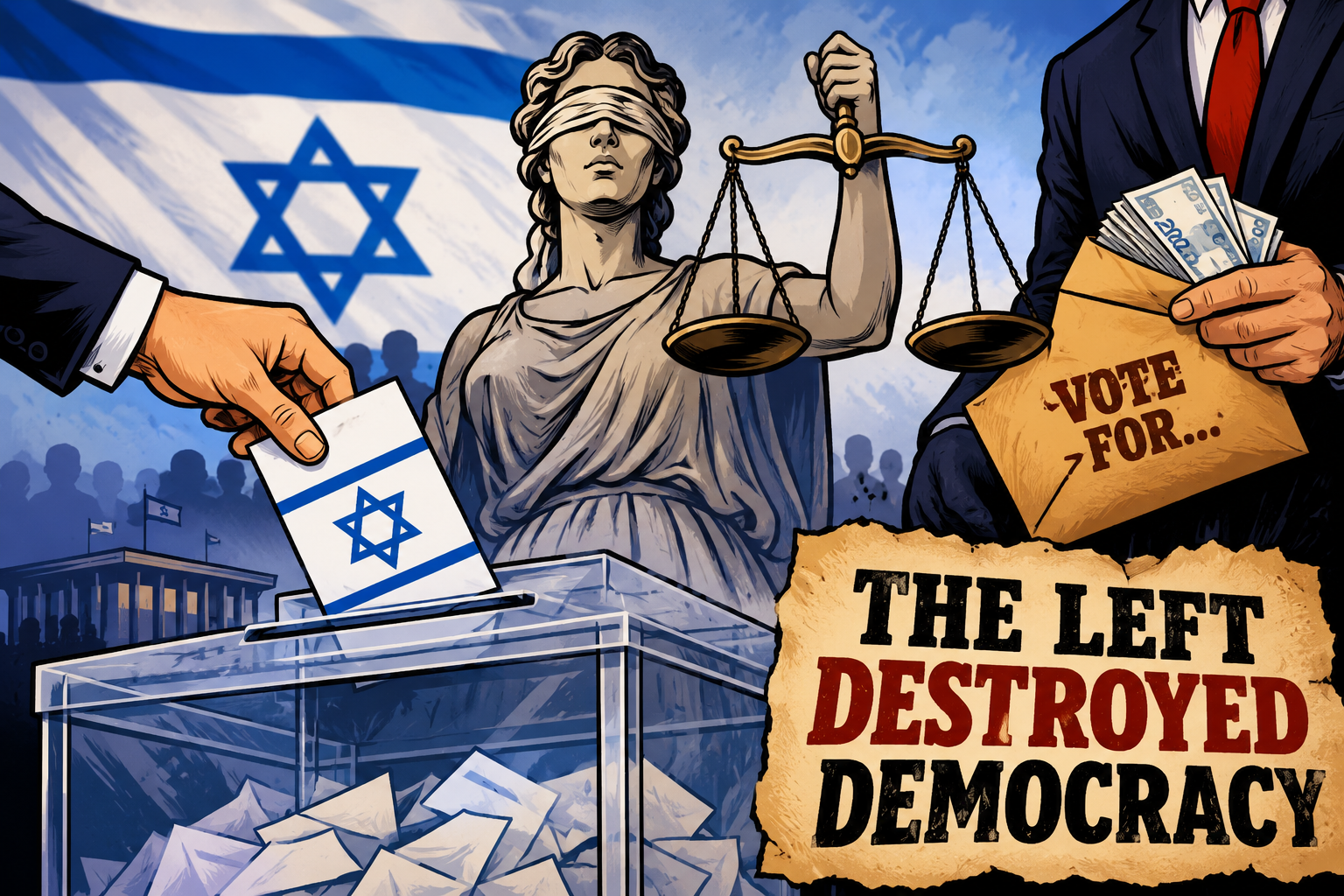
When those entrusted with defending democracy abandon impartiality, the foundations of democracy itself are put at risk.
When the legal establishment and institutions entrusted with safeguarding the democratic process and ensuring the integrity of elections become embroiled in political battles themselves, effectively taking the opposition’s side, a fundamental crisis of public trust emerges. When such institutions deliberately turn a blind eye to voter bribery and electoral violations, rather than investigating them and upholding the rule of law, democracy itself is placed in jeopardy. After all, democracy cannot survive when the very institutions charged with defending it abandon their political impartiality.
The elections to the 26th Knesset, held on October 27, once again exposed the true agenda of Israel’s legal establishment and raised a fundamental question about its role in the country’s democratic process.
On October 28, 2026, reports emerged of suspected large-scale voter bribery in Bedouin communities across the Negev. According to the investigation, cash and ballot papers bearing the name of the Ra’am party were reportedly found in the homes of three individuals who had been detained. In addition, suspicions arose that millions of shekels, allegedly originating from states hostile to Israel, may have been used to buy votes.
On October 31, 2026, an election committee chairman from the Negev gave an interview to Israeli public broadcaster Kan 11, with his identity concealed for his protection. Speaking to journalist Ayala Hasson, he described alleged irregularities near polling stations, including the exchange of cash and fuel cards in the vicinity of voters. He claimed that these practices were taking place openly throughout election day. His testimony formed part of a broader report featuring allegations by polling committee members of electoral misconduct, including attempts to influence voting and offers of material inducements.
This is not an isolated case. Likud has stated that it possesses hundreds of testimonies and pieces of evidence pointing to alleged violations at polling stations, including bribery, double voting, intimidation, violence, and the unlawful collection of citizens’ personal information.
On November 2, Channel 14 reported that Likud had formally petitioned Attorney General Gali Baharav-Miara, demanding the launch of a criminal investigation into approximately 700 reports of alleged violations of Israeli election law.
Seven hundred reports. That does not mean 700 votes. It may be only the tip of the iceberg.
The Central Question: Who Holds Accountable Those Entrusted with Protecting Elections?
The Chairman of the Central Elections Committee, Supreme Court Justice Noam Sohlberg, acknowledged the seriousness of the suspicions surrounding foreign funding and instructed Shin Bet Director David Zini to investigate the matter. However, on November 1, Sohlberg, together with Zini and the Attorney General, stated that the material currently available provided no grounds to question the overall results of the election.
Moreover, it was announced that even if the suspicions were confirmed, this would not necessarily lead to a change in the election results.
But how can the consequences of alleged foreign interference be definitively assessed while the investigation is still ongoing?
According to Likud’s calculations, just 4,612 votes stood between Ra’am losing a Knesset seat to the right-wing bloc, a shift that could potentially have altered the parliamentary balance. However, this calculation has been challenged by an alternative analysis that takes into account the surplus-vote agreement between Ra’am and the Joint List. The precise electoral implications therefore remain disputed. Nevertheless, the possibility of localised electoral violations warrants a thorough examination of the relevant polling stations and the evidence collected.
Even more troubling questions have emerged concerning the investigation itself.
On November 1, Channel 14 published a report under the headline “They Are Tying My Hands.” According to the channel, David Zini complained to Sohlberg about restrictions imposed by the Shin Bet’s legal adviser that were hindering the expansion of the investigation. Sources cited by the channel also claimed that the Attorney General had sought to restrict certain investigative measures.
However, the very fact that a public dispute has emerged between the head of Israel’s security service and the legal establishment over an investigation into alleged electoral violations raises serious questions of public trust.
Attorney General Gali Baharav-Miara must provide the public with clear explanations regarding her role and the decisions she has made. The Attorney General must not be beyond public scrutiny or take the side of the opposition, particularly when allegations of foreign interference in Israel’s elections are at stake.
The controversy escalated further on November 3, when reports emerged that Zini had sought authorization to question several senior Arab political figures under caution, including Ahmad Tibi, chairman of Ta’al; Mansour Abbas, chairman of Ra’am; and Sami Abu Shehadeh, chairman of Balad. A fourth senior Arab lawmaker was also reportedly included in the request, although his identity remains subject to a publication ban.
According to media reports, the investigation concerns suspicions of foreign financing, allegedly originating from Qatar and Turkey, intended to influence Israeli public opinion and electoral processes. These allegations have not been established, and the individuals concerned must not be presumed guilty.
The dispute also intensified over the scope of the investigative powers available to the Shin Bet. While Zini reportedly sought broader authority to pursue the investigation, Baharav-Miara maintained that exceptional investigative measures and questioning political figures under caution must be supported by an adequate evidentiary basis. She subsequently accused the Shin Bet of failing to transfer investigative materials to the joint investigative team, thereby delaying the investigation.
However, the problem extends far beyond a single position or an individual.
For years, sections of Israel’s political establishment, particularly the left and far left, as well as the legal establishment, have presented themselves as the foremost defenders of democracy. The rule of law, the judicial system, legal advisers, and independent institutions have been portrayed as the last line of defence against political threats.
But institutional independence does not mean institutional infallibility. The judiciary must not become a political arbiter whose decisions are beyond criticism. The legal system cannot demand public trust while refusing to provide transparent explanations for its own actions.
It is particularly dangerous when political forces that speak most loudly about defending democracy are prepared to accept election results as final before an investigation has been completed, while serious questions about the integrity of the electoral process remain unresolved and subject to public scrutiny.
The opposition has every right to defend the election results. Likud has every right to demand an investigation. But no political faction has the exclusive right to define what constitutes the defence of democracy.
Democracy is not the rule of an attorney general, a court, or a political elite. It is the rule of the people, expressed through free, fair, and transparent elections.
If there are credible suspicions of vote-buying, they must be thoroughly investigated. If the head of the Shin Bet is indeed being obstructed from carrying out necessary investigative measures, those restrictions must also be independently examined. If conclusions that the reported violations could not have affected the election results are reached before a full investigation has been completed, legitimate questions arise about the premature nature of such conclusions.
And if the investigation establishes that electoral violations may have affected the allocation of Knesset seats, the competent authorities must consider all remedies available under the law, including a review of the results in the affected polling stations and, where legally justified, broader measures to restore the integrity of the electoral process.
Democracy does not require blind trust in institutions. It requires institutions to earn that trust.
Perhaps this is the central paradox of modern Israel: those who spent decades claiming to defend democracy against political power are now themselves at the centre of questions about how democratically the system actually functions.
Defending democracy must never mean depriving citizens of their right to demand the truth.
And when the struggle to defend democracy turns into an effort to shield the system itself from uncomfortable questions, there is a danger that, in the end, nothing will remain of what that system was meant to protect.
Defending Democracy, the Left Killed It.
Related Topics
Related Posts