
Founder & Principal, Line of State
The Maduro Test: Why Qatar and Turkey Are Not Different from Venezuela
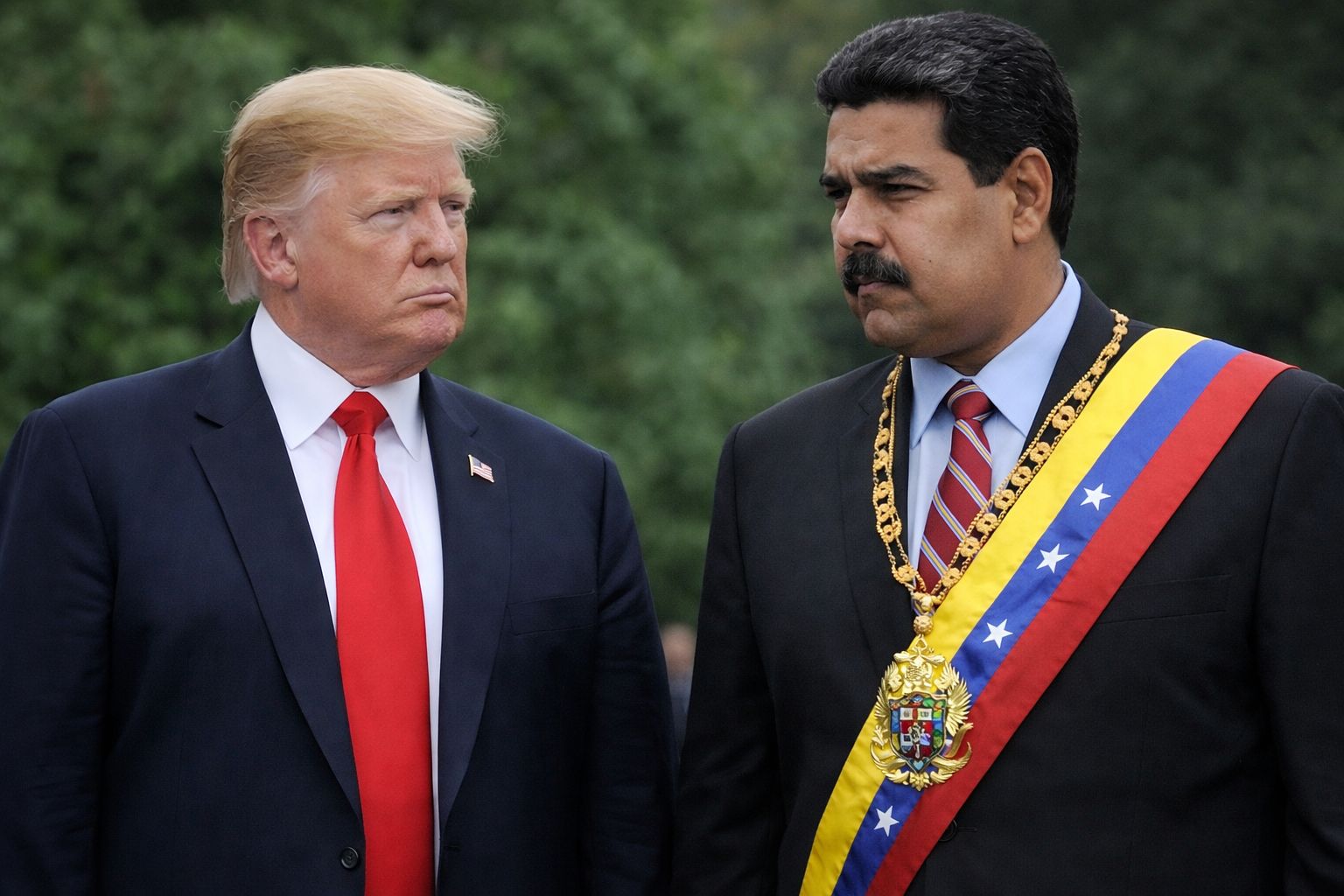
Donald Trump and Nicolás Maduro, an AI generated image created by the author for illustrative purposes and free for commercial use. A visual thought experiment: the “Maduro Test” asks why what Washington brands as terrorism in Venezuela is treated differently when it comes from Qatar and Turkey. The definition stays the same, the enforcement changes.
What counts as terrorism in Venezuela is rewarded when it comes from Qatar and Turkey. The Maduro Test reveals a simple truth: security labels are enforced not by actions, but by usefulness.
When the Trump administration designated Nicolás Maduro’s government in Venezuela as “narco-terrorist”, it did not introduce a new ideology. It changed the application. For the first time, Washington moved beyond the familiar and evasive category of a “state sponsor of terrorism” and applied a functional definition: a sovereign regime that operates as a terrorist organization. Not a failure of governance, but a governing model – one that integrates violence, financing, and state protection, and deliberately employs harm to civilians as a tool of policy. The criteria were clear: an organic relationship with violent organizations, their use as instruments of state power, and a willingness to absorb international costs. Venezuela met them.
This pattern is not incidental. The designation of Maduro’s regime was substantively justified, but its selective enforcement reveals how standards give way to performance and utility. The Maduro Test is where this logic becomes impossible to ignore.
In Caracas, the cartel is not the enemy of the state – it is its arm. The Cartel of the Suns is embedded in the military and political leadership, and narcotics are not a by-product but a governing tool: funding the regime, shaping alliances, and exerting pressure abroad. That is why the narco-terrorism indictments and the military action against trafficking infrastructure were not an escalation, but a conclusion. A regime that uses transnational crime as a lever of power is a terrorist organization with a flag.
The same logic applies to Qatar. It is not a “mediator”, but infrastructure. It routinely hosts Hamas leadership, provides financing and political protection, and enables the organization to operate as a legitimate political actor while waging armed violence against civilians. The 2017 rupture with Saudi Arabia, the UAE, Bahrain, and Egypt was not a diplomatic tantrum, but a regional indictment: systematic support for the Muslim Brotherhood, funding of armed groups, coordination with Iran, and the use of media as an instrument of incitement. The blockade was not born of whim, but of the recognition that the Qatari regime does not merely tolerate extremism – it operationalizes it.
Turkey under Erdoğan stands the same test. Ankara does not simply tolerate Hamas and the Muslim Brotherhood; it has become their political home. Leadership figures, operational hubs, passports, freedom of movement, and fundraising channels are provided under state auspices. Erdoğan insists on presenting the Brotherhood as a “political movement”, but in practice it is a transnational network that relies on terrorism and intimidation to impose political order. Turkey is not only a host; it is a protector and a launderer. If Venezuela uses a cartel as a knife, Turkey uses an armed ideological movement as an instrument.
Trump supplied the connecting thread. His declarations branding the Muslim Brotherhood as a terrorist organization were not mere rhetoric, even if their legal implementation remained cautious – while the states that host, finance, and shield the movement remained outside the designation. The statement itself established a principle: there is no meaningful distinction between religious terrorism and criminal terrorism when both are employed as tools of policy. And yet, this is precisely where the contradiction appears. While Venezuela is punished with sanctions, indictments, naval blockades, and force, Qatar and Turkey receive the opposite treatment. Not because they are cleaner – but because they are more useful.
Qatar receives American security guarantees, bases, arms deals, strategic recognition, and massive economic agreements. It also gives something back – conspicuously and generously: a lavish Boeing 747-8, valued at hundreds of millions of dollars, to be converted into a presidential aircraft. Turkey, despite recurring crises, enjoys continued defense cooperation, arms sales, and an American willingness to “reset” relations. Venezuela, by contrast, receives only a fist – not because it is morally worse, but because it has nothing to offer beyond oil, confrontation, and defiance.
It thus becomes clear that the Maduro test is not a test of terrorism, but of convenience. Terrorism is evaluated functionally: connection to violent organizations, financing, protection, and their use as instruments of state policy. By that standard, Qatar and Turkey meet the same criteria as Venezuela and are not meaningfully different in their conduct. From this follows a political question that will, sooner or later, become a legal one: had Maduro arrived in Washington with a gold-plated Boeing, would he have been designated a terrorist leader – or welcomed as a partner?
An earlier version of this analysis appeared in Hebrew in Maariv. This English essay is a revised and expanded edition, adapted for an international audience by the author.
Related Topics
Related Posts