
A believer in peace and human dignity
The many faces of Israel
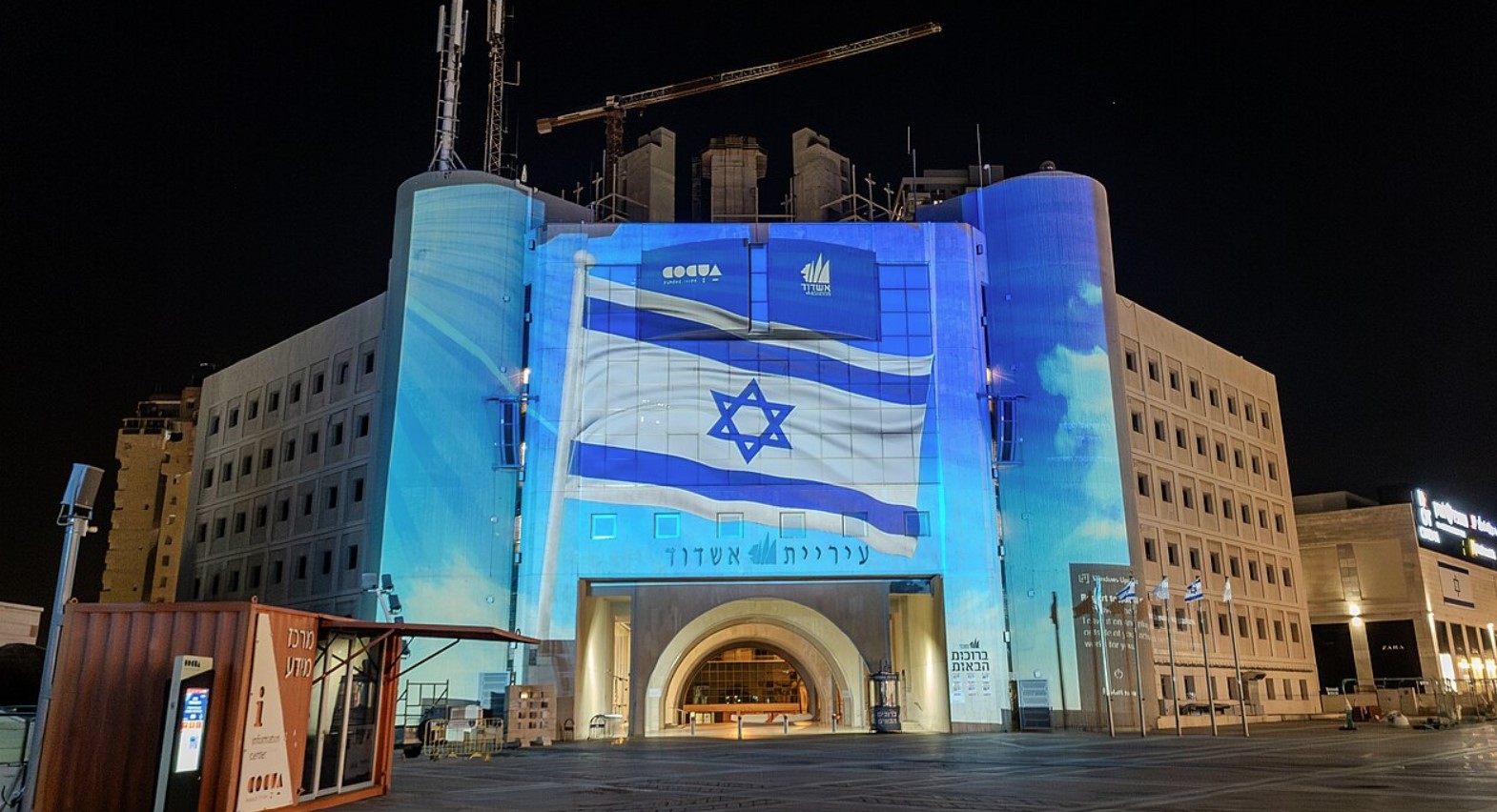
Ashdod City Hall (Ashdod is a coastal Israeli city north of Gaza) lit up with the Israeli flag to raise national morale in November 2023, one month after the October 7 attacks (Maqaf-Ivri / Wikimedia Commons).
The feelings about Israel range from seething hatred to absolute devotion, and they include many other feelings in between. There are probably not many entities on the planet that inspire such a complex and extreme range of emotions, and it’s fair to ask why that is.
It is undeniable that a large part of the reason is that much of the opposition to Israel is rooted in antisemitism, which often makes the criticism directed at Israel irrational and dishonest. The Israel-Arab conflict started because the Arab world could not accept even one tiny Jewish-majority state among them, and it continues mainly because most Arabs refuse to recognize Jewish history and the right of the Jewish people to have their own state. But there is much more to the story than this.
The face of Israel that we see depends a lot on who’s looking.
To Jews wishing to live in a place where most people are Jewish so that they can leave behind the antisemitism that is typical of much of the world, Israel is the home of the Jewish people.
To Jews who want to live on the land where their ancestors have lived for over three millennia and where Judaism has a rich history, Israel is the home of Judaism.
To Israelis of any religion who enjoy Israel’s economic opportunities, diversity, and democracy while they see Israel surrounded by many countries who mostly hold the opposite values, Israel is simply the place where they want to be.
To Israelis who are very much aware of the constant threats against their nation and who are determined to defend it and to keep it safe, Israel is their fortress.
But as genuine as these faces of Israel are, there are also others.
To Palestinians who see family and friends injured or killed during Israel’s attacks, regardless of how rationally justifiable the attacks may have been, Israel is the aggressor.
To Palestinians who live under Israeli occupation and all the indignities that come with it, no matter how rationally justifiable the occupation may be, Israel is the occupier.
To Palestinians who are attacked by settlers who believe that Palestinians are less than human and have no right to be anywhere on the land, even though there would be no settlements if the Palestinian leaders had accepted any of the two-state solutions proposed to them over the years, Israel is racist.
These faces of Israel are genuine too because these are the faces that many Palestinians see. One could argue that given the situation that Israel has been forced into, it could have been far worse for the Palestinians. Israel, unlike groups like Hamas, tries to avoid harming civilians. Israel even feeds them, houses them, provides them medical treatment, and so on. By any objective standard, Israel treats Palestinians better than Arab governments, including their own Palestinian governments, do. But being objective is not an easy position to take when one experiences daily the consequences of Israel’s occupation and its war on terrorism. It is not surprising that most Palestinians cannot see what an objective observer would see.
But there are faces of Israel that are far less genuine. They are the faces that aren’t real but are fabricated with the intention of demonizing Israel. As former US Secretary of State and former presidential candidate Hillary Clinton said, there is a massive campaign of misinformation and “pure propaganda” about Israel targeted at young people through social media. And of course, misinformation about Israel is not new, and before it used social media, it used other means.
Very few young people around the world, and increasingly few adults as well, see the real face of Israel: A country that has an undeniable right to exist but that has been forced to fight many and increasingly complex wars simply to defend that right. A country that is very diverse and often very genuinely self-critical, unlike any of its neighbors. A country that has tried many times to reach peace, including reluctantly accepting the 1947 UN partition plan that would have created an Arab state with almost no Jews and a Jewish-majority state with a large minority of Arabs. A country that is certainly imperfect, because no country is perfect. A country that has its own extremists who in the last few years have been gaining alarming amounts of influence in the government, largely thanks to many Israelis giving up on ever being able to reach peace with the Palestinians.
The real face of Israel is not as romantic and perfect as the faces that some people see, but it certainly isn’t the ugly face portrayed by the widespread and heavily organized campaign of hatred against Israel. The bottom line is that the conflict would end very quickly if the Arab world accepted the existence of the Jewish state and if the Palestinians were represented by honest leaders who were seeking a fair end to the conflict.
This acceptance, however, is not happening, and the antisemitic hatred continues to increase, making genuine acceptance even less likely every day.
Israel has won every military war but has lost every PR war. The reason is simple: antisemitism is widespread and is an effective vehicle for misinformation. The “demon” face of Israel is easy to draw and easy to spread, especially in a world where lying has become easier than it ever was.
The real face of Israel, on the other hand, takes time to explain and time to understand. It requires understanding history and context, and as Clinton said, many people who are the recipients of the misinformation campaign against Israel, have neither, so they are easily fooled.
If one took the time to learn the facts before judging Israel, the tide of hatred against Israel would be quickly reversed, but humans are naturally lazy. It would take many more Hillary Clintons, and preferably younger versions of her, to reverse the tide of hatred against Israel.
Sadly, peace is unlikely to come from genuine Arab acceptance of Israel. It is a nice dream but that’s all it is. Peace may come, however, from geopolitical necessities and Arab self-interest, in the form of agreements such as the Abraham Accords, and acceptance would eventually become the consequence rather than the cause. Peace could come despite the hatred, but not because the hatred was abated. That’s really the best that we can hope for.
As an Arab who has become a consistent supporter of Israel because I took the time to learn the real face of Israel, I certainly hope that peace will happen for Israel and the Palestinians.
Related Topics
Related Posts